
The Evolution of Foundries
From Traditional Foundries to Modern Technology-Driven Foundries


One of the oldest functions in industrial production is foundries: a foundry is simply a workshop in which metal is cast into various shapes to form parts for machinery, automobiles, infrastructure, and much more. The transition from old foundry practices to modern technology-driven foundries clearly represents a degree of change in the whole course of manufacturing processes, productivity, and precision in general.
In this blog post, we continue the conversation begun in previous essays regarding the differences between the age-old tradition foundries and the modern, technology-based foundries with details about how technology is changing things in this very important industry.
What is a Foundry?
A foundry is a place where metals are melted and poured into molds to make parts and other products. This process, called casting, is thousands of years old and has been used to make everything from bronze tools to very sophisticated machine parts.
Of course, since the beginning of the founding, it was discovered that its technology today has improved so much, but the core or basic principles are all the same: molten metal is put inside a mold, left to cool down, then out comes the rigid part for further process. Different today are the tools, techniques, and technologies having furnished the human being with more extreme accuracy, efficiency, and sustainability.
The Traditional Foundry
The traditional or conventional foundries were largely intensive type and heavily relied on manual practices. Some of the major characteristics of traditional foundries are listed below:
Manual Moulding: In traditional foundries, moulds were made from hand held sand and other materials. Although a long time consuming process, it was also labor-intensive and mostly skill-related in nature, which also led to variation in quality.
Cupola furnaces: They were the primary smelting technology, using coke as a fuel, smelting pig iron and scrap metals. This means very high energy input and serious emission problems.
Basic Quality Control: The quality of control in ancient foundries was mostly based on simple visual inspection techniques; very few technical methods were applied to quantify the casting process accuracy.
Low Automation: The automation of the process was very low, which meant pouring, molding, and making core were all done manually. This made the whole production process really slow, and there was lots of room for human error.
Material Limitations: Traditional foundries did not have much scope to alter the range of materials they could cast. Their casting processes were more suited to metals like iron and brass; there are few options on alloy and complex materials.
High pollution rates and huge amounts of wastes were associated with the old foundries. Air pollution especially came from burning coke with a large amount of scrap in the industry which made it rather less environment friendly.
Old foundries lay down the roots for the industrial revolution and mass production, but their limitations were on precision and efficiency, and it was damaging to the environment. So, they had to be modernized.
The Modern Foundry: A Technological Efficiency
A foundry in the new technology-driven design is way different from its traditional version. The latest technology has streamlined modern foundries to be much more efficient, precise, and environmental friendly. Now, let's see how modern technology has shaped operations in foundry:
Advanced Molding Techniques:
Automated Sand Molding: Modern foundries mainly use automated molding machines that can produce very high-precision and repeatable molds. These machines save on labor and provide accurate molds with tight tolerances for maintained quality standards.
3D-Printed Molds: The greatest stride in casting technology is the use of 3D printing to create molds. This provides designs of a very complex nature and reduces lead time so that foundries may really accelerate their production of complex parts.
Induction Furnaces:
Induction furnaces differ from the classical cupola furnace as they save lots of energy for modern foundries. Induction melting maintains a better control over the temperature and composition of the metal, which will eventually result in better castings.
CAD and Simulation
CAD Software
The process of making part and mold in modern foundries is done before any physical casting through CAD software. This design can be pursued considering the geometric aspect with its optimization aimed at the manufacturing with minimal chances of defect.
Casting Simulation: Simulation tools can predict what the molten metal's flow will look like in a mold. This means possible air entrapment or poor-cooled regions can often be detected early, preventing costly rework and yield improvements.
Quality Control through Non-Destructive Testing:
New cast foundries use non-destructive techniques including ultrasonic, X-rays, and CT scans to inspect castings without damaging them. Defects caused by porosity or inclusions will be detected at an early stage hence releasing more quality final products.
Automation and Robotics:
Modern foundries increasingly depend on robots for pouring molten metal, removal of castings, or finishing operations. Automation saves labor, reduces the environmental impact, and enhances productivity because human error is kept at a minimum.
Advances in Materials:
Since modern foundries can now cast materials as light as high-performance alloys to composite materials, specialty alloys are typically used in critical industries such as aerospace and automotive due to their good weight-to-strength ratio.
Environmental Sustainability:
Environmental regulations have also compelled foundries to become greener. Increased use of recyclable sand, reduced emissions melting technologies, and waste heat recovery systems have cut the energy consumption and pollution by many foundries.
Closed-loop systems for both water and waste management help further minimize the environmental footprint of modern foundries.
Industry 4.0 and Smart Foundries:
The integration of the Internet of Things, Artificial Intelligence, and Big Data into a foundry represents state-of-the-art innovation in technology. It is termed as a smart foundry because in such foundries, real-time data is provided for monitoring and optimization purposes right from the flow of materials to the temperature of the furnace with the view of maximum efficiency in the process.
Predictive maintenance through AI minimizes equipment shutdown time, thereby bringing down time-related operational disruption.
Comparison of Old and Modern Foundries:
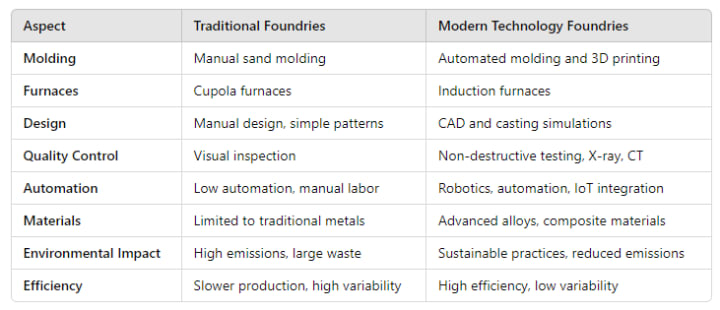
Future of Foundry Technology:
As technology continues to advance, foundries will see even greater integration of artificial intelligence, machine learning, and smart manufacturing technologies. Future foundries may operate with minimal human intervention, relying on AI-driven systems to make real-time decisions about production efficiency and quality control. Additionally, the recycling of materials and further improvements in energy efficiency will make foundries more sustainable.
Conclusion:
The shift from traditional foundries to modern, technology-driven foundries has revolutionized the casting industry. Today’s foundries are faster, more efficient, and produce higher-quality products with less environmental impact. As industries continue to demand precision and sustainability, the evolution of foundry technology will continue to play a vital role in manufacturing innovation.
Whether in the aerospace, automotive, or construction industries, modern foundries are helping drive the future of engineering and production, proving that the foundry industry, though ancient in origin, is constantly evolving to meet the demands of a high-tech world.
About the Creator
Kaniesh N
I am a YouTuber focused on mechanical engineering. With a diploma in the field, I create educational videos on topics from basics to advanced techniques. Check out my channel TechTorqueNK www.youtube.com/@TechTorqueNK
From ad men to mad men
It's after 2am in the morning when a local police patrol vehicle in Northern New Jersey spots a figure costumed as Quasimodo, The Hunchback of Notre Dame, proceeding southbound on the sidewalk along Lydecker Street. Though the hunchback’s costume stuffing offers added insulation, it's January, and friggin’ freezing. Carefully, the officers slow down, gently question the subject, and offer him a ride home.
By David W. Maury4 days ago in Humor



Comments
There are no comments for this story
Be the first to respond and start the conversation.