
THE EVOLUTION OF DINASOURS
wanna know how dinasours evolved and what made them become an extinct spieces
Traveling back 250 million years into the past would transport us to witness the dawn of dinosaurs, a time when these magnificent creatures began to emerge and dominate the Earth's landscapes. The prevailing theory suggests that dinosaurs evolved from a group of reptiles known as archosaurs, which were prevalent during the late Permian period. These archosaurs eventually split into two main lineages, with one leading to crocodiles and the other to dinosaurs. Over millions of years, dinosaurs diversified into thousands of species, each adapting unique characteristics and ecological niches. One crucial development was their acquisition of bipedalism, allowing them to walk on two legs and freeing their front limbs for various tasks such as hunting and defense.
Our journey back in time lands us in the Triassic period, a time of significant transition and evolution for dinosaurs. Among the earliest dinosaurs to emerge during this period was the Eoraptor, a small creature resembling a dog in size. It's important to note that dinosaurs of this era were not the colossal beasts we often envision but rather modest in size compared to later periods. The Triassic climate was markedly different from today, characterized by a hot and dry climate with no polar ice caps. Vegetation played a crucial role in the survival and evolution of dinosaurs, with diverse plant life influencing the dietary and adaptive strategies of different species.
As we observe the dinosaurs of the Triassic period, we encounter species such as the Coelophysis, a swift and agile predator weighing around 23 kilograms and standing about 1 meter tall. The Herrerasaurus, slightly taller and heavier than the Coelophysis, was another carnivorous dinosaur that roamed the Triassic landscapes. Additionally, the Plateosaurus stood out as one of the earliest examples of large dinosaurs, reaching heights of up to 3 meters and weighing as much as 4,000 kilograms. Despite their impressive size, dinosaurs coexisted with various other organisms, sharing their environments until a significant extinction event reshaped life on Earth.
Transitioning into the Jurassic period, we witness the rise of dinosaurs as dominant creatures, spreading across continents and thriving in diverse ecosystems. Iconic dinosaurs such as the Stegosaurus, Brachiosaurus, and Allosaurus roam the Earth, showcasing the impressive diversity of these ancient reptiles. Alongside these massive creatures, smaller, bird-like theropods begin to emerge, exemplified by the Archaeopteryx, a crucial link between dinosaurs and modern birds. As the Jurassic period comes to an end, another extinction event alters the course of dinosaur evolution, paving the way for the Cretaceous period.
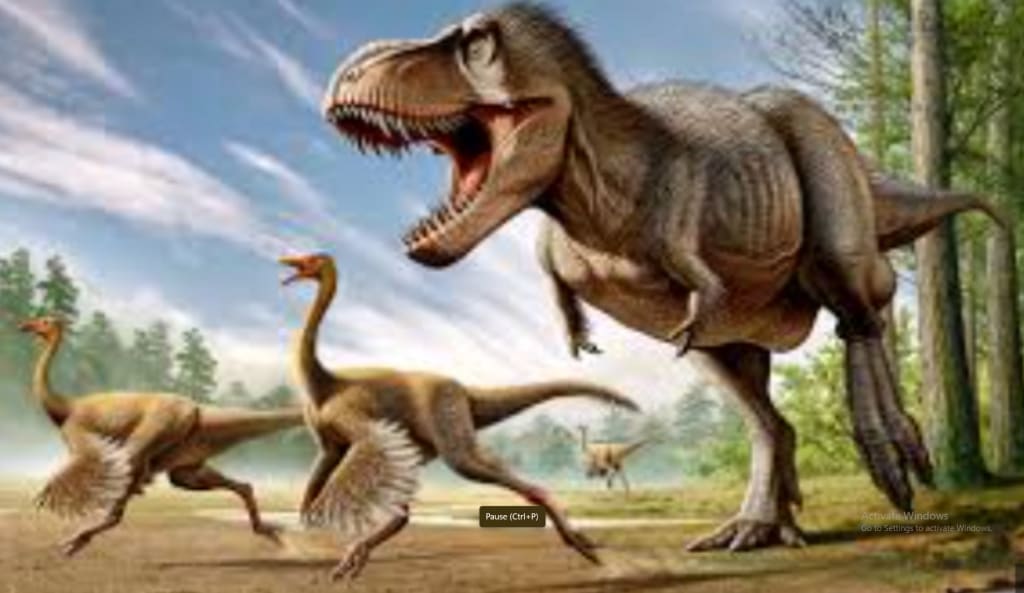
In the Cretaceous period, dinosaurs continue to thrive, with new species emerging and existing ones evolving to fill different ecological niches. Among the most notable dinosaurs of this era is the Tyrannosaurus Rex, a massive predator towering at 3.7 meters tall and 12 meters long, equipped with powerful jaws and sharp teeth. The Cretaceous period also sees the proliferation of feathered dinosaurs like Velociraptors and Microraptors, providing insights into the evolutionary link between dinosaurs and birds.
Continental drift during this time forces dinosaurs to adapt to changing environments, influencing their evolutionary trajectory. However, the climax of the Cretaceous period is marked by a cataclysmic event—an asteroid collision that triggers widespread devastation and leads to the extinction of 75% of Earth's species, including many dinosaurs.
Despite the devastation, some avian-based dinosaurs survive and evolve into modern birds, while mammals seize the opportunity to diversify and expand their presence. This event marks a pivotal moment in Earth's history, paving the way for the rise of mammals and eventually humans.
In conclusion, the story of dinosaurs is one of resilience, adaptation, and eventual extinction. From their humble beginnings in the Triassic period to their dominance in the Jurassic and Cretaceous periods, dinosaurs shaped the landscapes and ecosystems of ancient Earth. While much remains to be discovered about these fascinating creatures, their legacy continues to captivate the imagination of scientists and enthusiasts alike, offering glimpses into our planet's distant past.
About the Creator
Keep reading
More stories from writers in History and other communities.
Brosley Punch — The Strike That Shook Fate
Brosley was never taught how to throw a punch. He learned it the hard way—through hunger, through survival, through a childhood spent on a world that showed no mercy. Long before the universe would whisper his name in fear, Brosley was just a boy standing on cracked red stone, staring at a sky that never answered his questions.
By The best writer 6 days ago in History
Jesus Christ — A Life That Changed the World
Start writing...Jesus Christ is one of the most influential figures in human history. Revered by Christians as the Son of God and the Savior of humanity, and respected by Muslims as a great prophet (Isa), his life and teachings have shaped civilizations, moral values, art, law, and faith for more than two thousand years. The story of Jesus is not only a religious narrative but also a profound human story of compassion, sacrifice, and hope. Humble Beginnings Jesus was born around 4–6 BCE in Bethlehem, a small town in Judea, during the reign of King Herod the Great. According to the Gospels, his birth was miraculous. His mother, Mary, was a young woman who conceived by the will of God, and Joseph, her husband, was a carpenter. Jesus’ birth took place in modest circumstances, symbolizing humility and simplicity rather than power or wealth. Soon after his birth, King Herod, fearing the arrival of a rival “King of the Jews,” ordered the killing of infant boys in the region. To protect the child, Mary and Joseph fled to Egypt and later returned to settle in Nazareth, a quiet town in Galilee. Jesus grew up there, living an ordinary life and learning his father’s trade as a carpenter. Early Life and Preparation The Gospels provide limited details about Jesus’ childhood. One notable event occurred when he was about twelve years old, when he was found in the Temple in Jerusalem, discussing religious matters with scholars. This moment hinted at his deep spiritual insight and sense of divine purpose. For many years, Jesus lived quietly in Nazareth. This long period of preparation emphasizes an important theme of his life: greatness can emerge from patience, discipline, and ordinary daily work. Baptism and Beginning of Ministry Jesus’ public ministry began when he was around thirty years old. He traveled to the Jordan River to be baptized by John the Baptist, a preacher calling people to repentance. During the baptism, the Gospels describe a powerful moment in which God’s approval was revealed, marking the beginning of Jesus’ mission. After his baptism, Jesus spent time in the wilderness fasting and praying, resisting temptation and strengthening his resolve. He then began traveling throughout Galilee, preaching a message centered on love, repentance, forgiveness, and the coming of the Kingdom of God. Teachings and Parables Jesus taught in simple but powerful ways, often using parables—short stories drawn from everyday life. Through these stories, he explained deep spiritual truths. He spoke about loving one’s neighbor, forgiving enemies, caring for the poor, and seeking inner purity rather than outward show. One of his most famous teachings, the Sermon on the Mount, emphasized humility, mercy, peace, and sincerity. Jesus taught that true righteousness comes from the heart. His message challenged social norms and religious hypocrisy, calling people to a higher moral and spiritual standard. Miracles and Compassion Jesus was also known for performing miracles, which drew large crowds. According to the Gospels, he healed the sick, restored sight to the blind, fed the hungry, and calmed storms. These acts were not only signs of divine power but also expressions of deep compassion for human suffering. Through his actions, Jesus showed that God’s love was not limited to a select group. He welcomed sinners, spoke with outcasts, and treated women and the poor with dignity at a time when society often ignored them. Opposition and Conflict As Jesus’ influence grew, so did opposition. Religious leaders felt threatened by his authority and teachings, which challenged established traditions. Jesus criticized leaders who focused on rules but neglected justice, mercy, and faithfulness. Despite knowing the dangers, Jesus continued his mission with courage. He openly spoke about sacrifice, suffering, and the cost of following truth. His message was not about political power but about transforming hearts. Final Days in Jerusalem Jesus eventually traveled to Jerusalem, where he was welcomed by crowds who saw him as a hopeful leader. However, tension quickly increased. During the Jewish festival of Passover, Jesus was arrested after being betrayed by one of his followers. He was brought before religious authorities and then handed over to Roman officials. Though many found no true fault in him, Jesus was condemned and sentenced to death by crucifixion—a punishment reserved for criminals. Crucifixion and Sacrifice Jesus was crucified outside Jerusalem. Christians believe that his death was a sacrifice for the sins of humanity, an ultimate act of love and obedience to God. Even in suffering, Jesus demonstrated forgiveness and compassion, praying for those who harmed him. His death shocked his followers, who had hoped for a different ending. It seemed as though his mission had come to an end. Resurrection and Lasting Impact According to Christian belief, three days after his death, Jesus rose from the dead. The resurrection became the foundation of Christian faith, symbolizing victory over sin and death. Jesus appeared to his disciples, strengthening their faith and commissioning them to spread his message. After these appearances, Jesus ascended into heaven. His followers went on to share his teachings across the world, forming communities that grew into the global Christian Church. Legacy of Jesus Christ The life of Jesus Christ continues to inspire billions. His teachings on love, forgiveness, humility, and faith remain relevant in every generation. Beyond religion, Jesus’ influence can be seen in movements for justice, charity, peace, and human dignity. Whether viewed as the Son of God, a prophet, or a moral teacher, Jesus Christ stands as a symbol of hope—a reminder that compassion can overcome hatred, and that a life lived for others can change the world forever.
By The best writer 2 days ago in History
Thoughts on Vocal and the way the world is
"Death cannot stop true love, only delay it." – Wesley in The Princess Bride. I decided to come back to Vocal on a very cold and dark night at the end of December. I had been, and still am, convalescing from a horrible staph infection that had gone misdiagnosed for months. This, paired with the increasing challenges of being healthy, making the best choices for my co-parented child, being a wife, and being a director at a new job, was a lot to manage.
By Jazzy 6 days ago in Confessions


Comments (1)
That's very interesting story really like it and enjoyed it