
The Eternal Flame of Persia
A Journey Through the Glorious and Tumultuous History of Iran

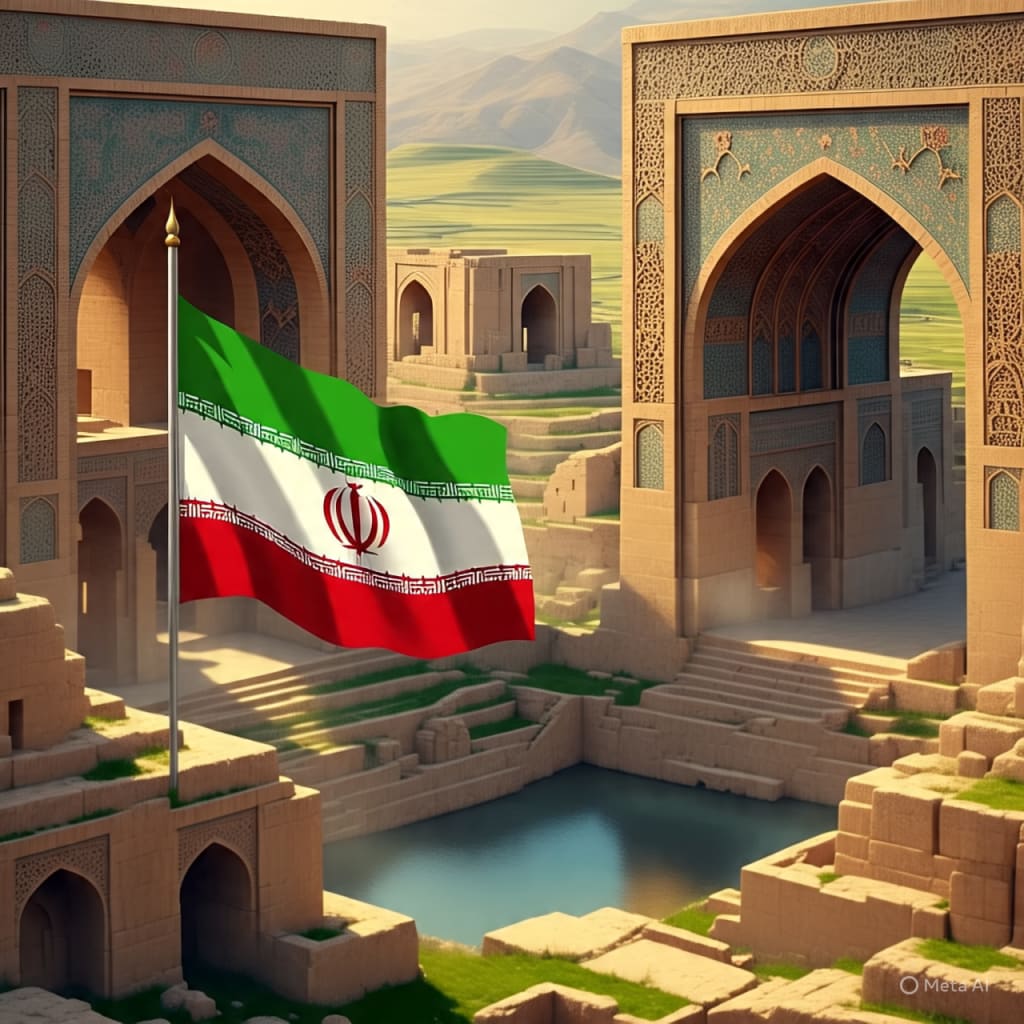
Iran, once known as Persia, is a land where the sands of time whisper tales of ancient empires, divine kings, poets, and revolutions. Its history spans over 2,500 years, marking it as one of the oldest continuous civilizations in the world. This is the story of a nation that has risen, fallen, and risen again—an eternal flame burning bright through centuries of glory, invasion, and transformation.
The Birth of an Empire
The roots of Iranian civilization trace back to the Elamites in the third millennium BCE. However, it was the emergence of the Achaemenid Empire in the 6th century BCE that marked the true birth of Persian greatness. Founded by Cyrus the Great, the Achaemenid Empire became the largest the world had ever seen, stretching from the Indus Valley in the east to the Balkans and Eastern Europe in the west.
Cyrus was not only a conqueror but a visionary. His respect for local customs and religions earned him the admiration of his subjects. The Cyrus Cylinder, often referred to as the first charter of human rights, stands as a testament to his enlightened rule.
His successors, Darius the Great and Xerxes I, expanded and solidified the empire. Under their reign, Persepolis was built—a symbol of Persian architectural brilliance. The Royal Road connected the empire, allowing swift communication across vast distances.
The Fire Dims – Greek and Arab Conquests
However, no empire is eternal. In 330 BCE, Alexander the Great of Macedonia invaded Persia, defeating Darius III. The burning of Persepolis marked the symbolic end of the Achaemenid dynasty. After Alexander’s death, the Seleucid Empire took control, though their Hellenistic rule was eventually replaced by the Parthians and then the Sassanids, who restored Persian culture and Zoroastrian religion.
The Sassanid Empire, lasting from 224 to 651 CE, was Persia’s last great pre-Islamic dynasty. It was during this time that Persian art, science, and philosophy flourished. However, the Arab-Muslim invasion in the 7th century brought a monumental shift. The fall of the Sassanids led to the spread of Islam, transforming Persian society, language, and identity forever.
The Blossoming of Islamic Persia
Though the conquest was a blow to Persian sovereignty, it was not the end of Persian culture. The Islamic Golden Age saw Persian scholars, scientists, and poets shine brightly. Iran became a center of learning and creativity. The Persian language experienced a renaissance, blending Arabic influences with ancient roots.
It was during this era that figures like Rumi, Hafez, Saadi, and Ferdowsi emerged. Ferdowsi’s epic poem, the Shahnameh, preserved the legends and history of pre-Islamic Iran in the Persian language, acting as a cultural lifeline to the past.
Dynasties and Division
From the 11th to the 16th century, Iran was ruled by a succession of dynasties—the Seljuks, Mongols, and Timurids—each leaving their mark. But it was the Safavid dynasty (1501–1736) that reshaped Iran profoundly. The Safavids established Twelver Shi'a Islam as the state religion, giving Iran a unique religious identity that persists to this day.
Under Shah Abbas the Great, Iran saw a golden era. He built the magnificent city of Isfahan, made trade alliances with European powers, and revitalized the economy. However, after his death, the empire gradually declined, succumbing to internal strife and external pressure.
The Age of Colonial Influence
In the 18th and 19th centuries, Iran became entangled in the politics of powerful empires. The Qajar dynasty (1789–1925) ruled during a time of increasing Western interference. Britain and Russia vied for control of Iranian territory and resources, especially oil.
This era saw widespread corruption and inequality. Intellectuals and revolutionaries began to push for modernization and constitutional reform. The Persian Constitutional Revolution of 1905–1911 aimed to establish a parliament and curtail the king’s powers, laying the groundwork for Iran’s political awakening.
The Pahlavi Dynasty and Modernization
In 1925, Reza Shah Pahlavi seized power and launched an aggressive campaign of modernization and secularization. Railroads, universities, and industries sprang up. Traditional clothing was banned, and the role of Islam in public life was minimized.
His son, Mohammad Reza Shah, continued this modernization, supported by the West, especially the United States. However, his authoritarian rule and disregard for traditional and religious values sowed discontent.
In 1953, with help from the CIA and MI6, the democratically elected Prime Minister Mohammad Mossadegh was overthrown after he nationalized Iran’s oil industry. This event deeply damaged Iranian trust in the West and strengthened anti-imperialist sentiment.
The 1979 Islamic Revolution
Mounting dissatisfaction with the Shah’s rule led to the 1979 Islamic Revolution, a turning point in Iran’s history. Led by Ayatollah Ruhollah Khomeini, a theocratic government replaced the monarchy. Iran was declared an Islamic Republic, governed by a combination of democratic institutions and clerical authority.
The revolution shocked the world and drastically altered Iran's trajectory. In 1979, Iranian students took over the U.S. Embassy in Tehran, leading to the hostage crisis and decades of strained relations with the West.
Iran in the Modern Era
Since the revolution, Iran has faced numerous challenges: the Iran-Iraq War (1980–1988), international sanctions, internal protests, and political repression. Yet, it has also made significant advancements in science, education, and technology.
Iran’s regional influence remains strong, and it continues to be a key player in Middle Eastern geopolitics. At the same time, debates over human rights, political freedoms, and women’s rights remain ongoing within the country.
Despite the turmoil, Iran’s rich cultural legacy—its poetry, philosophy, art, and resilience—remains undiminished.
---
Conclusion: The Flame That Endures
Iran's story is one of contrast—ancient and modern, secular and religious, poetic and political. From the glory of Persepolis to the streets of Tehran, the spirit of Persia continues to burn. Through empires and revolutions, invasions and innovations, Iran stands as a land where history is not merely remembered—it is lived.
The flame of Iran, like the eternal fire of Zoroastrian temples, still flickers—resilient, radiant, and ever-burning.
About the Creator
NIAZ Muhammad
Storyteller at heart, explorer by mind. I write about life, history, mystery, and moments that spark thought. Join me on a journey through words!
Keep reading
More stories from NIAZ Muhammad and writers in History and other communities.
The Trump Effect: A Journey Through Controversy, Power, and Legacy
In the heart of New York City, among towering skyscrapers and flashing billboards, one name has echoed louder than most: Donald J. Trump. Known initially for his vast real estate empire, Trump built a brand that came to symbolize luxury, wealth, and ambition. Yet, his most audacious venture was not another skyscraper or reality TV show — it was his unexpected leap into the political arena.
By NIAZ Muhammad8 months ago in History


Comments
There are no comments for this story
Be the first to respond and start the conversation.