
The Enigmatic Green Ox of the Classic of Mountains and Seas
A Symbol of Mythical Wisdom

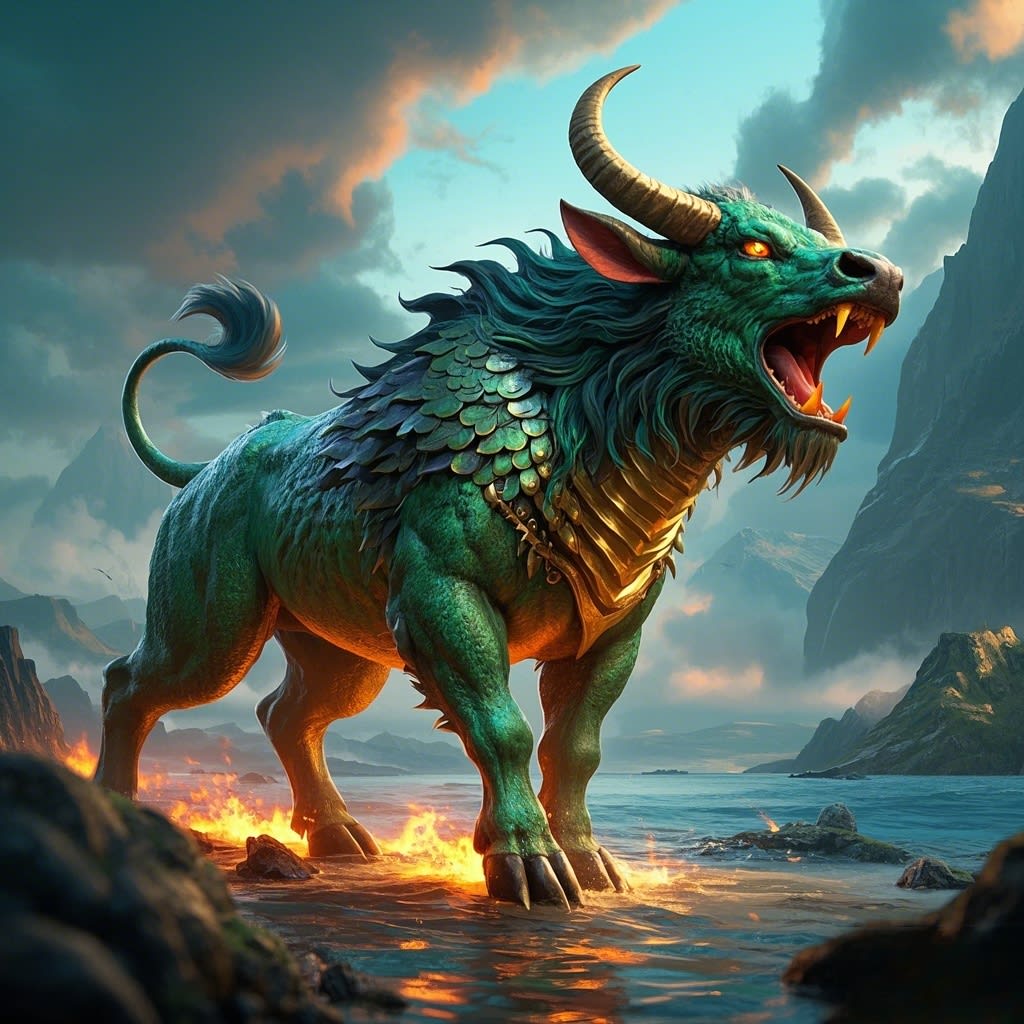
In the vast pantheon of Chinese mythology, few creatures embody the fusion of mysticism and philosophical depth as vividly as the Green Ox (青牛) from the Classic of Mountains and Seas (Shan Hai Jing). Though not explicitly named in the text itself, this enigmatic beast has become intertwined with the cultural legacy of the Shan Hai Jing through centuries of interpretation, particularly in Taoist traditions. Its enduring allure lies in its dual role as a mythical creature and a spiritual symbol, inviting readers to explore the rich layers of ancient Chinese cosmology.
The Green Ox: A Mythical Steed of the Divine
The Green Ox is most famously associated with Laozi, the revered founder of Taoism, who is said to have ridden the beast while journeying westward to compose the Tao Te Ching. While the Shan Hai Jing does not directly describe the Green Ox, its influence can be traced through the text’s broader themes of divine beings and enchanted animals. Like the Shan Hai Jing’s other mythical creatures—such as the horned, horse-like Bo (駮) that devours tigers or the fire-resistant Huan Shu (䑏疏)—the Green Ox is a creature of paradox: both powerful and serene, wild yet domesticated. Its green hue, linked to nature and vitality in Chinese symbolism, reinforces its connection to the earth’s primal forces.
Symbolism and Spiritual Depth
For Taoist adherents, the Green Ox represents the harmony between the mundane and the transcendental. Laozi’s mount is not merely a beast of burden but a metaphor for the journey of self-cultivation. The ox’s steadfast nature mirrors the Taoist principle of wu wei (non-action), suggesting that true wisdom comes from embracing simplicity and yielding to the natural flow of the universe. In this context, the Green Ox becomes a vehicle for enlightenment, carrying both the sage and his teachings across mythical landscapes.
A Cultural Legacy Beyond Myth
The Green Ox’s legacy extends beyond the Shan Hai Jing into literature and art. Poets and painters often depict it as a symbol of 隐逸 (reclusion) and moral integrity, embodying the ideal of withdrawing from worldly strife to seek spiritual truth. Its imagery also appears in festivals and rituals, where it is revered as a guardian against misfortune and a harbinger of auspiciousness. This enduring presence highlights how the Shan Hai Jing’s creatures continue to shape Chinese cultural identity, blending ancient folklore with philosophical thought.
The Allure of the Shan Hai Jing’s Beasts
The Green Ox’s story is part of the Shan Hai Jing’s broader fascination with hybrid creatures and liminal spaces. The text, compiled over centuries from the 4th century BCE onward, offers a kaleidoscope of mythical beings—some fearsome, others benevolent—that blur the lines between the natural and supernatural. These creatures serve as both cautionary tales and portals to a cosmos where humans, gods, and nature coexist in intricate balance. For modern readers, they evoke a sense of wonder and mystery, inviting speculation about the ancient worldview that birthed them.
Conclusion
The Green Ox, though not explicitly named in the Shan Hai Jing, encapsulates the text’s timeless appeal: a realm where imagination and philosophy converge. As a symbol of Taoist wisdom and mythical grandeur, it reminds us that the Shan Hai Jing is more than a collection of stories—it is a window into a world where every creature, real or imagined, holds a deeper truth. For Western audiences, this journey into ancient Chinese mythology reveals a universe as vast and captivating as the mountains and seas themselves.
About the Creator
hello-word
As a Chinese person, love for the culture of my own country. Nowadays, the global exchange of information is becoming increasingly rapid. I also hope that more people can gain a deeper and more detailed understanding of Chinese culture.
Keep reading
More stories from hello-word and writers in History and other communities.
A Brief History of the United States
The United States of America, a nation that has come to wield significant global influence, has a history rich in transformation, struggle, and progress. From its humble beginnings as a cluster of European colonies to becoming the world's preeminent superpower, the story of the United States is one of resilience, innovation, and the pursuit of the American Dream.
By hello-word11 months ago in History
From Desert Sands to a Global City
Long before Dubai became a city of glittering skyscrapers and global ambition, it was a quiet settlement shaped by the desert, the sea, and the determination of its people. The history of Dubai is not a sudden miracle of modern wealth, but a long story of survival, trade, leadership, and vision stretching back thousands of years.
By The best writer 6 days ago in History
Khabib: The Eagle’s Flight
In the rugged mountains of Dagestan, Russia, where winters are harsh and the land is unforgiving, a young boy named Khabib Nurmagomedov grew up in a world where survival required strength, resilience, and discipline. Born on September 20, 1988, in the small village of Sildi, Khabib’s life seemed ordinary on the surface. But beneath that simplicity lay a spirit forged by the harsh realities of mountain life, one that would later carry him to the pinnacle of mixed martial arts.
By The best writer 5 days ago in History




Comments
There are no comments for this story
Be the first to respond and start the conversation.