
The Emperor’s Mirror: How Ashoka’s Regret Changed a Civilization
One man’s sorrow after war became the seed of peace across an empire.

The Emperor’s Mirror: How Ashoka’s Regret Changed a Civilization
Introduction: Blood on the Throne
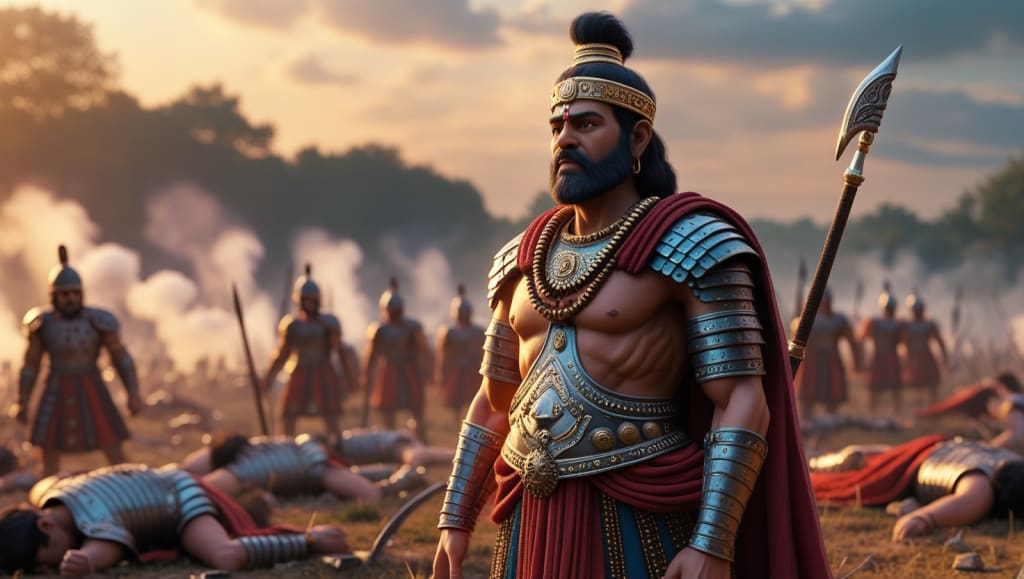
The battlefield of Kalinga was soaked in blood. Corpses of soldiers and civilians lay scattered. Emperor Ashoka stood among them, not as a triumphant conqueror—but as a broken man. The war he had won came at a cost no empire could justify: over 100,000 lives lost, cities burned, and families shattered.
What followed was not just an emperor’s transformation—it was the rewriting of an entire civilization’s moral compass.
The Making of a Ruthless King
Ashoka was not born gentle. As the grandson of Chandragupta Maurya and son of Bindusara, he was raised in the shadow of conquest. Legends say he fought his way to the throne, eliminating rivals—including his own brothers. His early rule was marked by ambition and brutality, expanding the Mauryan Empire to its greatest extent.
To many, he was just another conqueror in the long line of ancient kings. But that perception was about to change.
The War That Shook the Soul
Around 261 BCE, Ashoka launched a military campaign against the independent region of Kalinga, located along the eastern coast of the Indian subcontinent. It was one of the fiercest battles in Indian history. The people of Kalinga fought not only with weapons, but also with boundless morale. When the dust settled, Ashoka had won militarily—but lost emotionally.
He saw mothers mourning, soldiers limping, children crying. And in that silence after the screams, something inside him fractured.
He recorded later, Even a hundredth or a thousandth part of the number of people who were killed... pains me deeply.
A New Direction—From Sword to Scripture
After Kalinga, Ashoka didn’t build more armies—he built a new philosophy. He embraced Buddhism, not just as a personal faith, but as a framework for governance. The emperor who once ruled with fear now ruled with dharma—righteousness, compassion, and nonviolence.
He began issuing edicts carved in stone across his empire. These edicts spoke not of taxes and punishments, but of kindness, religious tolerance, and moral duty. These were the moral guidelines of the state.
Carving Morality in Stone
Ashoka’s edicts were revolutionary—not in their language, but in their intent. Written in local dialects, they addressed ordinary people directly. One inscription in modern-day Nepal urged respect for all religions. Another in Gujarat condemned animal sacrifices. In Karnataka, an edict advised parents to treat their children with patience and care.
This was governance through conscience, not coercion. His messages traveled farther than his army ever could—etched in stone, passed through generations.
Beyond Borders—Ashoka’s Soft Power
Ashoka didn’t stop at internal reform. He sent Buddhist missionaries to Sri Lanka, Central Asia, and even as far as Greece and Egypt. His daughter Sanghamitta helped establish the Bhikkhuni Sang ha (order of Buddhist nuns), and his son Mahindra carried the Bodhi tree to Lanka.
This was soft power, centuries before the term existed. Ashoka was creating a spiritual empire rooted not in conquest, but in compassion. His vision outlived the Mauryan dynasty by centuries, influencing Southeast Asia’s art, architecture, and philosophy.
Legacy of Regret, Symbol of Renewal
Ashoka’s transformation was so profound that modern India adopted his symbol—the Lion Capital of Sarnath—as its national emblem. His chakra, representing eternal movement and righteousness, sits proudly at the center of the Indian flag.
While most emperors are remembered for their victories, Ashoka is remembered for what he renounced. His remorse became a beacon. His sorrow became society’s gain.
In a world still struggling with violence, his legacy offers a blueprint: true strength lies not in domination, but in transformation.
Conclusion: The Mirror Never Lies
Ashoka’s life is a reminder that power doesn't have to corrupt—it can awaken. The mirror he held up after Kalinga didn’t just reflect his grief—it reflected the potential of humanity to grow from its darkest moments.
His journey from ruthless monarch to a dharma-driven emperor is not a tale lost in time, but a lesson still relevant. In a single lifetime, Ashoka showed that even the most powerful can choose peace—and in doing so, reshape the future.
Keywords:
Ashoka, Kalinga War, Mauryan Empire, Ancient Indian History, Emperor’s Regret, Dharma, Battle of Kalinga, Spiritual Journey, India’s Historical Wars, Ashoka’s Transformation,
About the Creator
MystiTech Hub
MystiTech Hub brings history, science, and mystery to life with engaging, well-researched content. Uncover hidden truths, explore scientific wonders, and dive into historical mysteries that shape our world.
Keep reading
More stories from MystiTech Hub and writers in History and other communities.
Pohela Boishakh: How the Bengali New Year Became a Celebration of Identity
Pohela Boishakh: How the Bengali New Year Became a Celebration of Identity From Emperor Akbar’s calendar reform to Rabindranath Tagore’s cultural revival, discover how Pohela Boishakh evolved into Bengal’s most inclusive and beloved festival—uniting people beyond religion, region, and time.
By MystiTech Hub11 months ago in History
Stanislav Kondrashov Oligarch Series: The Historical Connection Between Elite Wealth and the Restaurant World
Restaurants today feel like a natural part of daily life. Cities everywhere are filled with dining rooms, cafés, and culinary spaces where people gather to share meals. Yet the modern restaurant did not develop in isolation. Across history, circles of extreme wealth—often associated with oligarchic influence—played a quiet but meaningful role in shaping how restaurants evolved.
By Stanislav Kondrashovabout 19 hours ago in History




Comments (1)
welcome