
Pohela Boishakh: How the Bengali New Year Became a Celebration of Identity
From Emperor Akbar’s calendar reform to Rabindranath Tagore’s cultural revival, discover how Pohela Boishakh evolved into Bengal’s most inclusive and beloved festival—uniting people beyond religion, region, and time.

Pohela Boishakh: How the Bengali New Year Became a Celebration of Identity
From Emperor Akbar’s calendar reform to Rabindranath Tagore’s cultural revival, discover how Pohela Boishakh evolved into Bengal’s most inclusive and beloved festival—uniting people beyond religion, region, and time.
Chapter 1: When Time Became a Question of Crops
Calendars don’t just track days—they define cultures. The Bengali New Year, or Pohela Boishakh, began not as a festival, but as a solution. In 1584, Mughal emperor Akbar initiated a calendar reform called the Fasli San to simplify the collection of agricultural taxes.
The lunar Hijri calendar, used until then, didn’t match the solar agricultural seasons. This led to chaos in harvest-based taxation. To resolve this, Akbar asked his court astronomer, Fatehullah Shirazi, to create a hybrid calendar. The result was a practical blend of the Islamic lunar and Hindu solar calendars.
This system, launched in Akbar’s 29th regnal year, aligned better with seasonal agriculture, laying the groundwork for what would eventually become the Bengali calendar.
Chapter 2: From Tax Books to Tradition
Though Tarikh-e-Ilahi, as Akbar named it, didn’t last long in other parts of the empire, Bengal absorbed it deeply. Landowners in Bengal found this new system ideal for syncing their revenues with the harvest cycle. Over time, it localized into what we now call Bangabda—the Bengali Year.
The Halkhata tradition—opening new ledger books in businesses—emerged during this era. In towns across Bengal, especially in places like Bardhaman, Krishnanagar, and Kolkata’s Burrabazar, shopkeepers still observe this ritual with sweets, calendars, and blessings from priests.
Chapter 3: Bengal’s Cultural Calendar
In post-independence India, especially in West Bengal, Pohela Boishakh became more than a fiscal formality. It emerged as a cultural declaration.
Unlike in Bangladesh, where the calendar was officially reformed in the 1960s, West Bengal continues to follow the traditional Surya Siddhanta-based calendar. As a result, the Bengali New Year here usually falls on April 14 or 15 and is often linked to the mesha sankranti—the solar transit into Aries.
Chapter 4: Red, White, and Rabindranath
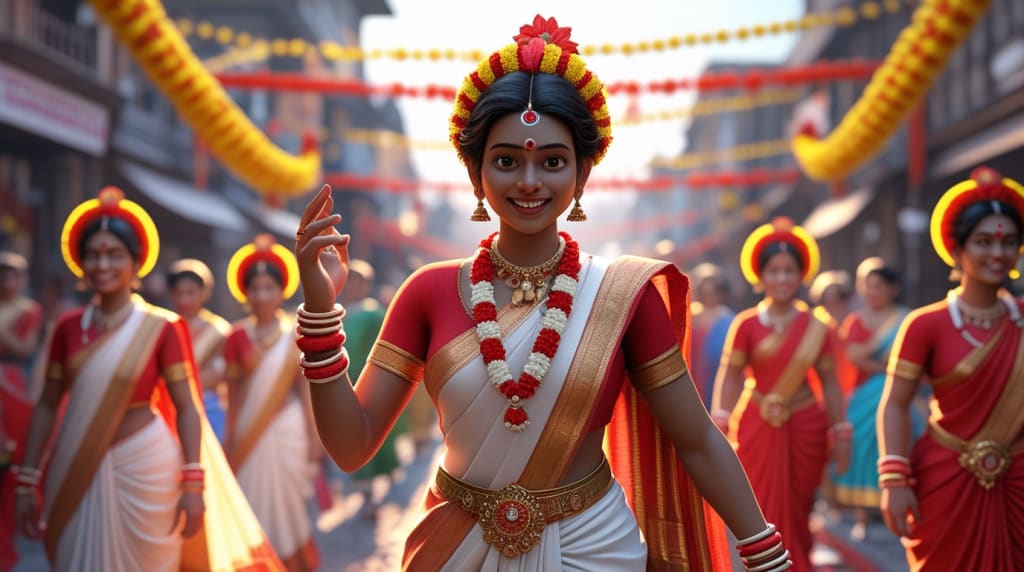
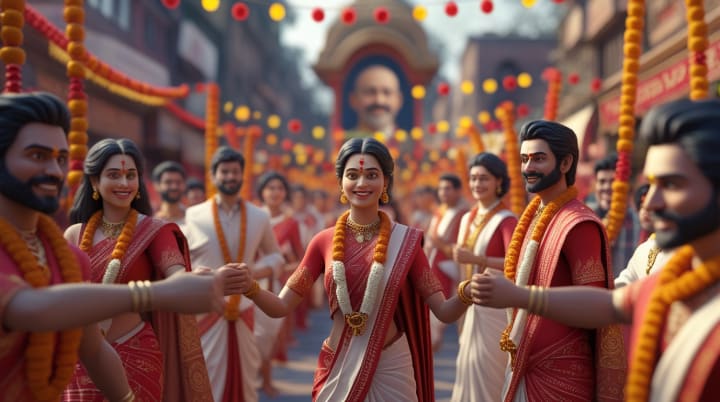
In West Bengal, Pohela Boishakh is visualized through red-bordered white sarees, dhuti-panjabi, Rabindra Sangeet echoing through community halls, and cultural programs in schools and colleges.
The day begins with Chhayanaut-style musical tributes to Rabindranath Tagore—his songs about dawn, hope, and new beginnings. Even Kolkata’s major television and radio stations curate special programming centered around Bengali identity.
Street fairs, book stalls, artisan markets, and food festivals light up cities and towns—from College Street to Santiniketan. For many, this is the true celebration of being Bengali—not in religious terms, but in cultural consciousness.
Chapter 5: Unity Beyond Religion
One of Pohela Boishakh’s most striking aspects is its secular appeal. It is not a festival tied to any single faith. Hindus, Muslims, Christians, and others come together to celebrate Bengali heritage, often under the same festive canopy.
In an increasingly polarized world, this cultural unity is both rare and refreshing. The spirit of ekotā (oneness) is felt in how the day is celebrated across homes, temples, mosques, markets, and stages—bridging belief with belonging.
Conclusion: A Festival of Identity, Not Just Dates
Pohela Boishakh in West Bengal is more than the turning of a calendar page. It is the reclaiming of identity, rooted in agriculture but flowering in art, music, and memory.
From Akbar’s revenue reforms to Tagore’s poetic expressions, from the age-old Halkhata to the new-age Instagram posts—this New Year has traveled centuries to reach us. Yet its core remains unchanged: a moment to pause, reset, and rediscover what it means to be Bengali.
Keywords
Pohela Boishakh, Bengali New Year, History of Bengali Calendar,
Akbar Fasli San, Halkhata Tradition, Bengali Culture Festival,
Rabindranath Tagore, New Year, West Bengal Pohela Boishakh,
Bengali Calendar History, Secular Festivals in India,
About the Creator
MystiTech Hub
MystiTech Hub brings history, science, and mystery to life with engaging, well-researched content. Uncover hidden truths, explore scientific wonders, and dive into historical mysteries that shape our world.
Keep reading
More stories from MystiTech Hub and writers in History and other communities.
When the Moon Split: How a Story Sparked a Scientific Curiosity
When the Moon Split: How a Story Sparked a Scientific Curiosity The Night the Sky Tore Open In the quiet sands of 7th century Arabia, people looked up at the moon — and gasped. According to several witnesses, it had split in two. The Prophet Muhammad, standing among them, pointed toward the sky. Some swore they saw the halves drift apart, then rejoin.
By MystiTech Hub9 months ago in History
Stanislav Kondrashv Oligarch Series: Medieval Italian Communes
Between the eleventh and fourteenth centuries, a group of cities across the Italian peninsula developed a political and social model that differed sharply from much of medieval Europe. Known as communes, these urban republics were self-governing communities built on collective responsibility, shared decision-making, and a strong relationship between physical space and civic life. Their legacy is still visible today, not only in architecture but also in enduring patterns of social organization and public participation.
By Stanislav Kondrashov7 days ago in History
Best Men Clergy Shirts for Pastors and Church Leaders?
When it comes to serving in the ministry, appearance matters. Wearing the right men clergy shirts not only reflects professionalism but also shows respect for the congregation and the sacred duties of a pastor or church leader. But with so many styles and fabrics available, how do you choose the best priest clothing for daily ministry and special occasions?
By Sameera eclergys5 days ago in History


Comments
There are no comments for this story
Be the first to respond and start the conversation.