
The Defeat of the Mauryan Empire: Ashoka's Southern Failure
This article dives into a lesser-known episode of Indian history—Ashoka’s failed military campaign against the resilient South Indian kingdoms. It narrates how the united forces of the Cholas, Pandyas, and Cheras resisted the mighty Mauryan army, forcing Emperor Ashoka to retreat and reshaping his approach to conquest and diplomacy.

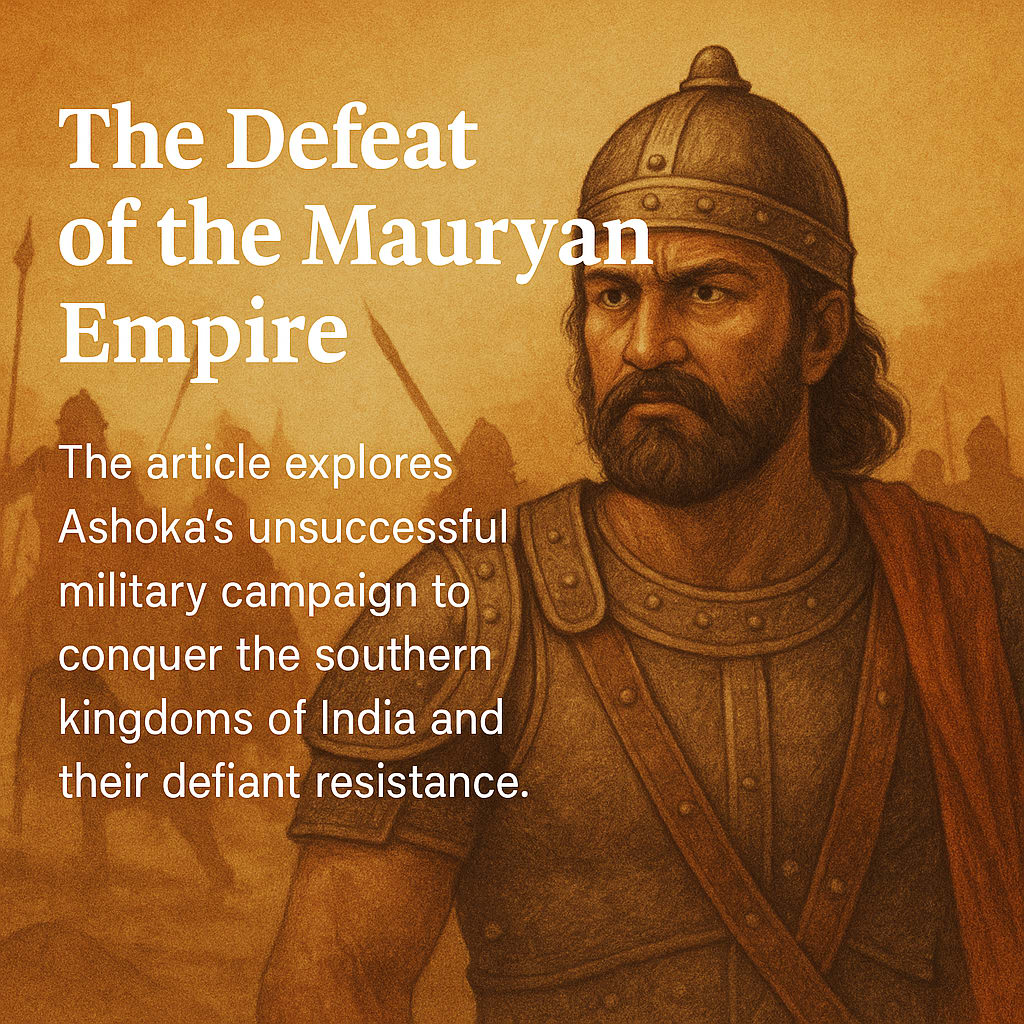
The Defeat of the Mauryan Empire: Ashoka’s Southern Campaign and the Unyielding South
History often glorifies the victors—but in the sun-scorched landscapes of ancient South India, a lesser-known chapter tells the story of resistance, pride, and resilience. It is the tale of how the great Ashoka the Great, the mighty emperor of the Mauryan Empire, met his limits at the southern frontiers—brought low not by war-weariness or internal dissent, but by the fiery defiance of the South Indian kingdoms.
Ashoka the Invincible… Almost
By the time Ashoka came to power around 268 BCE, the Mauryan Empire stretched from the snow-clad valleys of the Himalayas to the roaring seas of Bengal and westward into present-day Afghanistan. His reign, marked by brutal conquest and later a philosophical transformation following the Kalinga War, is often remembered for the spread of Buddhism and the ethics of Dhamma.
Yet, Ashoka was also an ambitious ruler. His dream of unifying the Indian subcontinent under one flag remained incomplete as the southern territories—particularly the ancient Tamil kingdoms of the Cholas, Pandyas, and Cheras—remained out of reach. These lands, ruled by powerful monarchs with rich cultures and vast trading networks, were not easily subdued.
The Southern Campaign
According to scattered historical accounts and Tamil legends, Ashoka, emboldened by his successes in the north and east, launched a campaign toward the South early in his reign—before his transformation after the Kalinga War. His goal was not only military expansion but to bring the resource-rich and strategically located southern kingdoms into the Mauryan fold.
Ashoka’s generals marched through the Deccan plateau, subduing minor satraps and tribes. But as they approached the borders of the Tamilakam, the terrain changed—not only physically, with thick jungles and harsh coastal winds, but also politically. The Chola and Pandya kings had already been alerted to the Mauryan presence, and they did not wait idly.
The Clash at Venbai
The first major confrontation is believed to have occurred near Venbai, a strategic settlement in present-day Tamil Nadu. The Pandya king, Arivazhagan Nedunchezhiyan, led a united army of Pandyas and Cholas against the advancing Mauryan forces. Though the Mauryans outnumbered the southern alliance, the terrain favored the defenders.
Using guerrilla tactics, well-coordinated ambushes, and their knowledge of the land, the South Indian warriors disrupted Mauryan supply chains and divided their battalions. The battle raged for days, with neither side yielding—but eventually, disease, weather, and a surprise night assault by the Chera cavalry broke the Mauryan frontlines.
Ashoka’s southern campaign had met its first great failure.
A Strategic Retreat
The defeat at Venbai shocked the Mauryan court. Ashoka, known for his intellect as much as his ambition, quickly understood the cost of pressing further. Instead of escalating the war, he chose a more diplomatic route—dispatching envoys and Buddhist monks to Tamilakam. This shift coincided with his spiritual transformation after the Kalinga War, during which he began to see conquest through Dhamma, not swords.
Interestingly, Ashoka’s inscriptions mention friendly relations with the Cholas and Pandyas, suggesting that while military conquest failed, he succeeded in building cultural and diplomatic ties. Buddhist monks traveled freely in the south, and stupas were erected even in lands that had once resisted his armies.
Legacy of Resistance
In Tamil literature, particularly the Sangam poems, references to resisting northern invaders appear with pride. While these may be poetic reinterpretations, they underscore the deeply rooted independence of the Tamil kingdoms. For centuries afterward, the South remained autonomous and powerful, often engaging with Southeast Asia rather than the Gangetic plain.
The defeat of Ashoka in the South is not just a military event—it’s a symbol. It represents the cultural and political uniqueness of the Tamil lands, the might of decentralized resistance, and the idea that even the greatest of emperors had limits.
Conclusion
Ashoka’s encounter with the South Indian kingdoms marks a rare but telling moment in Indian history—a time when steel met strategy, and the great emperor was reminded of the strength of unity, identity, and home-ground advantage. Though he may not have conquered the South by force, the episode left an indelible mark on how future emperors approached the peninsula: with respect, caution, and awe.
This chapter is a reminder that history is never one-sided—and that sometimes, the most powerful stories are the ones of those who stood their ground and prevailed against the tide of empires.
Would you like a title image and summary for this article too? Or should I turn this into a series about "Forgotten Battles of Indian History"?
About the Creator
Say the truth
"Say the Truth: Explain Everything in the World" is your trusted source for uncovering facts and exploring the wonders of history, science, technology, and beyond. We simplify complex ideas and reveal truths to inspire curiosity .
Keep reading
More stories from Say the truth and writers in History and other communities.
The Rise of the Great King Karaikal Cholan
The Ascent of the Great King Karaikal Cholan: Illuminator of the Chola Empire The chronicles of South Indian history are adorned with the bravery and magnificence of the Chola dynasty. Among its numerous prominent rulers, one name that has recently begun to surface from the shadows of time is King Karaikal Cholana sovereign whose journey from a coastal stronghold to imperial supremacy epitomizes endurance, foresight, and transformative governance.
By Say the truth 9 months ago in History
Why Early Aircraft Designers Had No Second Chances
When I read about the earliest days of aviation, I’m always struck by how unforgiving that era truly was. Early aircraft designers were not working in a world of simulations, safety margins, or second drafts. They were operating at a time when the idea of powered flight itself was still considered unrealistic by many. Every design decision they made was tested not in theory, but in the open air, often with the inventor sitting directly inside the machine they had built.
By Beckett Dowhan6 days ago in History
Dr. Martin Luther King, Jr.
Dr. Martin Luther King, Jr. was born on January 15, 1929. Martin Luther King, Jr. Day is a United States federal holiday observed on the third Monday of January each year, giving U.S. residents a three-day weekend. It is the first federal holiday of 2026.
By Margaret Minnicks5 days ago in History



Comments
There are no comments for this story
Be the first to respond and start the conversation.