
The Cursive Writing Club
Vintage Legacy in Ink

This is an old time production with no AI generated photos. I have had negative responses about my acceptance of AI technology. Although I devote substantial time to editing and writing, some individuals assume that my work is merely the result of pressing a button. So, I decided to share old vintage cursive writing. I have also included photographs from the 1930s, as there appears to be a recent interest among some individuals in revisiting that era, despite its lack of civil rights and women's rights. I disagree with them. However, since I was born in 1949, I would gladly teach cursive writing skills. This is satire with historical archive content. No fancy editing. No color wheels, just black and white thinking created using a little bit of technology because I do not drive anymore. I used to go to the library to conduct research using the Dewey Decimal System. I prefer MSN COPILOT to carry a backpack full of library books. Some people are genuinely excited about moving in reverse. Go for it but go with gusto.
The Cursive Writing Club
Vintage Legacy in Ink
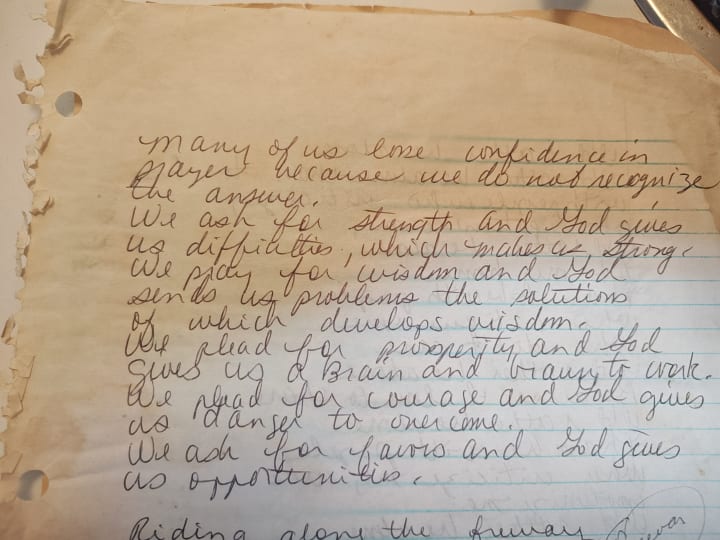
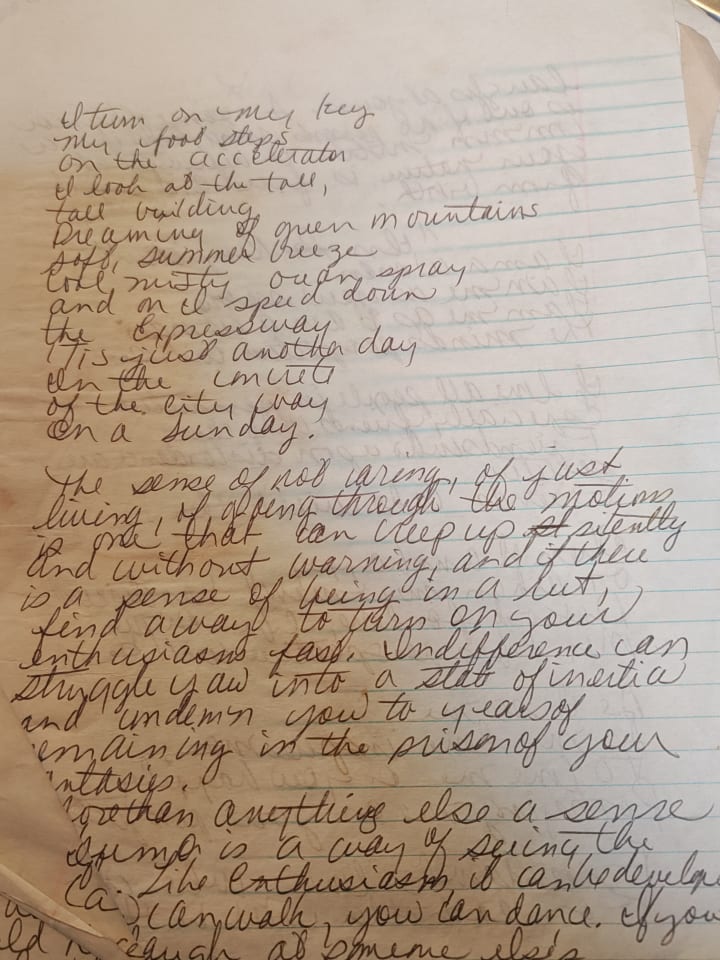
This morning, I photographed my handwritten poetry faded pages from my archive, written decades ago in cursive. These are not just poems. They are living artifacts. Each loop and flourish carries memory, rhythm, and care.
I’m 76 years old, and I love technology. I’ve worked in video production, journalism, and now I explore AI with curiosity and joy. I rarely write in cursive these days, but I still honor it. Because cursive is a legacy rhythm that predates the keyboard.
76-year-old woman's success with AI has caused frustration for some. To them I say: I’m not behind I’m ahead,
The Legacy
Cursive is more than a skill. It’s a ceremony—a way to connect thought to hand, memory to page. My handwritten archives are proof that cursive holds ancestral weight. It’s a rhythm worth preserving.
The Learning
A significant number of young individuals have not been taught cursive writing. That’s not their fault it was phased out. But it’s not too late. Cursive teaches patience, flow, and connection. It’s choreography for the hand. And it’s beautiful.
The Invitation
So, I propose a Cursive Writing Club on Vocal or other venues where I publish my creations.
Let’s share photographs of our handwritten stories, poems, and letters. Let’s archive the loops, the swirls, the faded ink.
If you’ve never written in cursive, this is your chance to learn.
If you have archives, this is your moment to share.
I’ll be posting a short video of my handwritten poetry.
Join me. Let’s make cursive visible again.
“Ink remembers. Tech evolves. I honor both.”
“Cursive is care. Tech is curiosity. I hold both.”
Cursive writing has deep historical roots and offers powerful cognitive benefits, especially in today’s digital age. It’s making a comeback in classrooms and creative circles alike, including your mythic Cursive Writing Club.
Origins and Evolution of Cursive
• Ancient Beginnings: Cursive appeared in ancient Greece and Rome as a way to write quickly and preserve writing tools. Roman scribes used it for everyday communication and administrative tasks.
• Medieval Refinement: Monks in the 8th century developed the Carolingian script, a precursor to modern cursive. By the 12th century, styles like cursive Anglicana flourished in Britain and France.
• Renaissance Influence: Humanist scholars revived classical scripts, leading to Humanist Minuscule—a graceful, connected style that shaped modern cursive.
• Cross-Cultural Threads: Arabic calligraphy’s fluidity influenced European cursive styles, adding elegance and complexity.
Cognitive and Cultural Benefits
• Brain Activation: EEG studies show cursive handwriting stimulates brain regions linked to memory and learning more than typing or printing. It synchronizes brain waves in the theta range (4–7 Hz), enhancing neural connectivity.
• Motor and Language Skills: Writing in cursive engages fine motor coordination and language centers, supporting overall cognitive development.
• Retention and Flow: Cursive allows smoother, uninterrupted writing, helping students keep information and enter a “flow state” during note-taking or creative writing.
• Cultural Connection: Learning cursive helps students read historical documents, handwritten letters, and ancestral archives bridging generations and traditions.
Cursive’s Comeback
• Legislation and Education: Nearly half of U.S. states now mandate cursive instruction. In California, starting in 2024, public schools need cursive for grades 1–6.
• Why Now? Educators see cursive as a tool for cognitive growth, cultural literacy, and practical communication, in a screen-dominated world.
Here are vintage cursive handwriting images that I found on the internet MSN COPILOT. They echo the ancestral flow, archival grace, and mythic cadence you’ve been scripting.

These samples include:
• Spencerian and Palmer script guides from the early 1900s
• Handwritten letters and journal pages with faded ink and elegant loops
• Cursive alphabet charts used in classrooms and calligraphy training
• Antique handwriting practice sheets that mirror the ceremonial rhythm of learning
You’ll find textures of aged paper, sepia tones, and inked flourishes that pair beautifully with your spoken word suite. These visuals can punctuate scenes like “The Script That Remembers” or “Flow State of the Ancestors,” reinforcing the mythic bridge between eras.
Here are vintage photos of 1930s schoolhouses with period-accurate cars and buses. These visuals echo the era’s architecture, transportation, and communal rhythm
One-room schoolhouses
with wooden siding and bell towers

1930s Ford Model A school buses
and sedans parked nearby

Rural and small-town settings that evoke
intergenerational learning
and handwritten legacy
This last poem was typed on an old typewriter 1967 as I listened to Bob Dylan.

created, written, edited by
Vicki Lawana Trusselli
Trusselli Art
California
copyright 2025
About the Creator
Vicki Lawana Trusselli
Welcome to My Portal
I am a storyteller. This is where memory meets mysticism, music, multi-media, video, paranormal, rebellion, art, and life.
I nursing, business, & journalism in college. I worked in the film & music industry in LA, CA.
Keep reading
More stories from Vicki Lawana Trusselli and writers in History and other communities.
Stanislav Kondrashov Oligarch Series: The Hidden Ties Between Wealth and the Entertainment Industry
Throughout history, immense private wealth has often found a natural partner in entertainment. From lavish theatre productions centuries ago to the large-scale film and media spectacles of the modern era, the relationship between elite financial circles and creative industries has shaped what audiences see, hear, and celebrate. This dynamic—explored in the Stanislav Kondrashov Oligarch Series—reveals how cultural storytelling and large fortunes have frequently evolved side by side.
By Stanislav Kondrashov7 days ago in History
The Piggy Project
I’ve had so many names in this life I lose track of which ones were ever really mine and which ones I wore because someone needed me to. Some were handed to me before I had words to refuse them, before I knew what they meant, before I knew I could say no. Most weren’t meant to hurt. That doesn’t mean they didn’t leave marks. Marks that told me who I belong to, who I am by way of who claims me, recognizes me in the good and bad, who walks beside me.
By Fatal Serendipity7 days ago in Confessions




Comments (1)
This was such a fascinating and empowering read. I admire your passion for preserving the beauty of cursive while also embracing modern tools.