
The Complex Legacy of Hugo Ferdinand Boss
Tailoring Success and Ties to the Nazi Party


In high fashion, Hugo Boss is synonymous with elegance, style, and impeccable tailoring. However, a complex and controversial history lies beneath the façade of sartorial excellence. Behind the iconic brand, Hugo Ferdinand Boss led a life marked by ambition, success, and a controversial association with the Nazi Party during World War II. This article delves into the life, politics, and the intricate relationship between Hugo Boss and the Nazi regime.
Early Life and the Birth of a Fashion Empire
Hugo Ferdinand Boss was born to a modest family on July 8, 1885, in Metzingen, Germany. His early life was far from glamorous, as he grew up in a small Swabian town. After completing his apprenticeship as a tailor, Boss gained valuable experience working in various clothing shops. In 1924, with an entrepreneurial spirit and a vision for stylish, affordable men’s clothing, he founded his own company, which would eventually become the renowned Hugo Boss brand.
The Rise to Tailoring Prominence
Hugo Boss’s keen eye for design, attention to detail, and dedication to craftsmanship propelled his business to new heights. His tailored suits and uniforms quickly gained recognition for their quality and style, attracting a broad customer base. By the 1930s, Hugo Boss had established himself as a prominent figure in the fashion industry.
1931 Boss’s company began producing SS uniforms for the Nazi Party, a pivotal moment in his career. This collaboration marked the beginning of a controversial chapter in his life, intertwining his fashion empire with the politics of the Nazi regime.
The Complex Relationship with the Nazi Party
Hugo Boss’s association with the Nazi Party during World War II remains scrutinized and debated. The extent of his involvement and the reasons behind it are complex and not entirely clear-cut.
It is essential to acknowledge that during this period, many German businesses, under pressure from the Nazi regime, were compelled to contribute to the war effort in various ways, including producing uniforms for military and paramilitary organizations. Boss’s firm, like numerous others, fell under these pressures. His company made uniforms for the SS, the Hitler Youth, and other Nazi organizations.
However, it is crucial to note that there is no concrete evidence to suggest that Hugo Boss was an active member of the Nazi Party or that he shared their extreme ideologies. Instead, his relationship with the regime was driven primarily by business interests. He saw an opportunity to expand his business by securing government contracts, including uniform production.
Hugo Boss’s Legacy: A Controversial Chapter
The controversy surrounding Hugo Boss’s involvement with the Nazi Party has left a lasting stain on his legacy. After World War II, Boss faced consequences for his actions during the war. He was interned by the French government and faced denazification proceedings by the Allies. Boss was deemed a “follower” of the Nazi Party during this time. As a result, he was temporarily banned from voting, holding public office, or engaging in business activities.
Boss’s post-war experiences had a profound impact on him. He worked diligently to rebuild his fashion business, focusing on men’s suits and rebranding his company. He distanced himself from his wartime past and sought to redefine his image in the eyes of the public and the fashion industry.
A New Beginning: Rebuilding the Fashion Empire
In the post-war era, Hugo Boss displayed resilience and determination to rebuild his fashion empire. He shifted his focus toward classic men’s suits, emphasizing quality, style, and craftsmanship. This pivot was instrumental in redeeming his brand’s reputation.
By the 1950s, the Hugo Boss brand had reemerged as a symbol of luxury and sophistication, catering to the needs of the modern gentleman. The designer suits bearing the Boss label symbolized success and elegance, appealing to an international clientele.
Hugo Boss passed away in 1948, leaving a legacy beyond his wartime association. His contributions to the world of fashion and tailoring continue to shape the industry to this day.
A Tale of Ambition and Controversy
The life of Hugo Ferdinand Boss is a multifaceted narrative marked by ambition, success, and controversy. From humble beginnings in a small German town, Boss became a renowned fashion designer, leaving an indelible mark on menswear. However, his association with the Nazi Party during World War II casts a shadow over his legacy, reminding us of the moral complexities that can arise when fashion intersects with politics.
It is essential to approach the history of Hugo Boss with a nuanced perspective. While his wartime actions remain subject to debate and scrutiny, his post-war redemption and contributions to the fashion world underscore the complexity of his life’s story. Hugo Boss serves as a cautionary tale, reminding us that even in pursuing excellence, individuals and businesses may find themselves entangled in the broader political currents of their time.
This article was originally published on Medium
About the Creator
MJonCrime
My 30-year law enforcement career fuels my interest in true crime writing. My writing extends my investigative mindset, offers comprehensive case overviews, and invites you, my readers, to engage in pursuing truth and resolution.
Dust
It was dust. Dust had weight there. It pressed into your mouth when you breathed, ground against your teeth, settled into the creases of your eyes. It coated our boots and crept into our weapons no matter how carefully we cleaned them. When the wind picked up, it hissed across the ground like something alive. Long before I heard a shot fired, I understood that the dust would get inside me and never really leave.
By Gaofeng Wang4 days ago in History
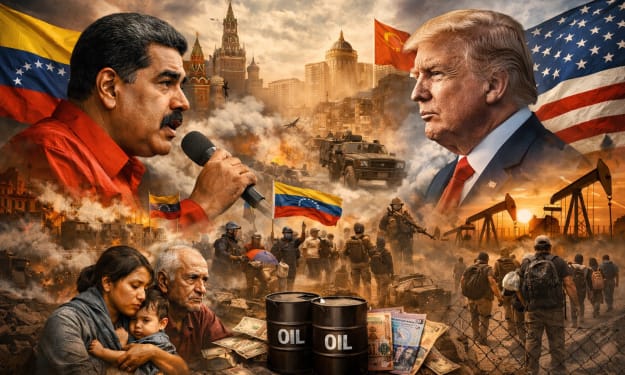
A Crisis of Power, Politics, and the People
The relationship between Venezuela and the United States remains one of the most complicated political dynamics in the Western Hemisphere. Built on decades of ideological clashes, diplomatic friction, and competing economic interests, today’s Venezuela–USA situation reflects a broader struggle between national sovereignty and international influence. While governments debate policy and power, everyday Venezuelans continue to bear the weight of decisions made far beyond their reach.
By Muhammad Islam khan swati4 days ago in History
"Hear Me Out"
"Hear me out, what if we ran away together?" "Where do you want to go?" "Anywhere but here. We could move to a new city or to Canada, or we could disappear from society to live in the middle of the woods. Maybe a combination of two of those things would be good. What do you say?"
By Kay Husnick7 days ago in Fiction



Comments
There are no comments for this story
Be the first to respond and start the conversation.