
The Complex History of India and Pakistan: From Unity to Division
An In-Depth Exploration of Shared Origins, Violent Partition, and a Tumultuous Relationship Between Two Neighbours
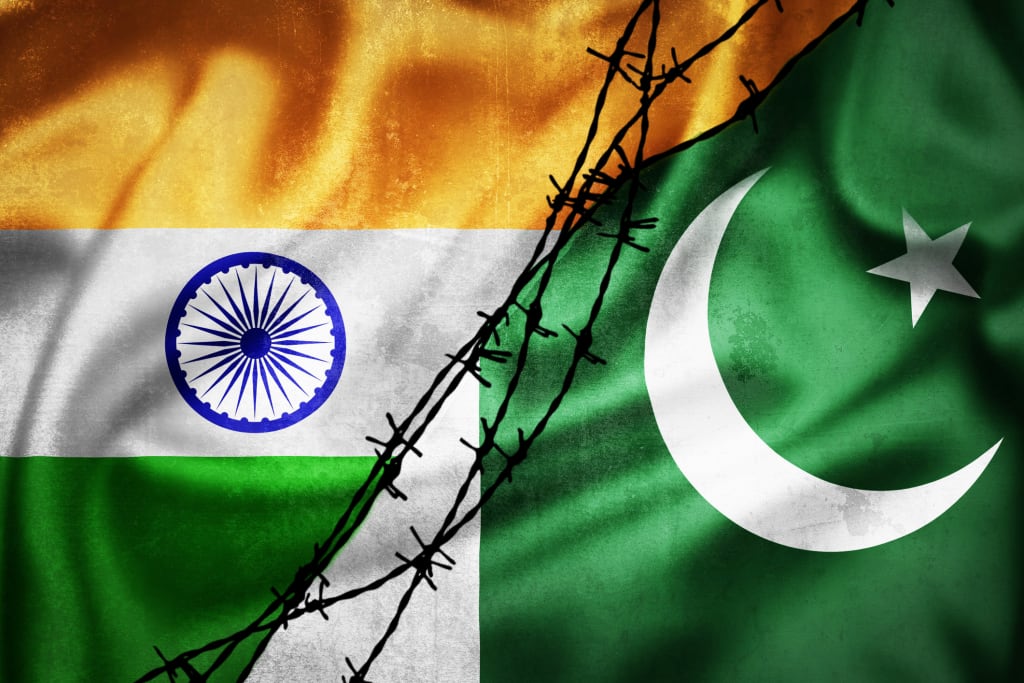
A shared civilization, colonial dominance, religious and political divisions, and persistent geopolitical rivalry make up the deeply intricate history of India and Pakistan. They were once part of a unified cultural and political entity under various historical empires, despite the fact that these two nations are largely viewed today through the lens of mutual suspicion and conflict. 1. Shared Origins and Pre-Colonial Unity:
Before the arrival of the British, the Indian subcontinent was home to several powerful empires that ruled over regions now belonging to both India and Pakistan. Among the most influential was the Mughal Empire (1526–1857), which presided over a flourishing period of art, culture, and architecture and fostered a syncretic Indo-Islamic culture that defined the social fabric for centuries. Persian, Arabic, and Sanskrit coexisted as languages of the elite, while Sufism and Bhakti movements emerged as spiritual reform traditions.
Although Hinduism was the majority religion, Muslim communities were deeply embedded in the cultural, administrative, and economic systems. Cities such as Lahore, Delhi, and Agra were important centers of art, trade, and learning, reflecting the interconnectedness of regions that would later be divided.
2. Colonial Rule and the Rise of Nationalism:
The British East India Company began exerting control in the 18th century, culminating in direct Crown rule after the Revolt of 1857. Military dominance, economic exploitation, and strategic alliances with princely states were all used by the colonizers to rule. They also introduced Western-style education, legal systems, railways, and administrative reforms—but often with the aim of consolidating power.
With time, Indian nationalist movements grew in strength. The Indian National Congress (founded in 1885) became the primary vehicle for independence, promoting a secular and united India. However, many Muslims began to feel that their political and cultural identity might be overwhelmed in a Hindu-majority state. The All-India Muslim League, which was established in 1906 and initially sought to safeguard Muslim interests but later began advocating for a separate nation, emerged as a result of this. 3. The Demand for Pakistan and the Partition of 1947:
Under the leadership of Muhammad Ali Jinnah, the Muslim League proposed the creation of Pakistan as a separate homeland for Muslims. The demand culminated in the Lahore Resolution of 1940, which laid the foundation for partition. As communal riots intensified in the 1940s—especially in Bengal and Punjab—the British, exhausted after World War II and under internal pressure, decided to grant independence.
In a rushed and ill-prepared process, the Partition of British India was carried out in August 1947, leading to the formation of India and Pakistan (the latter in two parts: West Pakistan and East Pakistan). The consequences were catastrophic:
An estimated 10 to 15 million people crossed borders in both directions in what became the largest mass migration in human history.
Widespread communal violence broke out, with as many as 1 to 2 million deaths, countless rapes, abductions, and disappearances.
The border regions of Punjab and Bengal saw the worst violence, and the newly formed governments struggled to provide safety or order.
4. Post-Independence Conflicts and Wars:
Since partition, India and Pakistan have fought four major wars:
1947–48 (First Kashmir War): Triggered by the princely state of Kashmir’s accession to India, which Pakistan contested. Ended with a UN-mediated ceasefire and the creation of the Line of Control (LoC).
1965 (Second Kashmir War): Pakistan launched Operation Gibraltar to infiltrate Kashmir; India retaliated. Another ceasefire was brokered by the Soviet Union in Tashkent.
1971 (Bangladesh Liberation War): Pakistan’s internal conflict in East Pakistan (now Bangladesh) escalated into war with India. It resulted in Pakistan’s defeat and the creation of Bangladesh, one of the most humiliating events in Pakistani history.
1999 (Kargil War): Pakistani soldiers and militants occupied strategic heights in Kargil; India successfully repelled them. This conflict was particularly notable for occurring between two nuclear-armed states.
5. Nuclear Arms Race and Tense Diplomacy:
In 1998, both India and Pakistan conducted nuclear tests, making their rivalry far more dangerous. Since then, there have been continued military skirmishes, especially across the LoC, terrorist attacks (such as the 2001 Indian Parliament attack and the 2008 Mumbai attacks), and cross-border surgical strikes. Diplomatic efforts like the Agra Summit (2001), Lahore Declaration (1999), and Composite Dialogue Process have shown moments of hope, but progress remains fragile.
6. Cultural and Social Interconnection:
Despite political animosity, the people of India and Pakistan share deep cultural, linguistic, and emotional ties. Urdu and Hindi are mutually intelligible; classical music, cuisine, clothing, and cinema (especially Bollywood) are celebrated across the border. Families divided by partition still hold onto memories of unity, and diasporas worldwide often advocate for peace.
7. The Present and the Way Forward:
Today, the India-Pakistan relationship is shaped by both domestic politics and international alignments. While border clashes and nationalist rhetoric continue, there are also persistent calls for engagement, trade normalization, and people-to-people diplomacy.
Understanding the historical context of this relationship is vital not only for South Asia but for global stability. The trajectory from shared heritage to separation, from unity to enduring conflict, offers lessons on nationalism, identity, colonial legacies, and the cost of division.
About the Creator
Keep reading
More stories from sadhin khan and writers in History and other communities.
Mena-Raju and the Case of the Missing Ilish
Setting: In the quiet riverside village of Shonargram, life is simple. The morning breeze carries the call of the muezzin, fishermen cast nets in the river Padma, and children run barefoot through jute fields. But peace is often short-lived when Mena and Raju, the village’s most curious duo, are around.
By sadhin khan10 months ago in Fiction
The Mughal Princess Who Changed the Image of the Imperial Harem
When people imagine royal harems in medieval empires, they often picture places of luxury, secrecy, and endless indulgence. The Mughal Empire is no exception. For centuries, the Mughal harem has been portrayed as a secluded world of wealth and pleasure where royal women lived hidden lives behind palace walls. However, one remarkable woman challenged this narrow view: Gulbadan Begum, a Mughal princess whose life and writings revealed a very different reality.
By Irshad Abbasi 3 days ago in History



Comments (1)
Great history of South Asia. Thank you for this information.