
The Complete History of the Second World War Part I
World War II or the Second World War, often abbreviated as WWII or WW2, was a global conflict that lasted from 1939 to 1945.


On the morning of August 9th, 1945, air-raid sirens sounded in the Japanese city of Nagasaki. However, the sirens rang out again shortly after, indicating that there was no danger and people resumed their daily activities. Japanese spotters had only cited two US AAF B-29 bombers, which were presumed to be on a reconnaissance mission and not enough for an air raid on a major city. At 11:01 hours, a single bomb was dropped into the city's industrial area, detonating with the equivalent force of 22,000 sticks of TNT. The resulting blast was seen by observers over a hundred miles away, generating temperatures in excess of 3,900 degrees centigrade and winds of up to 600 miles per hour that added to the destruction. The exact figures are unclear, but at least 129,000 people were either killed on the day or would die in the weeks and years that followed. Six days after this attack, Japan surrendered to the Allies, bringing to a close the most destructive conflict ever recorded, which ended with the first two and so far only nuclear attacks in history.
The causes of the Second World War cannot be dissected without discussing the rise of the Nazi Party in Germany and its leader, Adolf Hitler. Hitler fought in the German army during the First World War and felt bitter about Germany's humiliation when the war ended. He feared communism spreading beyond the borders of post-revolutionary Russia and joined the German Workers Party in 1919, which was later renamed the National Socialist German Workers Party, commonly known as the Nazi Party. Hitler rose to become the leader of the party in 1921 and continued to garner more and more support until the Nazis attempted a coup in Munich in 1923, known as the Beer Hall Putsch. Hitler used the trial to gain even more supporters, and despite spending a year in prison, the Nazis continued to establish themselves in German politics. Hitler's autobiography, Mein Kampf, outlined his own story and established his vision for the future of the German people, blaming Jews and communists for holding them back from achieving their destiny through measures such as the Treaty of Versailles.
In 1933, the Nazi Party secured enough political support, and Hitler legally became Chancellor of Germany. He quickly began passing legislation that would transform Germany into Nazi Germany, and the swastika would symbolize this reinvigorated country. The prosecution of Jews, Gypsies, and political opponents soon became government policy as Hitler began preparing Nazi Germany to attain what he saw as his destiny centered around the concept of the Aryan race, with himself as the undisputed leader, the Fuehrer. The Second World War began in 1939, but some historians argue that it began in 1931 with the Japanese invasion of Manchuria in China. The Japanese deliberately detonated a bomb by a Chinese railway line used by Japanese citizens to blame it on Chinese dissidents, using it as a pretext to invade the country. Japanese occupation of Chinese territory was extraordinarily harsh, with rape and murder widespread and often encouraged by the Japanese leadership. In 1922, Benito Mussolini and his national fascist party rose to power in Italy, reshaping the Democratic political landscape of the country into a dictatorship centered around himself.
As the 1930s progressed, Hitler's Nazi Party became firmly embedded in German politics and society as a whole. The German people had much to thank the Nazi Party for, as they had pulled the country after the disparate feat and reinvigorated it, promising that Germany would soon be attaining its destiny of becoming a great power again. Hitler's appeal and influence were not lost on foreign observers, many of whom admired him and even began to sympathize with the Treaty of Germany after the war. Hitler became Time Magazine's Man of the Year, playing perfectly into his hands as he began making notions of regaining lost territory in the east and west of the country. The first test of how the Allied powers of Britain and France would respond to his new Germany came in 1935 when Hitler introduced military conscription, which saw the German armed forces swell many times beyond the number permitted by the Treaty of Versailles. Encouraged by this, he then ordered his troops into the Rhineland in 1936, which had been demilitarized in 1925 to create a safety zone for France. Despite protests by France and the Legion of Nations, they did nothing.
In 1937, British Prime Minister Stanley Baldwin stood down and was succeeded by Neville Chamberlain. Meanwhile, Germany continued to rearm and set their sights on reclaiming the German state land, which had been absorbed into Czechoslovakia after the war. Hitler looked to his own birth country of Austria to become a part of his new Germany, although this was again forbidden by the Versailles Treaty.
Several of Germany's cautious generals had advised Hitler that the country was not yet prepared for a second major European conflict. However, Germany's rearmament plans predicted a war with Britain and France in 1945, by which time they would have their own aircraft carrier, large U-boat fleets, and powerful tank forces. The generals therefore developed their blitzkrieg style of warfare, which called for the widespread use of tanks and aircraft to break through enemy formations, capture key strategic areas, and divide enemy forces to make them easier to destroy. The goal was to achieve a quick victory rather than a drawn-out war of attrition, which Germany could not afford. The blitzkrieg was first used in Poland, where the Polish army proved inadequate for this new form of warfare. In less than a month, the Polish army was annihilated, and Germany began consolidating its positions in western Poland as the Soviet Union invaded the east of the country on September 17th, as agreed to by von Ribbentrop. This was largely ignored by Britain and France, who concentrated on Germany. Poland ceased to exist as a free country on October 6th, 1939, and Nazi Germany now shared a land border with the Communist Soviet Union.
Britain and France's declaration of war on Germany sent shockwaves across Europe, which were felt politically but appeared to do very little in terms of helping defend Poland. Belgium, Holland, and Norway declared themselves neutral in the fighting, but in reality, there was very little fighting at all. Britain and France could do very little to defend Poland and instead prepared for when Hitler would charge west. This was the start of the phony war, a period where both sides seemed to be doing everything they would normally do in a war except all-out warfare. The French mobilized their armed forces and sent them to the border, while Britain created the British Expeditionary Force (BEF) to be sent to France to support them, mirroring how the country went to war in 1914. At sea, German U-boats and surface raiders sank unprotected merchant ships, while in the air, British aircraft made attacks on German shipping or conducted leaflet drops over the Ruhr region.
During one such leaflet dropping mission on September 9th, a formation of RAF Whitley bombers strayed into Belgian airspace and were attacked by Belgian fighters. This forced one of them to land, and they lost two aircraft to British defensive fire. However, in the South Atlantic, a drama was about to unfold that would become a naval legend. The German pocket battleship Graf Spee was attacking British merchant ships, capturing their crews, and then sinking them. The crews were then put on the Graf Spee support ship, the Altmark, for returning to Germany. Three British cruisers met the German ship in battle and managed to inflict enough damage to force the German battleship to put into neutral, Montevideo, modern-day Uruguay, for repairs. While there, the British began flooding local media sources that a huge British Armada was assembling to destroy the pocket battleship when it left port. The German captain learned of this and, believing the situation was hopeless, he scuttled his mighty warship. In reality, there was no Armada, but the deception meant potentially thousands of sailors' lives were saved. A few weeks later, British special forces raided the Altmark and rescued a number of captured merchant crews.
Everyone knew the phony war couldn't last forever, and it would only be a matter of time before Hitler struck west of France. In the meantime, Britain and France decided to embark on a campaign in Norway, a neutral country, but one that, along with Sweden, helped supply Germany with vital iron ore. Norwegian harbors from where German ships operated provoked Hitler to send his forces in on April 9th to secure them. The battle for Norway would last until June 10th, by which time France and Britain had long retreated, leaving the country to its fate. The disaster in Norway forced Chamberlain to stand down as Prime Minister on May 10th, and after Lord Halifax refused the post, it was offered to Winston Churchill, who was still basking in the success of the Graf Spee operation as the First Lord of the Admiralty. Churchill was something of a surprise, having more friends than enemies in the establishment and was a popular figure amongst the people. He would eventually form a new government made up of members of the main political parties but, in doing so, effectively suspended British democracy for the foreseeable future. He told the British people rather bluntly that he had nothing to offer them but "blood, toil, tears, and sweat."
Across the channel, the French had been preparing for another war against Germany for over a decade by constructing the Maginot Line, a series of turf fortifications along the border with Germany. It was designed and constructed in the belief that the war...
Want Second part? Subscribe now or go to my profile, there you got it...
About the Creator
MALIK T.
Creative writer who loves the paranormal, fiction, mystery, articles and the occasional Stories. Take a chance, you'll be thoroughly entertained.
Is the U.S. Preparing to Attack Iran?
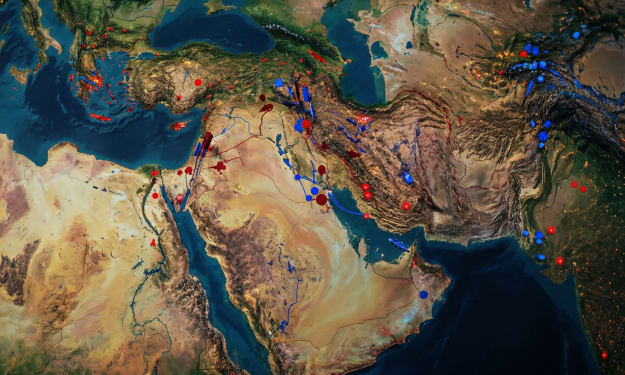
Is the U.S. Preparing to Attack Iran? Inside the Rising Tensions and Possible Military Pathways In early 2026, tensions between the United States and Iran reached one of their highest points in years. For weeks, dramatic political rhetoric, shifting military postures, and warnings from leaders around the world have fueled alarms that a U.S. military strike against Iran may be imminent. Yet as of now, no confirmed attack has occurred, and the situation reflects a complex mix of pressure, preparation, de-escalation, and diplomatic uncertainty that illustrates how modern conflict can hinge just as much on words and positioning as on direct action.
By Wings of Time 4 days ago in History
No ICE, No KKK, No Fascist USA
"I don't 'do' politics." Politics will do you, regardless. Watching from the sidelines for the last year I can see far too many similarities in the way Trump's ICE Gestapo is to Nazi Germany. Considering the United States just invaded Venezuela and kidnapped their President and his wife I would say we are there.
By Lyvia Jack6 days ago in History
How, Too
Many people wonder how, too. You are not alone, and I am an expert. I will teach you how, too! First, you need to remit a small application fee and fill out an application describing the nature of your financial situation and how often payments will be made, as this will have great bearing on how well I teach you how, too.
By Harper Lewis3 days ago in Fiction



Comments
There are no comments for this story
Be the first to respond and start the conversation.