
How Constantine XI Faced the Fall of Constantinople
"The Battle for the City" "The End of an Empire, the Birth of a Legend"
📖 The Last Emperor’s Choice
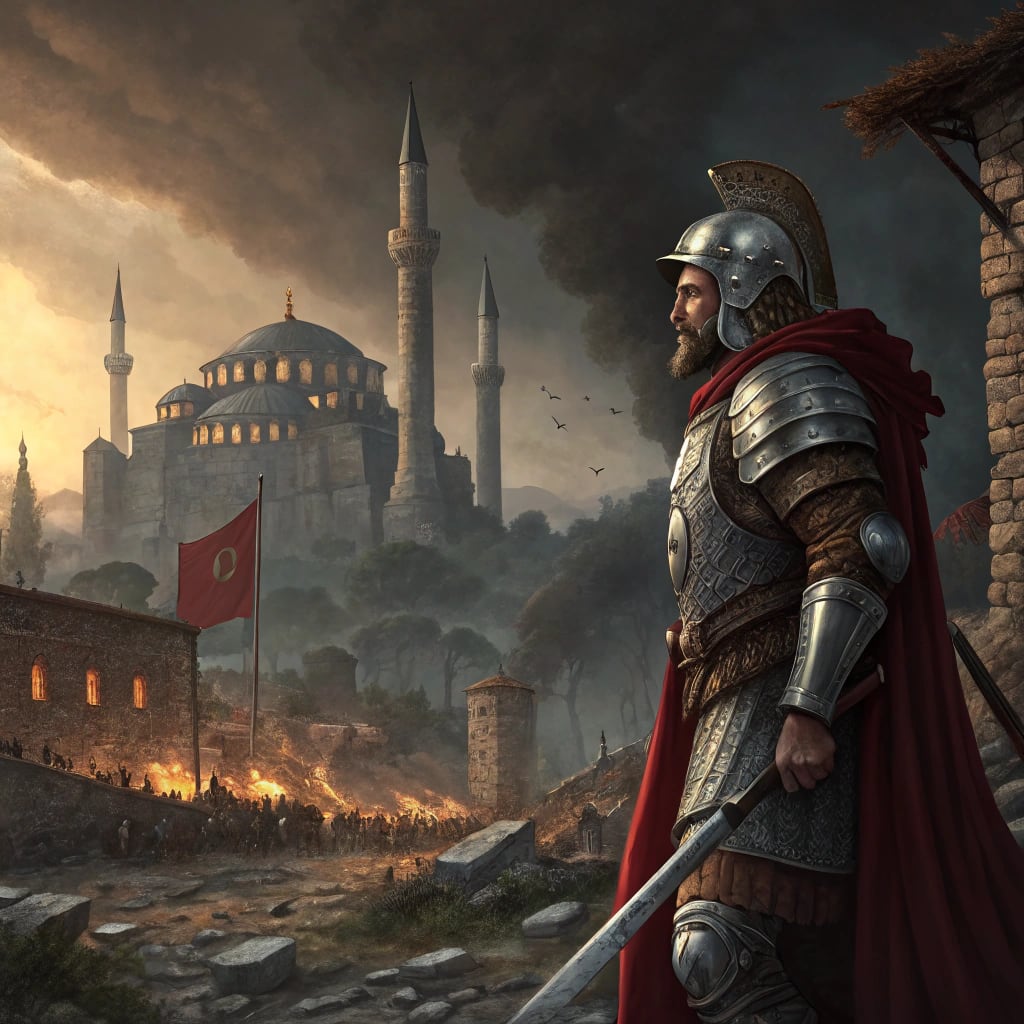
The night of May 28, 1453, was heavy with silence inside Constantinople. The once-great capital of the Byzantine Empire stood on the edge of ruin. For nearly two months, Sultan Mehmed’s army had encircled the city, hammering its ancient walls with cannons and cutting off every hope of rescue. By dawn, the final assault would begin.
Inside the Blachernae Palace, Emperor Constantine XI Palaiologos sat alone. He was not dressed in royal robes but in the simple armor of a soldier. The crown rested on the table before him, untouched. He had worn it with pride for four years, but now he looked at it as if it were a burden.
He knew what awaited him. The Ottoman army was vast—more than 80,000 men. His defenders were barely 7,000. The walls were cracked, the gates were weak, and the people were exhausted. There was no miracle coming, no last-minute rescue from the West. Constantine understood one truth: his empire would not survive the dawn.
Yet, he had a choice. He could flee across the sea, escape to safety, and live out his days in exile as a powerless king. Many urged him to do so. But Constantine shook his head. “I will not live as a king without a kingdom. If the city falls, I fall with it.”
That evening, he rode through the streets of Constantinople. Men, women, and children looked at him with tired, fearful eyes. Some cried, some prayed, others simply watched him in silence. For many, this would be the last time they saw their emperor. He raised his hand to them, not as a distant ruler, but as a man sharing their fate.
When he reached Hagia Sophia, the great church glowed with candlelight. Hundreds of citizens had gathered—Orthodox and Catholic, rich and poor, noble and beggar—united for the first time in centuries. The endless arguments between churches were forgotten; everyone stood together in prayer.
Constantine entered quietly, kneeling before the altar. Tears filled his eyes as the priests chanted. This was not just a prayer for victory—it was a farewell. The emperor took communion with his people, sharing bread and wine with the very citizens he would die defending. One chronicler later wrote: “In that moment, there were no divisions in the city, only Christians awaiting their end.”
After the service, Constantine returned to the palace one last time. He gathered his closest generals and commanders. The candlelight flickered across their tired faces as he spoke.
“Gentlemen, the time has come. Tomorrow we fight not only for the city, but for our faith, our families, and our honor. I thank you all for your loyalty. I have no more wealth or lands to give you, only this: my gratitude. Tonight we prepare, tomorrow we die free men.”
His words struck their hearts like fire. Some wept, others embraced one another, but none wavered.
Before leaving, Constantine did something no emperor before him had ever done. He removed the imperial crown from his head and placed it aside. “God made me emperor of the Romans,” he whispered, “but He did not make me emperor without a people. If they perish, I perish with them.”
When dawn came on May 29, 1453, the sky was red with fire. The cannons roared, shaking the ground as the Ottomans stormed the walls. Arrows rained from above, swords clashed, and cries of battle filled the air.
And in the midst of the chaos, Constantine fought—not as a king, but as a soldier among soldiers. His armor was dented, his sword stained, but he did not retreat. Witnesses later said he fought with the strength of ten men, shouting, “The city is lost, but not our courage!”
Then, somewhere near the Gate of St. Romanus, the emperor disappeared. Some said he was struck down by enemy blades. Others claimed he threw himself into the thick of battle, refusing to be captured alive. His body was never truly identified.
The city fell that day. Hagia Sophia was turned into a mosque. The Byzantine Empire, which had lasted for more than a thousand years, came to an end. But the story of its last emperor lived on.
To his enemies, Constantine XI was a brave foe. To his people, he became a legend—the emperor who chose to die with his city rather than live without it. Centuries later, Greek folk songs still whispered of him, calling him the Marble Emperor, a hero waiting to rise again.
History remembers many kings who fled when their thrones crumbled. Constantine XI was not one of them. His choice on that final night made him immortal, not in victory, but in sacrifice.
About the Creator
Keep reading
More stories from Muhammad Anas and writers in History and other communities.
📖 The Forgotten Prince: The Story of Alexander IV
Son of the man who conquered half the known world, Alexander IV often wondered, “Will I too command empires? Will the shadow of my father ever fade, or will I forever walk beneath it?” History promised him greatness, but fate had written a harsher truth. For in the ruthless game of power, crowns are heavy, and even a child of destiny can be crushed before his time.
By Muhammad Anas 4 months ago in History
Venezuela’s President Under Pressure: Arrest Calls, Indictments, and a Nation at a Crossroads
How the Arrest Narrative Began The idea of arresting Venezuela’s president did not appear out of nowhere. It stems from years of accusations that range from human-rights abuses to corruption and drug-related activities. U.S. authorities have filed formal charges against Nicolás Maduro, linking him to cocaine trafficking networks and large-scale financial misconduct. These cases place him among the few sitting leaders facing active international legal pressure.
By Muhammad Islam khan swati4 days ago in History
How I Learned That Aircraft Structures Are as Critical as Engines
When I first started studying aviation, I believed that engines and avionics defined an aircraft’s reliability. Over time, as I explored aerospace history and manufacturing records, I realized how incomplete that understanding was. Aircraft safety does not depend solely on thrust or navigation systems. It is deeply rooted in structural engineering, certified manufacturing, and the disciplined production of components that passengers never see.
By Beckett Dowhanabout 12 hours ago in History


Comments (1)
Incredible I like it