
The Church of the Silent Light
Where Shadows Speak and Candles Whisper

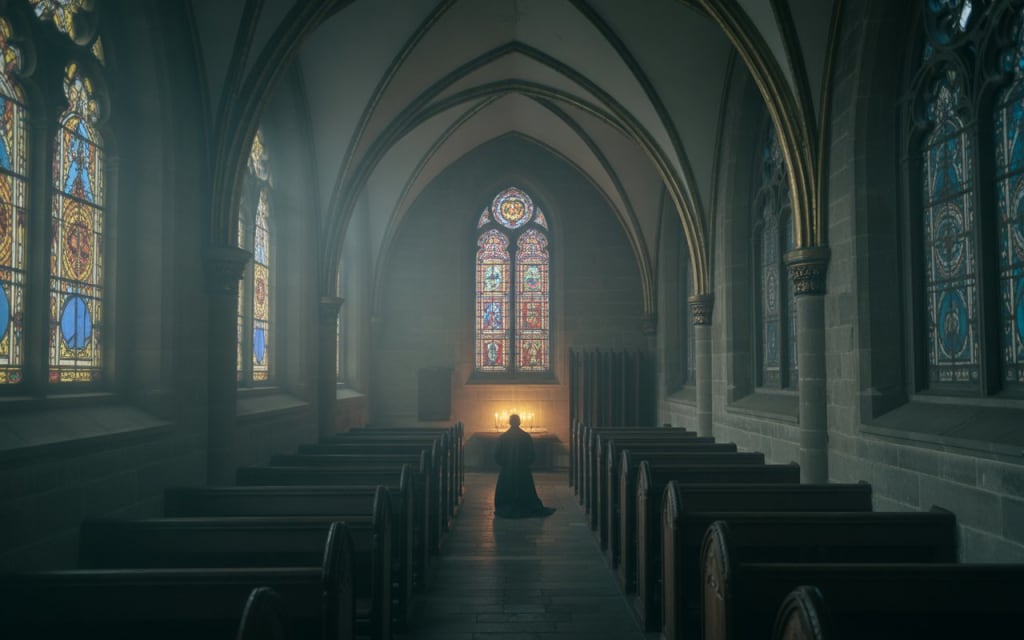
Elara had always been drawn to the strange and unexplained. As a child, she wandered through old cemeteries, explored abandoned mansions, and pored over dusty tomes in her grandmother’s attic. But nothing had captured her imagination like the stories of the Church of the Silent Light—a mysterious cathedral hidden somewhere in the forests of Eastern Europe, where light moved like liquid and shadows held secrets.
The first time she heard of it was in a faded journal she found in Prague, tucked between books about forgotten saints and cryptic rituals. The author wrote of a church that existed out of time, where visitors heard whispers without sound and saw visions without dreaming. Most dismissed it as allegory or superstition, but Elara felt a pull in her chest, a curiosity that refused to be denied.
She traveled to the Carpathian Mountains, following vague maps and fragments of stories passed down by villagers. The forest was thick, dense with pine and mist, and each step seemed to echo with voices she could almost—but not quite—hear. Locals avoided the deeper woods, muttering that the Church of the Silent Light was alive, and that some who entered never returned unchanged.
After days of searching, Elara stumbled upon it. The church was half-hidden by centuries of overgrowth, its spires piercing the fog like fingers reaching for the sky. Stained glass windows shimmered faintly even in daylight, casting surreal patterns onto the ground. She approached cautiously, her heart pounding. The air was still, heavy with the scent of damp stone and candle wax.
Inside, the church was unlike anything she had ever seen. Light flowed in unnatural streams, bending and twisting around columns and arches. Shadows seemed to gather in corners, almost watching her as she moved. She knelt at the altar, feeling a presence that was neither threatening nor comforting—simply aware. It was as though the church itself breathed, pulsing with quiet life.
Hours passed. Elara explored in silence, her footsteps muffled by centuries of dust and decay. She noticed carvings on the walls—figures caught in mid-motion, expressions frozen in a way that made them seem almost alive. Candles flickered without wind, illuminating symbols that she could not read but somehow understood. She realized that the church was teaching without words, guiding her perception, inviting her to see beyond ordinary reality.
One night, she awoke to a faint glow near the altar. Shadows danced in intricate patterns, forming shapes that told stories she had never heard. A soft warmth enveloped her, and she understood the church’s name: the Silent Light was not just illumination—it was awareness. It allowed one to perceive truth without noise, to witness the hidden rhythms of life, and to see what most could not.
Elara spent weeks in the church, meditating and observing. Each day, the visions became clearer. She saw the flow of human history, the rise and fall of civilizations, the quiet acts of compassion and cruelty that shaped the world. The church revealed itself not as a building but as a lens through which one could perceive the hidden threads connecting all life.
She learned to move with the light, letting it guide her understanding rather than forcing her to grasp it. The shadows spoke in subtle gestures—a tilt of a statue’s head, the curve of a painted line, the flicker of a candle. She realized that silence was not emptiness; it was a medium, a way to perceive layers of reality usually unnoticed.
Eventually, she knew it was time to leave. The forest outside had grown darker, the fog curling like fingers around the spires. Yet, as she stepped into the trees, she felt a calm clarity she had never known. The church had not left her; its light lingered in her perception, a quiet understanding of the world’s unseen patterns. She carried it in her thoughts, her actions, and her curiosity.
Back in the village, she shared fragments of her experience carefully, speaking of light, silence, and observation, avoiding claims of supernatural power. Most dismissed her as eccentric. Some listened in quiet awe, sensing that she had touched something extraordinary. And in the quiet of her own mind, Elara understood the truth: the Church of the Silent Light was not a place for everyone—it was a gift for those patient and perceptive enough to see beyond noise and illusion.
Years later, she returned to the edge of the forest. The church was gone, swallowed by mist and trees as if it had never existed. And yet, Elara felt it in every ray of sunlight, every shadow in the corners of a room, every whisper in a quiet night. The Silent Light was not lost; it was alive wherever perception was keen enough to notice.
Elara smiled, knowing that some secrets are not meant to be captured, only lived. And in her heart, she carried the quiet pulse of the church, an enduring reminder that the most profound discoveries often reside in silence, waiting for the attentive to awaken to their truth.
About the Creator
Nusuki
I am a storyteller and writer who brings human emotions to life through heartfelt narratives. His stories explore love, loss, and the unspoken, connecting deeply with listeners and inspiring reflection.
Why Didn't Anyone Tell Us
Men, move along. This is not for you. This is for the women. I was forty-five when I began menopause. It is pretty young for that to be going on in a woman’s life, but I had undiagnosed PCOS, my entire life. Thank you to all the gynecologists I had seen my entire life. That in itself should encourage women to keep seeking second opinions, especially when you are not getting correct answers or any at all.
By Alexandra Grant3 days ago in Humans




Comments
There are no comments for this story
Be the first to respond and start the conversation.