
The Burning of Acadie: The Day the Acadians Were Cast Out
Subtitle: A quiet genocide that turned farmers into refugees—and gave birth to the Cajun soul.
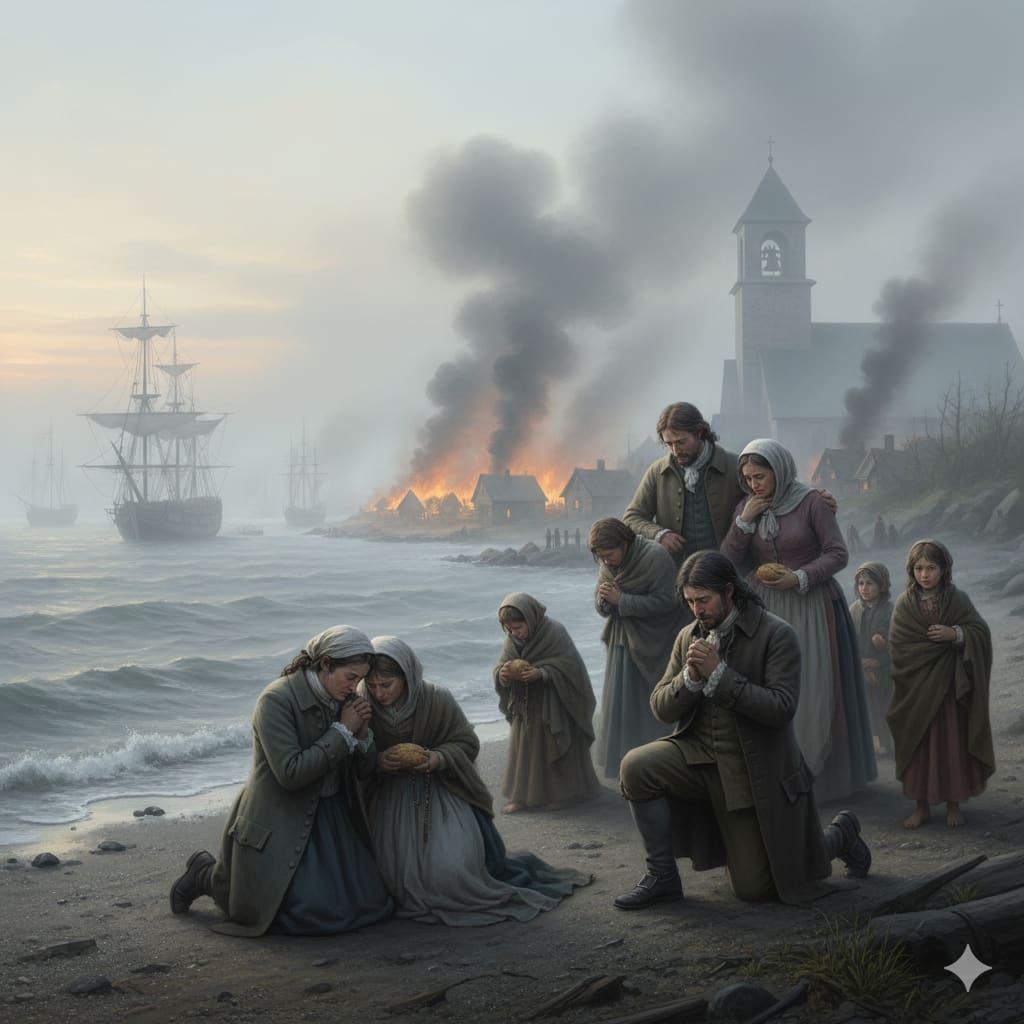
"The untold tragedy that scattered a peaceful people across oceans and centuries".
---
🔔 – The Bell That Called for Surrender
The church bell in Grand-Pré rang that October morning in 1755—not for prayer, but for surrender.
Inside, over four hundred Acadian men stood silent, their hands clasped in disbelief as British soldiers sealed the doors. Outside, wives and children waited in the cold, clutching bread, rosaries, and the faint hope that this was all a mistake.
They had tilled the same fields for generations, turning tidal marshes into farmland. They called this place Acadie. But by sunset, they would be prisoners of an empire that decided they no longer belonged.
---
⚓ A Land Between Empires
The Acadians were French settlers who arrived in the 1600s, long before British flags flew over Nova Scotia. They lived between worlds—speaking French, trading peacefully with the Mi’kmaq, and farming the land with quiet devotion.
When Britain took control of the region, the Acadians swore neutrality. They refused to fight for either side, clinging to peace. But neutrality is a dangerous thing in a time of war.
As tensions rose between France and Britain, Acadian loyalty became a question of empire. “If they are not with us,” said British Governor Charles Lawrence, “they are against us.”
---
🔥 The Day the Fires Began
In September 1755, British troops marched into Acadian villages under orders of deportation. Families were told they would be “resettled” elsewhere in the colonies. In truth, it was exile.
Men were locked in churches or forts. Women and children were loaded onto ships. Homes were burned to the ground—so there would be no reason to return.
Eyewitnesses described the scene in horror:
> “They burned our barns first, then our homes. The sky filled with smoke and wept with ash. We left with nothing but the clothes we wore.”
Over 11,000 Acadians were forced from their homeland. Many never made it to shore again.
---
🌊 The Voyage of Despair
Crammed into the dark holds of wooden ships, the deportees faced hunger, disease, and death. Some ships sank in storms; others were refused entry by colonies unwilling to take them in.
Mothers buried children at sea. Husbands lost wives to fever. Whole families vanished into the Atlantic without a trace.
Those who survived were scattered—from New England to England, from France to the Caribbean. They became a people without a country, ghosts of their own past.
---
🌾 Out of Exile, a New Identity
Decades later, some survivors found their way south to Louisiana, then a French colony. There, amid swamps and cypress trees, they began again.
They built small farms, spoke their old language, and sang the songs they carried from the North. In time, they became known as the Cajuns—a name born from “Acadiens.”
> “We are what was left after the fire,” one descendant said. “But even ashes can bloom.”
From tragedy, they forged a new culture—one of music, resilience, and fierce pride.
---
💭 Remembering What Was Lost
The Expulsion of the Acadians remains one of history’s quietest genocides. There were no grand monuments, no famous battles—only families erased by paperwork and politics.
And yet, their spirit survived. Today, Acadian and Cajun communities keep the memory alive through festivals, songs, and storytelling. Each October, the bell at Grand-Pré rings again—not for surrender, but remembrance.
---
🌅 Reflection
History is filled with wars and empires, but what endures are the stories of the displaced—the ones who carried their homes within them.
When we read about refugees today, when we see families forced to flee, we are reading echoes of 1755. The Acadians remind us that exile does not end a people; forgetting them does.
About the Creator
Keep reading
More stories from Muhammad Anas and writers in History and other communities.
No ICE, No KKK, No Fascist USA
"I don't 'do' politics." Politics will do you, regardless. Watching from the sidelines for the last year I can see far too many similarities in the way Trump's ICE Gestapo is to Nazi Germany. Considering the United States just invaded Venezuela and kidnapped their President and his wife I would say we are there.
By Lyvia Jack5 days ago in History
3 Moments When Reality Accidentally Became a Horror Movie
Horror movies usually rely on a simple agreement with the audience: this could never really happen. Ghosts follow rules, monsters have weaknesses, and there’s always a clear point where reality hands the story over to fiction. Real life, unfortunately, does not care about narrative structure, logic, or closure.
By Enoch Sagini4 days ago in History


Comments
There are no comments for this story
Be the first to respond and start the conversation.