
The Boy Who Painted the War in Color
In the shadows of WWII, a young artist risked everything to reveal the truth

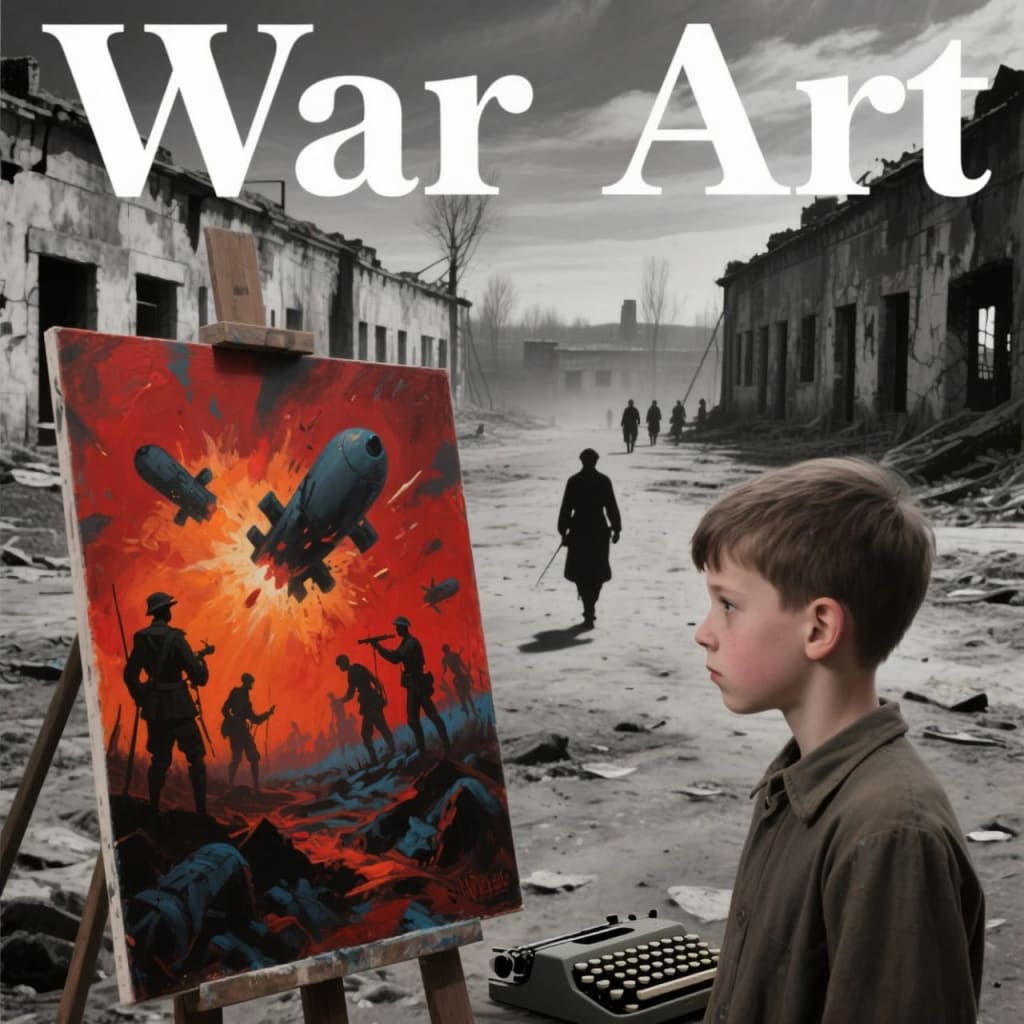
Somewhere in the forgotten attics of Europe, hidden between faded letters and crumbling photographs, there are whispers of a boy who painted the war — not in black and white, like the newspapers showed — but in wild, searing color.
His name was Emil Kovács.
Born in Budapest in 1927, Emil was the kind of child who saw the world differently. While bombs fell and sirens wailed, while soldiers stomped heavy boots through the cobbled streets, Emil sat in a corner with a stub of pencil, sketching not what he feared — but what he imagined. His mother said he had "the eyes of an old man and the soul of a poet."
When the Nazis swept through Hungary in 1944, life as he knew it cracked apart. Friends disappeared overnight. Teachers stopped showing up. His father, a quiet bookseller, was dragged from their home one morning and never returned. At just seventeen, Emil was forced to fend for himself and his fragile mother, hiding in basements and abandoned buildings, stealing what little food he could find.
But through it all, he kept drawing.
At first, it was simple — scenes from memory: summer days by the Danube, his mother’s face, a market square full of life. Then, as the darkness pressed harder, his sketches changed. He began documenting what he saw: a boot crushed into a child's toy, a wagon overloaded with terrified families, soldiers laughing under a noose.
But Emil didn’t just sketch the horrors.
He painted them.
Stealing pigments from bombed-out art supply stores and trading for scraps of canvas, he turned the bleak terror into something devastatingly vivid. A train station painted in a violent, bleeding red. The hunched figures of refugees in bruised purples and sickly yellows. The sky over Budapest, not grey — but a churning storm of angry green and black.
He didn't sign his paintings. He left them tucked into alleyways, pinned to the walls of abandoned buildings, slipped between the pages of discarded books. No one knew where they came from — only that they captured the unspoken truth of the war better than any photograph or official report ever could.
People started whispering about "the boy who painted the war."
It was dangerous work. In Nazi-occupied Hungary, spreading "defeatist propaganda" was a death sentence. But somehow, Emil evaded capture. Or perhaps no one could believe that a skinny teenager with ink-stained hands could wield such defiance.
Until the wrong painting fell into the wrong hands.
One rainy March evening in 1945, a German officer stumbled across one of Emil’s pieces — a brutal, haunting portrait of a soldier gloating over a mass grave. Furious, the officer ordered a sweep of the area, vowing to find the "degenerate" responsible.
Word spread fast.
Friends urged Emil to run. His mother begged him to destroy his work. But Emil refused. He believed that if people could see — truly see — the reality they were living through, they might finally find the strength to resist.
That night, Emil packed his few belongings and left their shelter, a roll of his paintings under one arm. He said he was going to deliver them to a contact — a resistance leader rumored to have a safe passage out of the city.
He never returned.
His mother waited for days, then weeks. When the Soviets finally liberated Budapest, she scoured the city. No body was ever found. No paintings either.
Emil Kovács vanished as if swallowed by the very darkness he had fought to reveal.
For decades, his name was almost forgotten — until, in 1997, during the restoration of an old cathedral near the Danube, workers discovered a hidden compartment behind a crumbling wall.
Inside were dozens of rolled-up canvases.
They were unsigned, but there was no mistaking their origin. Art historians and survivors alike immediately recognized the brutal beauty — the unflinching color — of the Boy Who Painted the War.
Today, some of Emil’s paintings hang in the Budapest Museum of History. Others travel between exhibitions on wartime art, often labeled simply as “Unknown Artist.” But those who know the story — those who remember — whisper his name under their breath like a prayer.
In a world desperate to move past its ugliest moments, Emil Kovács refused to let the truth be forgotten.
Not in black and white.
Not in fading headlines.
But in bold, blistering, unforgettable color.
And though he disappeared without a trace, every brushstroke he left behind still shouts:
"I was here. I saw. I remembered."
About the Creator
Muhammad Sabeel
I write not for silence, but for the echo—where mystery lingers, hearts awaken, and every story dares to leave a mark
Keep reading
More stories from Muhammad Sabeel and writers in History and other communities.
Why We’re Still Obsessed with 90s Nostalgia
The 1990s: a decade of neon scrunchies, dial‑up tones, grunge music and VHS tapes. In 2025 it seems odd that today’s generation—born well after the 90s ended—are enveloped in nostalgia for an era they barely (or never) experienced. From reboots of Friends to resurgence of cassette tapes and flannel shirts, the 90s persist in pop culture. But why? Why does 90s nostalgia grip us so deeply—even two and a half decades later?
By Muhammad Sabeel8 months ago in History
What St. Patrick’s Day Really Means: A Story Woven in Green and Shadow
What St. Patrick’s Day Really Means: A Story Woven in Green and Shadow St. Patrick’s Day comes each year like a familiar tune drifting down a long corridor of memory. The world dresses itself in green, the fiddles come out, and laughter rises from places that have forgotten why the day mattered in the first place. For many, it has become a carnival of noise, a blur of beer and novelty hats, a holiday flattened into something loud and careless. But beneath that surface lies a story older than the parades, older than the pubs, older even than the feast day itself. It is the story of a people who carried poetry in their bones and sorrow in their pockets, who crossed oceans with nothing but hope, and who built new lives in places that did not always welcome them. To understand St. Patrick’s Day, one must listen for the heartbeat beneath the noise, the quiet rhythm of endurance that has always defined the Irish spirit.
By Julie O'Hara - Author, Poet and Spiritual Warrior5 days ago in History



Comments
There are no comments for this story
Be the first to respond and start the conversation.