
The Boy from the Black
The Short, Bitter, and Undeniably Strange Story of Kaspar Hauser


It has been observed by no less an august personage (not to mention an expert on occult matters) than the late John Alva Keel, that flying saucer "occupants" (UFO entities and "aliens") used to be seen to "stagger" from their vehicles, as if drunk. Why this should be the case is puzzling, but an equally alien entity or personage, one of a strange and befuddling character, staggered into Nuremberg, Germany in 1828, not, seemingly, having had any origin in the common world. (Like UFO occupants, it is said he had "a staggering gait.")
A policeman spotted him (or sentry, or whatever the hell they considered these guys to be in Germany in 1828) and took him in to the station. He tried to pick a flame off the end of a candle, and had seemingly never tasted any food beyond bread and water. He repeated endlessly, "I want to be a soldier like my father." Odd. Who in the hell was he, they wondered.
He produced two letters. One of them urged them to send the boy on so he could join the army, or his "regiment" (this was addressed to a 'Captain von Wessening, of the 4th regiment, sixth cavalry').
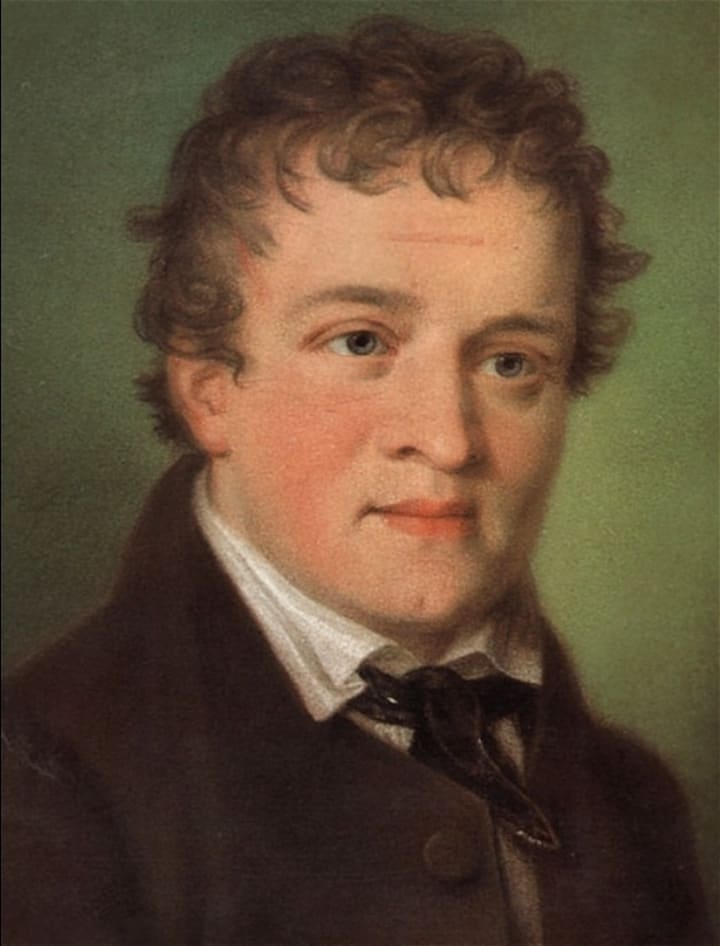
Thus, one supposes, he could finally become "a soldier like my father." The other missive was poorly written, and basically claimed to be from someone who had cared for the boy but could no longer do so. He was, approximately, sixteen or eighteen years old. Perhaps. (One of the letters gave his birth as April 30th, 1812. This would have made him around fourteen, if true. April 30th, of course, is Walpurgisnacht, which is the high, unholy day for Satanists and black magicians since time immemorial.)
His clothing was that of a vagrant. He had, apparently, never viewed his own reflection in a mirror, staring at it in wonder. As previously noted, he walked with a staggering gait.
A Dr. Daumer took him in. When asked his name and given a pen and paper (the notes he was carrying were written on a curious kind of vellum no one had ever seen before), he wrote, in a legible and slow script: KASPER HAUSER.
And thus began what, according to the monument erected upon his death, was "The riddle of our times."
Dr. Daumer took the strange, infantile tramp in and taught him, and discovered his curious talent for drawing. Of his origins, Kasper Hauser could only state that he had been "raised in total darkness." It was a dungeon-like place where he was brought food by a mysterious man in a "green uniform." The man taught him reading, writing, and the Christian religion, but had never let Kasper Hauser see his face. Finally, inexplicably, he released him. Surely to die of exposure had he not managed, by hook or by crook, to make his way to Nuremberg in May of 1828.
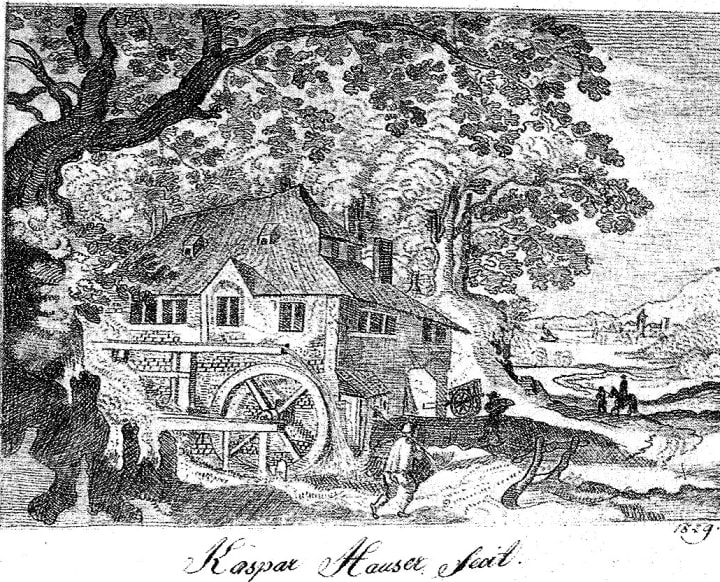
(The letter, incidentally, invited the Reader to either take Hauser in or "hang him.")
Hauser was sent to a prison for a short time, cared for by the jailer, before being given the custody of Daumer. From the custody of daumer, over the next five years, he lived with a succession of hosts: a Biberbach, a Lord Tucher, a man named Stanhope, and finally a man named Meyer.
Daumer, who had regarded Hauser as some sort of scienific wonder of the age, performed experiemnts on him, upon which Feurerbach, the famed philospher stated,
"When Professor Daumer held the north pole [of a magnet] towards him, Kaspar put his hand to the pit of his stomach, and, drawing his waistcoat in an outward direction, said that it drew him thus; and that a current of air seemed to proceed from him. The south pole affected him less powerfully; and he said that it blew upon him."
It was in 1829 that Hauser was found bleeding from a mysterious headwound, inflicted, or so he claimed, by a "hooded man" (always an ominous sign), whom he identified as the masked man who had cared for him since birth (who gave him rye bread and water, cut his hair and nails, and taught him, somehow, while confining him in total darkness). Skeptical persons in Nuremberg whispered that Hauser had self-inflicted the injury to incur sympathy. All very, very strange.
The Gunshot Wound
Kasper was not well-liked by any of his hosts, who complained of his "petty vanity," and compulsive lying, although no concrete examples of this seem to ever be given. One commentator referred to him as a "charlatan." Perhaps the young vagabond was simply trying to incur sympathy to win a free lunch, as it were; room and board and fame and adulation while he was pampered and cared for.
Suspected by some of being the deposed ruler of the House of Baden, in Hungary, Lord Stanhope, one of his last patrons, took him to tour Hungary. Alas, the bleak rocky landscape abutting the mystical and picturesque Carpathians jogged no memory from the boy, who seemed to have emerged, full-blown, from some "land beyond" no one had ever mapped.
Kasper was shot while sitting on the privy. His explanation for this (a rather superficial head wound that some doubted had even been made by a gun), was that he was reaching for something and "accidentally" grabbed the gun, causing it to discharge quite close to his head.
Unlikely some considered. And some murmured he had self-inflicted the wound, "for sympathy's sake." More curious still.
His final caretaker, a man named Myer, ended up loathing Kasper, as really, everyone who was associated with him ended up doing. Beyond his bad personal behavior though was a pudgy-faced, strange young boy who seemed desperate for answers as to who he exactly was.
It was on December 14th, 1833 that those questions, at least for Hauser, came to an abrupt end. While arguing with Meyer about possibly leaving Ansbach (where he was now living), and going with Lord Stanhope to visit England, Hauser returned to Meyer's home covered in blood, apparently from a deep chest wound.
Hauser claimed (though, now, everything he said was taken as suspect due to his compulsive prevarications), that a "strange man" in a had lured him to a nearby park and then tried to kill him. Upon investigation, a note was found, written in mirrored or reverse lettering, stating,
"Hauser will be able to tell you quite precisely how I look and from where I am. To save Hauser the effort, I want to tell you myself from where I come _ _ . I come from from _ _ _ the Bavarian border _ _ On the river _ _ _ _ _ I will even tell you the name: M. L. Ö."
Curiouser and curiouser still.
This was contained in a small, violet-colored pure Hauser said the man gave him.
Three days later, on December 17th, 1833, Kasper Hauser perished of his, perhaps, self-inflicted wound. Whatever secrets he carried into our world he took with him to his premature grave.
The Man From Taured and the Mandela Effect
Kasper Hauser's claims and the theories about his origins are suspect still. A DNA examination indicated that despite popular legends about him, he was, in point of fact, NOT a deposed relative of the Royal House of Baden. Nor did he, apparently, have Hungarian antecedents.
A small vaccination scar for smallpox seemed to disprove the claim he made about being raised "totally in isolation," as he would have had to have been taken to a vaccination center during the epidemic.
But theories of his origins prove even stranger.
Some posit he was, quite literally, from an alternate dimension, another world, one close enough to our own, but separated by the thin veil of illusion. A sort of variation in another dimension, the shift or doorway being, perhaps the "liminal space" of the empty alleys of Nuremberg that evening in May 1928. And did his mysterious assailants chase him from this strange alternate world, through the yawning doorway, to somehow "correct" the schism or paradox by literally killing him?
Is there another reality in ever shifting mirrored realities, sharing the "multiverse" alongside our own. Physicists postulate that there must be another "you" out there somewhere, in an infinity when all infinite possibilities must independently, variably arise from the Universal Consciousness.
The so-called "Mandela Effect," so-named because a certain segment of the populace believed they had heard, or had a memory of, South African President Nelson Mandela having died in prison when, in fact, he was still alive.
(Still other examples include the character image on the Monopoly Board gameboard having had a monocle; the character never did. Or there being a "Jiffy" brand of peanut butter; it is called "Jiff." These are just small examples of course. This author, recently, was struck again by the fact that he thought, for years, that Stephen King's novel The Shining ended with the line "...and he was still sitting there when Spring came," referring to the ending wherein the character of Jack Torrance [played so incredibly in a classic camp performance by actor Jack Nicholson] freezes to death while chasing his son Danny through the hedgerows during a blizzard. In fact, the novel, unlike the movie, ends with the Overlook Hotel literally exploding when the boiler overheats. Again, a small example of the Mandela Effect, but, an example nonetheless.)
The legend of the "Man From Taured" is as close as we can come, perhaps, in modern times, to the Kasper Hauser saga. Sometime in the late 1950s it is said, a mysterious man entered a Tokyo airport (an airpot being another "liminal space," wherein embodied souls are coming and going to their respective spots, neither "here nor there", but in transit, their fates "becoming").
This man presented a passport the likes of which mystified authorities. He claimed to be from a country no one had ever heard of, and he pointed to it on a map — a place that, to his bafflement, did not exist in our world. His documents were authentic, his demeanor was confident, yet no record of Taured existed anywhere. He was detained, placed in a hotel room under guard, and by morning, he had vanished without a trace, as if he had never existed.
This mirrors the fate of Kasper Hauser— a young man whose origins were unclear, whose presence defied conventional explanation, and whose untimely death left behind more questions than answers. Both cases suggest the possibility of transient individuals slipping through the cracks of reality, their sudden arrival and disappearance reminiscent of some cosmic error being corrected.
Could Kasper Hauser have been a "glitch" in our reality? A man displaced from another timeline or dimension, a being whose very presence was a mistake that had to be rectified? If so, did his death serve to restore balance?
Or was he simply an unfortunate soul, abandoned and exploited by those who sought to mold his mystery into their own narratives? Perhaps he was merely a lost boy with an embellished past, whose tale grew in mythic proportion over time.
Regardless of the truth, Kasper Hauser remains an enigma— a riddle that straddles the boundary between history and folklore, between conspiracy and reality. His story persists, tantalizing us with its unanswered questions, and leaving us to wonder whether he was, in fact, a stranger from a world just beyond our reach.
Endless variations on a theme, in the Universal Mind. Infinite possibilities stretching out to a point that could never be quantified by the mind of man. "A picture, of a man painting a picture, of a man painting a picture," going on FOREVER.
And forever might be nearer than we surmise.
Good day.
About the Creator
Tom Baker
Author of Haunted Indianapolis, Indiana Ghost Folklore, Midwest Maniacs, Midwest UFOs and Beyond, Scary Urban Legends, 50 Famous Fables and Folk Tales, and Notorious Crimes of the Upper Midwest.: http://tombakerbooks.weebly.com
Chinese Water Torture
Since the dawn of history, human beings have inflicted unimaginable suffering upon one another. Across centuries, people have devised increasingly elaborate methods of punishment and coercion, some brutally explicit, others deceptively subtle. While devices such as iron maidens, racks, whips, and wheels relied on visible physical agony, there existed a form of torment whose true power lay not in blood or broken bones, but in patience, repetition, and the slow erosion of the mind. This method came to be known as Chinese water torture.
By Pure child2 days ago in History
Saddam Hussein: Rise, Rule, and Fall
Saddam Hussein was born on April 28, 1937, in a small village near Tikrit, Iraq. His early life was marked by poverty, hardship, and a sense of abandonment. His father died before he was born, and his mother remarried soon after. Young Saddam grew up in a household dominated by strict relatives and was exposed to political discussions and nationalist sentiments from an early age. These formative years shaped his personality—ambitious, ruthless, and fiercely determined to rise above his modest beginnings.
By The best writer 2 days ago in History
The Devil's Cut
“Comrade, finally you’re awake.” The voice was smooth, sensual. A flickering incandescent bar was all that lit the white, sterile room. All Vladimir remembered was everything going black. He tried to move his arms and found them strapped to the gurney.
By Matthew J. Fromm5 days ago in Fiction


Comments (1)
Why, to me it's as plain as the nose on either of our faces: Kaspar Hauser is the ghostly distant relative of Doogie Howser, though apparently not nearly as friendly or cheerful as the comics would have us believe. Fascinating story.