
The Birth of a Nation: A Story Etched in Ink
How Courage, Unity, and a Simple Piece of Paper Changed the World

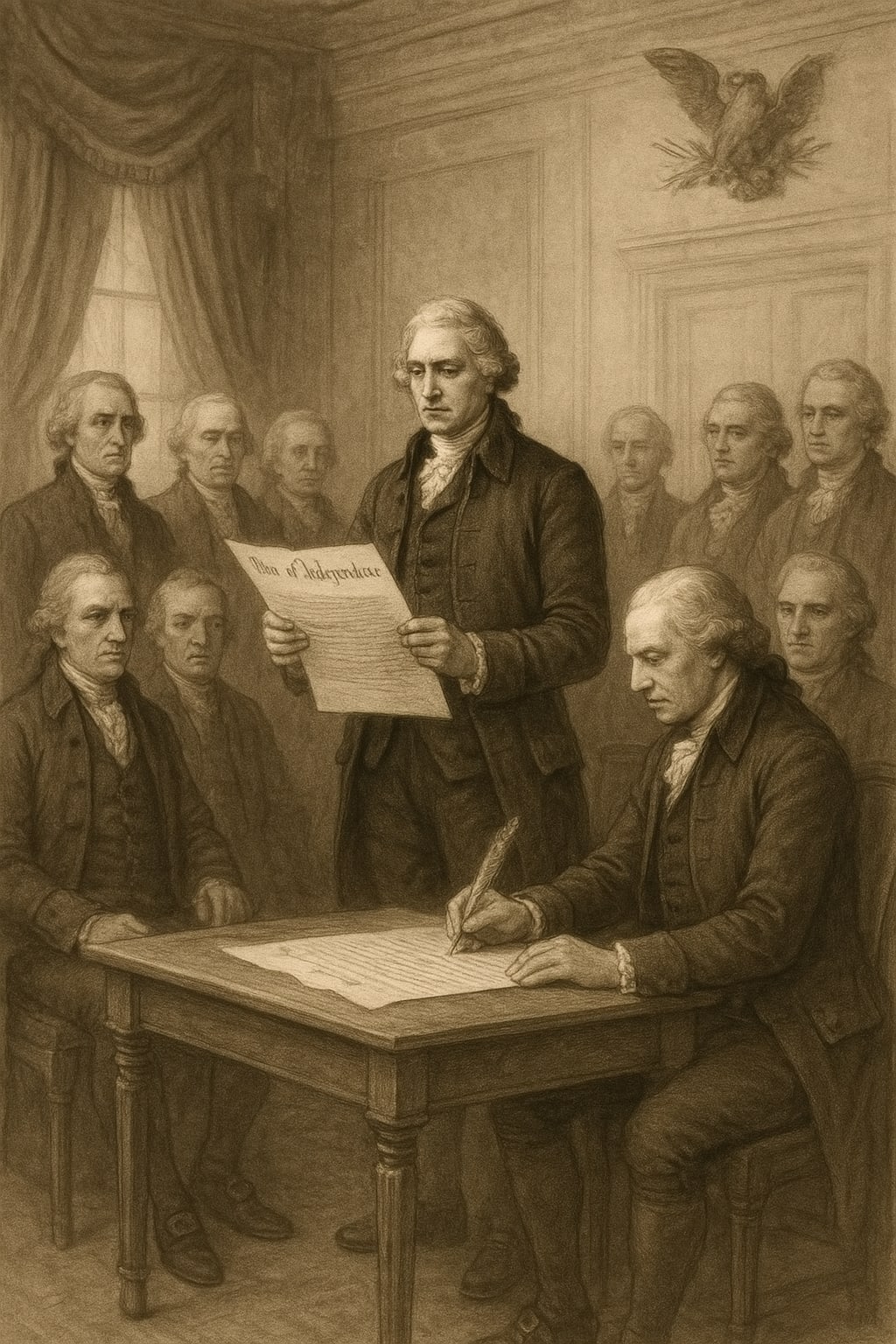
History is not merely about dates and events—it is about the quiet courage of individuals who dared to dream beyond their time. The sepia-toned image of America’s founding fathers, gathered around a wooden table as they crafted and signed the Declaration of Independence, captures one such defining moment. It is more than just an artistic portrayal; it is the visual embodiment of sacrifice, vision, and unity.
The year was 1776. The colonies had long endured the weight of British rule—taxation without representation, restricted freedoms, and a constant sense of being silenced. But whispers of resistance had grown louder, turning into a unified cry for liberty. It was in this charged atmosphere that leaders from across the colonies convened, not just to discuss rebellion, but to build the foundations of a new nation.
In the image, one man stands, document in hand, reading aloud words that would echo through the centuries: “We hold these truths to be self-evident, that all men are created equal…” His voice, though trembling with the gravity of the moment, carried the hopes of millions who longed for freedom. Around him, others leaned in—some with solemn expressions, some with quiet resolve—each man aware of the risk they were taking.
For this act was not simply political; it was treason. Signing the Declaration of Independence was, in the eyes of the British Crown, punishable by death. Yet they signed. One by one, with quills pressed into parchment, they etched their names not just into history but into the soul of a nation yet to be born.
The table at which they sat was ordinary, the ink they used unremarkable, but the courage behind every stroke of the pen was extraordinary. It is this duality—the simplicity of the scene and the enormity of its consequence—that makes the image so powerful.
The men in the picture were not perfect. They were flawed, burdened with contradictions of their time. Some owned slaves even as they proclaimed freedom. Some doubted whether the colonies could truly stand alone. Yet, despite their shortcomings, they chose unity over division, belief over fear. Their signatures symbolized not just their agreement with the text but their willingness to risk everything for the possibility of a better tomorrow.
What followed was years of hardship—the Revolutionary War, battles lost and won, sacrifices made on fields and in homes. But the foundation had been laid. That piece of parchment, born from candlelight debates and sleepless nights, became the cornerstone of the American identity.
Looking at this image today, it is easy to see it as a frozen moment, far removed from our modern world. Yet, the essence of that gathering still speaks to us. It reminds us that change often begins in quiet rooms, with ordinary people daring to write extraordinary words. It reminds us that unity does not require perfection but a shared vision. And most importantly, it reminds us that freedom is never given—it is claimed.
For Vocal Media readers, this story is not just about America’s independence. It is about the universal struggle for self-determination. Across centuries and continents, people have gathered in similar ways—around tables, in hidden rooms, or even in open squares—to declare their right to live free. The power of ink, of words spoken and signed, has moved empires, toppled regimes, and given birth to nations.
As we reflect on this picture, we must ask ourselves: what are we willing to sign our names to today? What causes, what ideals, what dreams are worth risking everything for? History is not just behind us; it is waiting to be written in front of us.
The men in the image could not have known the full impact of their actions. They did not know if their new nation would survive, if their words would endure. Yet they signed anyway, guided by hope. That is the legacy of the Declaration of Independence—not certainty, but courage in the face of uncertainty.
More than two centuries later, the sepia-toned moment remains alive. The parchment may have faded, the ink may have aged, but the spirit it captured continues to inspire. It is a reminder that sometimes, the most powerful revolutions begin not with armies, but with pens.ù
About the Creator
Keep reading
More stories from Fazal wahid and writers in History and other communities.
Mumdani vs Donald Trump: The Clash of Two Worlds
In a world increasingly shaped by political extremes, cultural divides, and clashing ideologies, few imagined that two figures from vastly different worlds — Maulana Fazlur Rehman (often called “Mumdani”) and Donald J. Trump — would ever share a headline. Yet, the symbolic face-off between the Pakistani religious leader and the American business tycoon-turned-politician captures something much larger: the confrontation between East and West, faith and capitalism, morality and power.
By Fazal wahid 2 months ago in History
Power's Sake
When it comes to gaining power, bad people use it to gain more They never gain power to do something with it, they gain power to have it, relish in it, double it down on itself so it grows exponentially and never goes anywhere. Even if you see the people in power commit an atrocity, that is never the true goal. It is a deplorable action for sure but the action itself usually doesn't matter it's the outcome.
By Donny Foley4 days ago in History

Comments
There are no comments for this story
Be the first to respond and start the conversation.