
Age Against Love: The Story of Agatha Christie
She was famous, he was young. And yet…

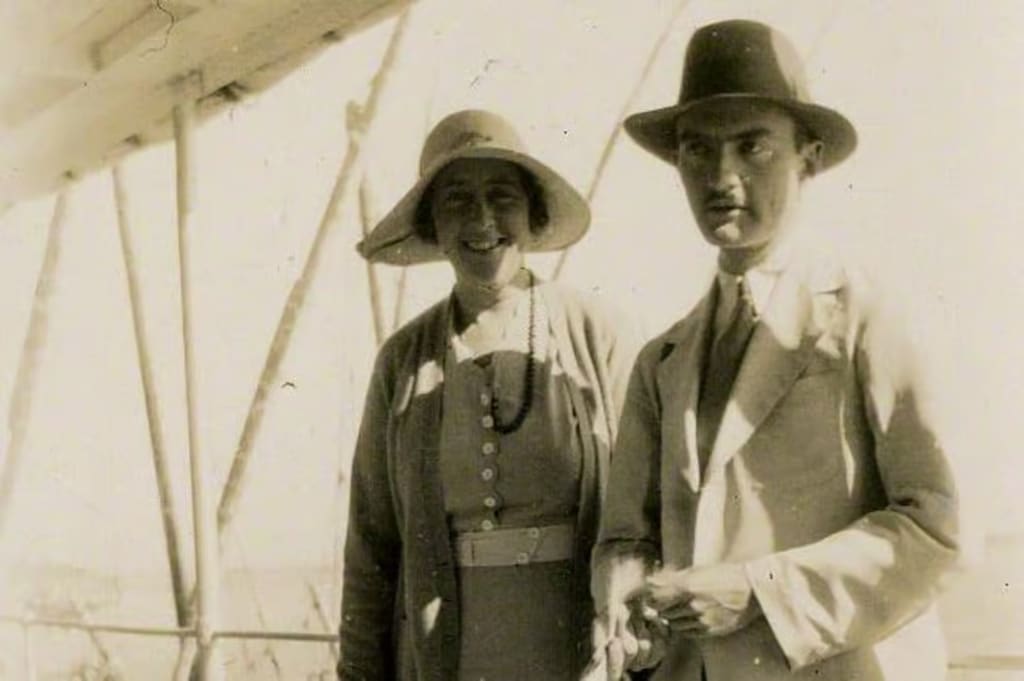
She was forty, divorced, and already celebrated. He was twenty-six and working in the Iraqi desert. When he asked her to marry him, she kept saying “No” for two full hours — until she finally said Yes.
Together they proved the world wrong.
March 1930. The ancient city of Ur, in what is now Iraq — the cradle of civilization.
Agatha Christie, by then one of the world’s most famous detective writers, stood among ruins four thousand years old, trying to piece herself back together.
Four years earlier, her first husband had asked for a divorce. The scandal nearly broke her. She vanished for eleven days. They found her in a hotel under a false name, claiming amnesia. The British tabloids turned her private pain into a public puzzle everyone wanted to solve.
Now, at forty — considered almost middle-aged by the standards of the 1930s — she traveled alone to Baghdad, seeking escape, sunshine, and perhaps some peace among monuments that had outlasted millennia, far longer than any marriage.
There she met Max Mallowan.
He was twenty-six, an assistant archaeologist tasked with guiding visitors. Young, charming, passionate about his work. He showed Agatha the dig site and explained pottery shards and ancient ivories with such enthusiasm that four-thousand-year-old civilizations suddenly felt alive.
They talked archaeology, literature, history. She was fascinated by his work — the patient reconstruction of lost worlds from fragments. He was captivated by her wit, her intelligence, her gift for spinning stories from the tiniest details.
Age seemed irrelevant when they stood in the shadow of ziggurats that had outlived them both by four thousand years.
When the excavation season ended, Max visited Agatha and her daughter Rosalind in Devon. On his second evening there, during a walk across rain-soaked moors, he proposed.
Agatha said "No" immediately.
For two hours they argued in the rain.
The age gap terrified her. She was forty, divorced, with a teenage daughter; her reputation was only just recovering from the divorce scandal. He was twenty-six, at the beginning of a promising career. People would talk. People would judge. They would say she was mad, desperate, foolish. They would say she was “stealing his youth,” that he would leave her when she grew old, that such a relationship was doomed.
“It won’t work,” she insisted. “You’ll regret it. I’m too old for you.”
But Max wouldn’t budge. The fourteen-year difference didn’t bother him. Society’s opinion didn’t bother him. He saw her — brilliant, creative, adventurous, wounded but healing — and he knew.
He didn’t care about convention. He cared about her.
Agatha’s sister Madge was firmly against the marriage. Her daughter Rosalind and her secretary Carlo supported it. The family debated. Society would certainly judge — a famous older woman marrying a much younger man was a scandal in 1930.
But somewhere during those two hours of arguing on the Devon moors, with rain soaking their clothes and Max refusing to accept her fear as an answer, Agatha made the decision that shaped the rest of her life.
She chose happiness over convention. She chose love over fear.
In September 1930, just six months after they met, Agatha Christie and Max Mallowan married quietly.
The world raised its eyebrows. Whispered. Gossiped. The tabloids feasted again. “She’s too old.” “He’s too young.” “It won’t last a year.”
They proved everyone wrong — for 46 years.
Their marriage became one of the most remarkable partnerships in literary and archaeological history. Every autumn and spring they traveled to the Middle East for digs in Syria and Iraq. Agatha wasn’t just a tourist or a bored wife — she became an indispensable part of Max’s team.
She was the official photographer on every excavation, developing prints herself in makeshift darkrooms under the desert sun. She discovered an unexpected talent for restoring ancient fragments — piecing together thousand-year-old shards with the same patience she used to craft detective plots.
Max later wrote: “Agatha’s disciplined imagination came to our rescue” when saving fragile artifacts. Famously, she used her Innoxa face cream to clean ancient ivories, then complained: “There was such a rush on my face cream that I had none left for my poor old face!”
But their partnership went deeper than archaeology.
When World War II separated them — Max serving with the RAF in North Africa while Agatha worked in a London hospital pharmacy — they wrote to each other every day. She told him she missed him with “a twisting feeling inside.” He said he felt “a sort of emptiness, like hunger.”
They shared theories. She discussed plots with him. They argued about theater, literature, geology. They were intellectual equals, creative partners, best friends who were also husband and wife.
During their Middle Eastern adventures, Agatha wrote some of her greatest works: Murder on the Orient Express (1934), Death on the Nile (1937), Appointment with Death (1938), and Murder in Mesopotamia — the last set on an archaeological dig, where anyone in their circle could guess which characters were based on real people.
She described their marriage as “parallel railway lines, each needing the other close by, but never quite merging.” Two separate but essential tracks running side by side toward the same destination.
Max became one of the leading archaeologists of his generation, a specialist in the ancient Near East. In 1968 he was knighted for his services. Agatha was made a Dame Commander of the British Empire in 1971.
Sir Max and Dame Agatha — a partnership built on mutual respect, shared passion, and genuine love. A relationship no one expected when a forty-year-old divorced woman married a twenty-six-year-old archaeologist.
In his memoirs, Max wrote something that captures their entire marriage: “Few men know what it is to live in harmony beside an imaginative, creative mind that gives life its spark.”
He never regretted marrying an older woman. He never felt he had sacrificed his youth. He considered himself lucky to have found her.
When Agatha Christie died on January 12, 1976, at age 85, she had lived an extraordinary life. She wrote 66 detective novels, 14 short story collections, and The Mousetrap — the longest-running play in the world. She traveled the globe, took part in excavations of ancient civilizations, and created characters that would outlive her by generations.
But perhaps her greatest achievement was simpler: she chose love when the world told her not to. She risked happiness when fear seemed safer. She said yes because sometimes the bravest thing is believing you deserve joy.
Max Mallowan died just two years later, on August 19, 1978, at age 74. They are buried together in the churchyard of St Mary’s in Cholsey, Oxfordshire. Their shared headstone bears their initials — A and M — intertwined in an elegant ligature, forever linked.
A forty-year-old divorced writer and a twenty-six-year-old archaeologist proved that age is just a number when two souls recognize each other. That society’s expectations carry far less weight than personal courage. That the wisest choice isn’t always the safe one — sometimes it’s stepping into the unknown and arguing in the rain for two hours until you realize the person in front of you is worth the risk.
In her autobiography, Agatha wrote that the days spent with Max on archaeological sites were “some of the happiest and most perfect I have ever known.”
For a relationship everyone said wouldn’t last a year, not bad at all.
They were given a full 46 years. Forty-six years of digs and manuscripts, desert adventures and London winters, arguments and laughter and the quiet contented companionship of two people who chose each other against all advice.
When Max proposed in the rain and she said no, she was protecting herself from more pain, more scandal, more judgment. When she finally said yes two hours later, she chose something more important than safety.
She chose life.
Love doesn’t consult calendars or birth certificates. It doesn’t care what’s conventional or what people will say. It asks only whether you have the courage to say yes when everyone else says no.
Agatha Christie had that courage. Max Mallowan had the patience. And together they showed that the best mysteries aren’t always solved — they’re sometimes simply lived.
About the Creator
Keep reading
More stories from writers in Writers and other communities.
Nine Souls for a Bloody Mary
If you think back to the autumn into winter challenges, you may remember that I found the villanelle challenge psychologically abusive and you may have accepted a free pass to my insanity show in one of these pieces. (Fuck you, Vocal, for that villanelle of regret challenge. I hope it was as torturous for the team to read them as it was for me, as it's only fair to reap what you sow. (Parentheses intentionally left open. Did it again.
By Harper Lewis5 days ago in Writers
Affection and Healing for Yourself
During the night of the last quarter moon, I gathered my ritual supplies. I carefully handled the chunk of black tourmaline that would protect me from your overall negative and narcissistic energy. I carefully walked the house with my stick of selenite in hand, asking the universe to cleanse our working space.
By Alisha Wilkins ✒️🦋🖋️7 days ago in Fiction




Comments
There are no comments for this story
Be the first to respond and start the conversation.