
The Battle of Thermopylae: Spartans vs. Persians
Legendary Standoff: Spartans Defending Thermopylae Against the Persian Onslaught
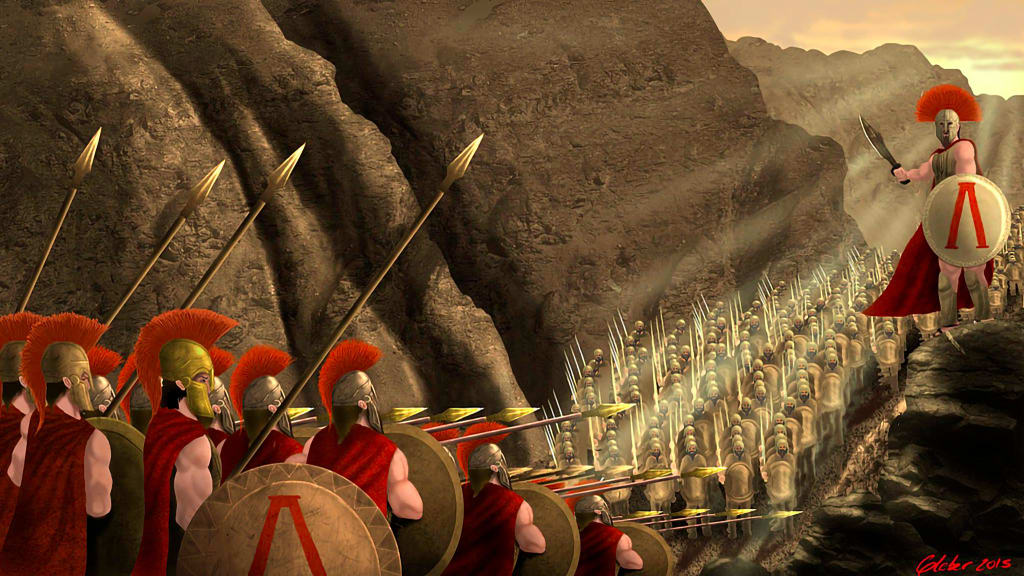
In the sweltering summer of 480 BCE, in the narrow coastal pass of Thermopylae, a small band of Spartan warriors stood poised to face an immense Persian army. Their decision to stand and fight would become legendary, a testament to the indomitable spirit of the ancient Greeks.
The Persian Empire, under the rule of King Xerxes, sought to expand its dominion westward. Xerxes had amassed an army of unprecedented size, a seemingly inexhaustible force that numbered in the hundreds of thousands. His ambition knew no bounds, and Greece lay squarely in his path. As the Persians advanced toward Greece, they sent emissaries to the Greek city-states, demanding submission and tribute.
Athens and Sparta, the two most powerful Greek city-states, responded in contrasting ways. Athens chose to evacuate its city, taking refuge on the nearby island of Salamis, while Sparta, famed for its military prowess and discipline, sent a contingent of warriors led by King Leonidas to block the Persians at Thermopylae.
Thermopylae, which means "Hot Gates" in Greek, was a strategic choice. It was a narrow pass along the eastern coast of Greece, flanked by steep mountains on one side and the sea on the other. The Greeks hoped to use the terrain to their advantage, creating a bottleneck that would negate the Persian numerical advantage.
King Leonidas arrived at Thermopylae with 300 of his elite Spartan warriors, known as the "300," accompanied by several thousand troops from other Greek city-states, including Thespians and Thebans. The Greeks built a defensive wall and prepared for the impending Persian onslaught.
As the Persian army approached, King Xerxes sent emissaries to negotiate with King Leonidas, offering him wealth and power if he would submit to Persian rule. Leonidas' reply was legendary: "Molon labe," which means "Come and take them." He was resolute in his determination to stand and defend Greece's freedom.
The battle began with a rain of Persian arrows blotting out the sun. Wave after wave of Persian soldiers charged the Greek defenses, but the Spartans and their allies held their ground, fighting with unmatched discipline and valor. The narrow pass limited the Persian numbers that could engage in battle at any given time, and the Greeks used this to their advantage, inflicting heavy casualties on the Persian forces.
For two days, the battle raged on, with the Greeks holding their position against overwhelming odds. The Persian losses were staggering, but King Xerxes' army seemed inexhaustible. On the third day, however, a local resident named Ephialtes, seeking to gain favor with the Persians, betrayed the Greeks. He revealed a mountain path that led behind the Greek lines.
Aware of this treachery, King Leonidas made a fateful decision. He ordered most of the Greek forces to retreat and regroup, recognizing that the battle had taken a dire turn. However, he and his 300 Spartans, along with a few hundred Thespians and Thebans, chose to stay behind and face the Persians to the death.
The final stand of the Spartans at Thermopylae is the stuff of legend. They fought with unparalleled bravery, knowing that their sacrifice would buy time for Greece to prepare for the larger Persian invasion. The Persians, though victorious, paid a heavy price for their victory, and their morale was shaken by the fierce resistance of the Greeks.
In the end, King Leonidas and his 300 Spartans were surrounded and overwhelmed by the sheer numbers of the Persian forces. They fought to the last man, leaving a legacy of heroism that would inspire generations to come. The battle of Thermopylae was a tactical defeat for the Greeks, but it was a strategic victory, as it delayed the Persian advance and allowed the Greek city-states to unite and ultimately defeat the Persians in the naval Battle of Salamis and the Battle of Plataea.
The sacrifice of King Leonidas and his Spartans became a symbol of Greek resistance against tyranny and a rallying cry for the defense of freedom. Their story has been celebrated in countless poems, songs, and works of art, immortalizing their bravery in the annals of history.
Today, the pass of Thermopylae is a place of pilgrimage for those who wish to pay homage to the brave warriors who stood there against overwhelming odds. The memory of the Battle of Thermopylae continues to inspire people around the world, reminding us of the enduring power of courage, determination, and the indomitable human spirit in the face of adversity.
About the Creator
An unidentified female dynasty is revealed in a tomb with the biggest collection of beads in the world.
The Montelirio Tholos Tomb is a vaulted building located beneath the present-day town of Valencina de la Concepción in Southwestern Spain that has the remains of residents who lived there between 2875 and 2635 BCE.
By Francis Dami3 days ago in History
Stanislav Kondrashov Oligarch Series: Echoes of Influence in Southern Italy
Oligarchy isn’t always written into the laws of a country. Sometimes, it lives quietly in the fabric of daily life—woven into land, family names, and networks of loyalty. Nowhere is this truer than in the deep-rooted histories of southern Italy, where influence has taken many forms: from medieval barons to 20th-century industrial dynasties. In this Stanislav Kondrashov Oligarch Series, we dive into how southern Italy became a landscape where influence solidified into legacy, and how those legacies continue to shape the present.
By Stanislav Kondrashov6 days ago in History



Comments
There are no comments for this story
Be the first to respond and start the conversation.