
The Battle of the Teutoburg Forest: How Kalkriese Still Speaks of Rome’s Greatest Defeat
In 9 AD, the Battle of the Teutoburg Forest annihilated three Roman legions. New discoveries reveal how terrain, treachery, and time shaped one of history’s greatest defeats.

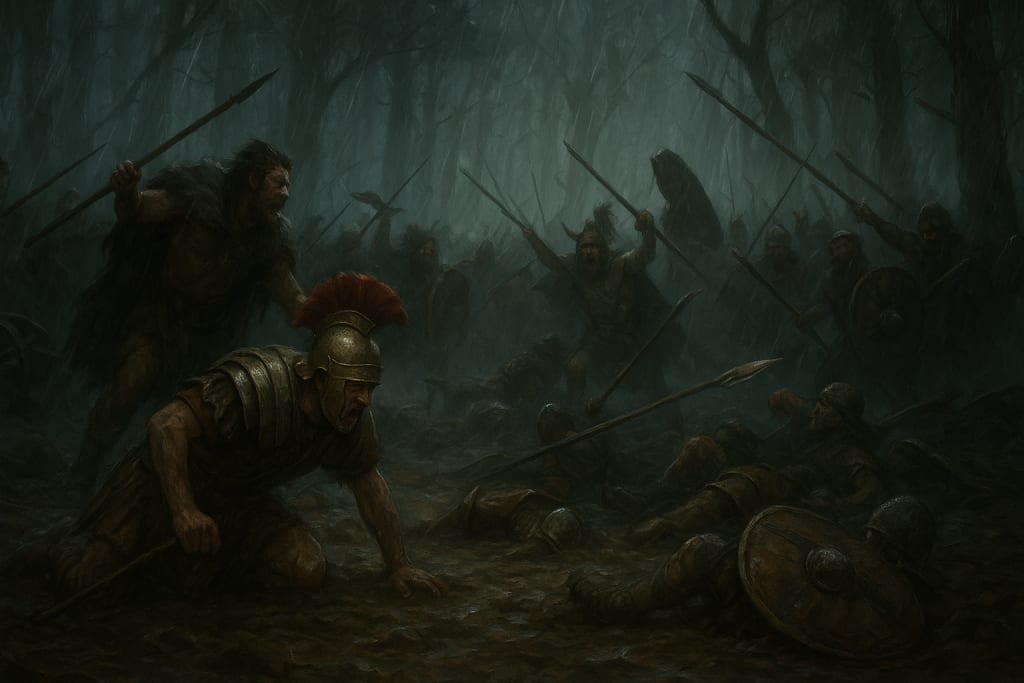
The rain fell in sheets, drumming on iron helmets, soaking wool tunics, turning the path into a river of sludge. The legions pressed on, their line stretching for miles, burdened with carts and baggage animals that lurched and stumbled. Varus’s voice carried faintly through the storm, but his orders scattered like leaves in the wind.
Then came the silence. A heartbeat later, a scream. Spears whistled from the treeline, shields splintered, and men toppled into the mud. From the shadows, bare-chested warriors with painted faces darted forward, striking, retreating, vanishing as swiftly as they appeared. Roman discipline fractured, ranks dissolved, and the proud eagles of the legions became beacons for slaughter.
For three endless days, through bog, forest, and rain, the ambush never ceased. By its end, more than 20,000 Romans—three entire legions, auxiliaries, and camp followers—were annihilated. Their bones lay unburied for years, until later Roman expeditions stumbled upon fields of skulls still bleaching in the sun.
A Turning Point in Roman History
The Battle of the Teutoburg Forest in September 9 AD was not just another frontier clash. It was the moment Rome’s northern ambitions shattered. Publius Quinctilius Varus, governor of Germania, had trusted Arminius, a Cheruscan prince raised in Roman ways, even trained as a cavalry officer. Arminius dined with Varus, advised him, marched beside him—while secretly uniting the Cherusci, Bructeri, and Marsi against their unsuspecting overlords.
The trap was perfectly laid. Instead of open plains where Roman discipline could shine, the legions were lured into a maze of forested hills and marshes. The terrain itself became the enemy. Heavy rain turned roads to swamps. Wagons overturned. Horses bolted. Soldiers, weighed down by armor, slipped and fell into the muck. Each delay was fatal. Arminius’s men struck in waves, never long enough to face Roman steel in formation, but always enough to bleed the column.
Ancient historian Cassius Dio describes how panic spread as men realized there was no escape, no chance to regroup. By the fourth day, the Romans were encircled and overwhelmed. Varus, seeing the disaster complete, fell on his own sword. His officers followed, leaving their soldiers leaderless in the storm.
Kalkriese: A Battlefield Rediscovered
For centuries, the site of the battle remained a mystery. “Teutoburg Forest” was a broad term, and legends clouded memory. It was only in the late 20th century that systematic excavations at Kalkriese revealed undeniable proof. Roman coins stamped with the profile of Augustus, weapons buried in the soil, armor fragments, horse gear, and mass graves painted a chilling picture.
Now, with modern LiDAR scans stripping away the canopy, archaeologists can see what the legionaries once faced. Hidden ditches and embankments appear like scars across the land, revealing a corridor of ambush rather than a single battlefield. The so-called “Germanic Wall,” once thought to be the ambush’s centerpiece, now seems less certain—parts may date from centuries later. But dozens of smaller obstacles and earthworks confirm the genius of Arminius’s plan: not one trap, but many, stretching for miles.
Each feature tells its story. Where LiDAR shows a steep slope, excavators find clusters of hobnails from Roman sandals, suggesting soldiers stumbled and fell under attack. Where the scans reveal narrow choke points, archaeologists uncover smashed shields and spearheads. In this way, the land itself testifies to the horror of those days.
The Human Cost
Excavations at Kalkriese uncovered a shallow pit containing the bones of men, women, and animals, thrown together without order. Roman soldiers did not receive burials worthy of their service; they were left to decay, later gathered in haste by survivors or Roman retribution forces. Germanicus, the adopted son of Emperor Tiberius, led campaigns into Germania years later, recovering two of the lost legionary eagles. Tacitus describes how his troops stumbled upon the battlefield still strewn with remains, a ghastly monument to defeat.
Even today, visitors to Kalkriese Museum Park can see these fragments—buckles, swords, helmets, horse harnesses—that survived centuries in the soil. Each piece speaks of panic, of courage, of betrayal.
The Legacy of Betrayal
The Battle of the Teutoburg Forest was more than a military loss; it was a psychological blow from which Rome never fully recovered. The Rhine became a hard frontier. Efforts to conquer Germania beyond it faded, and the empire’s strategy shifted. Arminius became a hero of resistance, celebrated centuries later as a symbol of German independence.
For Rome, Teutoburg was a wound that lingered. The cry attributed to Augustus—“Quinctilius Varus, give me back my legions!”—echoes as a symbol of imperial anguish. The numbers of the legions lost—the XVII, XVIII, and XIX—were never re-used in Roman history, as though cursed by defeat.
A Forest That Still Speaks
What makes Kalkriese haunting is how alive the past feels here. Every LiDAR scan, every unearthed coin, every soil layer reminds us that history is not static. The landscape itself was the greatest weapon: the rain, the mud, the marshes, the narrow passes, and the forest that seemed to close in on the Roman column like a living trap.
The Teutoburg Forest was not just a setting; it was an accomplice. And more than two millennia later, it continues to whisper of Rome’s darkest day, when empire met its limits and was devoured by the woods of Germania.
References
Härtling, J.W., Stele, A., Ortisi, S., Jepsen, A., Rappe, M., Bussmann, J. & Fülling, A. (2025) ‘Germanic Rampart or Roman Encampment? — New Geoarchaeological Evidence at the Roman Conflict Site at Kalkriese (NW-Germany)’, Geoarchaeology, 40: e22031. https://doi.org/10.1002/gea.22031
‘Ancient artefacts from the Battle of the Teutoburg Forest examined at PETRA III’, DESY Light & Science, 2022. Available at: https://photon-science.desy.de/news__events/news__highlights/archive/archive_of_2022/ancient_artefacts_from_the_battle_of_the_teutoburg_forest_examined_at_petra_iii/index_eng.html (Accessed: 12 September 2025)
Hoekstra, K. (2024) ‘At Kalkriese, Archaeology Reveals Evidence of Rome’s Most Famous Defeat’, History Hit, 27 September. Available at: https://www.historyhit.com/kalkriese-archaeology-teutoburg-forest/ (Accessed: 12 September 2025)
New Geoarchaeological Evidence Challenges the Identification of Kalkriese Hill as the place of the Battle of the Teutoburg Forest. LBV Magazine, 6 December 2024. Available at: https://www.labrujulaverde.com/en/2024/12/new-geoarchaeological-evidence-challenges-the-identification-of-kalkriese-hill-as-the-place-of-the-battle-of-the-teutoburg-forest/ (Accessed: 12 September 2025)
About the Creator
Jiri Solc
I’m a graduate of two faculties at the same university, husband to one woman, and father of two sons. I live a quiet life now, in contrast to a once thrilling past. I wrestle with my thoughts and inner demons. I’m bored—so I write.
The Untold Story of Tata Group , Who built the Empire ?
If you live in India, at some point in your day you probably come across a product from the Tata Group of Companies. Look at the cars running on the roads — you’ll see Tata Motors. Look up at planes flying in the sky — you’ll think of Air India. And the iconic Taj Hotel, famous all over the world, is also owned by the Tata Group. From power to fashion, from tea to salt — the Tata Group has a presence everywhere.
By Imran Ali Shah2 days ago in History




Comments
There are no comments for this story
Be the first to respond and start the conversation.