
The Amethyst Legacy: The Exquisite Head of Queen Arsinoe II
Queen Arsinoe

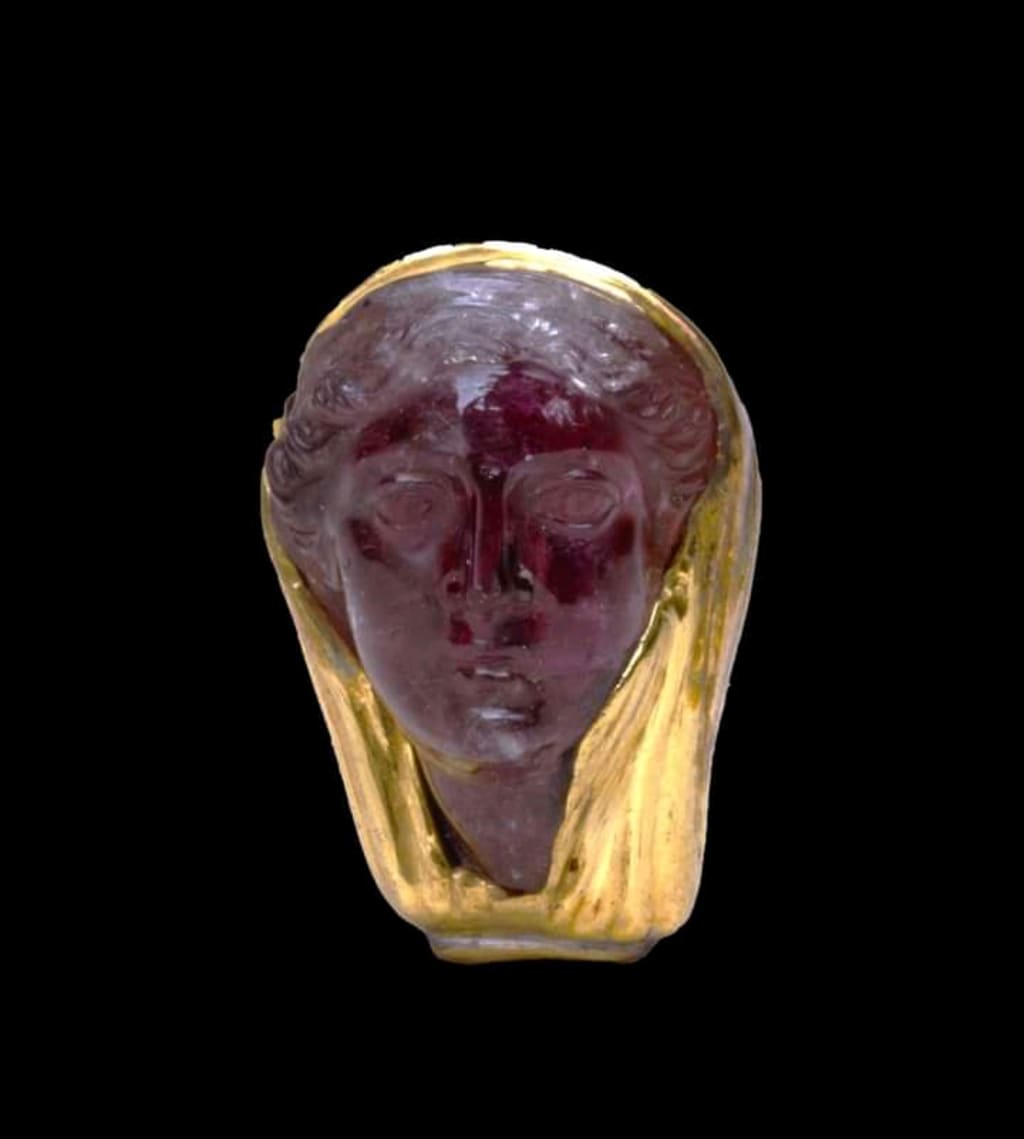
Among the treasures of the ancient world, few artifacts encapsulate the splendor and sophistication of their era like the Head of Queen Arsinoe II. This exquisite amethyst carving, created during the 3rd century BCE in the Ptolemaic-Hellenistic period, represents not only a remarkable artistic achievement but also the legacy of a queen who played a pivotal role in Egypt’s history. Mounted in a modern gold setting, the piece—measuring a modest 2.2 × 1.5 × 1.4 cm—combines delicate craftsmanship with timeless beauty.
This miniature masterpiece is housed in the Walters Art Museum, where it continues to captivate audiences and spark curiosity about the queen it depicts and the world in which it was created.
Arsinoe II: A Queen of Power and Influence
Arsinoe II (316–270 BCE) was one of the most influential figures of the Ptolemaic dynasty. Born into the Macedonian royal family, she was the daughter of Ptolemy I Soter, one of Alexander the Great’s generals who became the founder of the Ptolemaic Kingdom in Egypt. Arsinoe’s life was marked by political alliances, royal marriages, and a shared rule that strengthened the dynasty’s grip on Egypt.
Arsinoe married her brother, Ptolemy II Philadelphus, a common practice among the Ptolemies to consolidate power. Together, they elevated the dynasty’s prestige, promoting arts, science, and religion. Arsinoe was deified during her lifetime, worshipped as a goddess alongside her husband in the Egyptian and Greek traditions.
Her legacy endured long after her death. Arsinoe II became a symbol of power, divine femininity, and political acumen, qualities immortalized in this amethyst portrait.
The Carving: Artistry in Amethyst
The Head of Queen Arsinoe II is a stunning example of ancient craftsmanship. Carved from a single piece of amethyst, the sculpture captures the queen’s features with remarkable precision. Amethyst, a semi-precious gemstone prized in the ancient world for its rich purple hue, was associated with royalty, luxury, and divine protection. Its use in this piece underscores Arsinoe’s elevated status as both a queen and a deity.
Despite its small size, the carving showcases intricate details: the carefully rendered facial features, the subtle expression of serenity and authority, and the proportions that suggest the artistic sophistication of the Hellenistic period. The modern gold mount, while not original, complements the carving’s regal aura, framing it as a jewel that embodies the grandeur of its time.
Symbolism and Significance
The amethyst head likely served as more than just a decorative object. Its creation during Arsinoe’s lifetime suggests it could have been part of a larger sculpture or a votive offering in a temple dedicated to her cult. The use of amethyst, with its association with spirituality and protection, reinforces its potential religious or ceremonial purpose.
For Arsinoe’s subjects, such depictions would have emphasized her divinity and reinforced the idea of her rule as ordained by the gods. The blending of Greek and Egyptian artistic styles in the piece also reflects the cultural fusion of the Ptolemaic dynasty, which sought to unite its Greek origins with the ancient traditions of Egypt.
The Ptolemaic-Hellenistic Period: A Cultural Crossroads
The Ptolemaic dynasty ruled Egypt from 305 BCE to 30 BCE, a period marked by the blending of Greek and Egyptian cultures. The Hellenistic influence is evident in the artistic styles of the time, which combined Greek ideals of naturalism and proportion with Egyptian symbolism and themes.
This fusion is beautifully illustrated in the Head of Queen Arsinoe II, where the Greek focus on realistic portraiture meets the Egyptian tradition of deifying rulers. The result is a piece that transcends its time, embodying the cosmopolitan nature of the Ptolemaic court.
Preservation and Legacy
That the Head of Queen Arsinoe II has survived for over two millennia is a testament to both the durability of its materials and the reverence in which it was held. Today, it offers a tangible link to the Ptolemaic era, providing insights into the artistic techniques, cultural values, and political dynamics of the time.
Housed in the Walters Art Museum, the piece continues to inspire admiration and scholarship. Visitors are drawn to its intricate details and the story of the queen it represents—a woman who wielded power in a male-dominated world and whose influence extended beyond her death.
Conclusion
The Head of Queen Arsinoe II is more than just a work of art; it is a symbol of a queen who shaped history and a testament to the artistic and cultural achievements of the Ptolemaic-Hellenistic period. Its delicate carving in amethyst reflects the craftsmanship of its time, while its modern gold mount serves as a reminder of its enduring appeal.
As we gaze upon this ancient gem, we are invited to reflect on the legacy of Arsinoe II: her role as a ruler, a goddess, and a symbol of the enduring power of art to connect us to the past. In its small yet profound form, this artifact reminds us that history often reveals itself not in grand monuments but in the quiet elegance of objects that once held deep significance for the people who created them.
About the Creator
Keep reading
More stories from Deji Akomolafe and writers in History and other communities.
The 500-Year-Old Marriage Bed of Henry VII and Elizabeth of York: A Regal Rediscovery
In the annals of British history, few artifacts capture the imagination like the recently rediscovered marriage bed of Henry VII and Elizabeth of York. Believed to be the only surviving medieval royal state bed in England, this extraordinary relic embodies the union that founded the Tudor dynasty. Its story, however, is as fascinating as its origins: found abandoned in a Chester car park, the bed’s journey from royal treasure to modern-day marvel is a tale of mystery, intrigue, and historical significance.
By Deji Akomolafeabout a year ago in History
No ICE, No KKK, No Fascist USA
"I don't 'do' politics." Politics will do you, regardless. Watching from the sidelines for the last year I can see far too many similarities in the way Trump's ICE Gestapo is to Nazi Germany. Considering the United States just invaded Venezuela and kidnapped their President and his wife I would say we are there.
By Lyvia Jack5 days ago in History
3 Moments When Reality Accidentally Became a Horror Movie
Horror movies usually rely on a simple agreement with the audience: this could never really happen. Ghosts follow rules, monsters have weaknesses, and there’s always a clear point where reality hands the story over to fiction. Real life, unfortunately, does not care about narrative structure, logic, or closure.
By Enoch Sagini3 days ago in History




Comments
There are no comments for this story
Be the first to respond and start the conversation.