
The affinity of Americans towards large automobiles
"The Predilection of Americans for Oversized Vehicles: An Analysis"

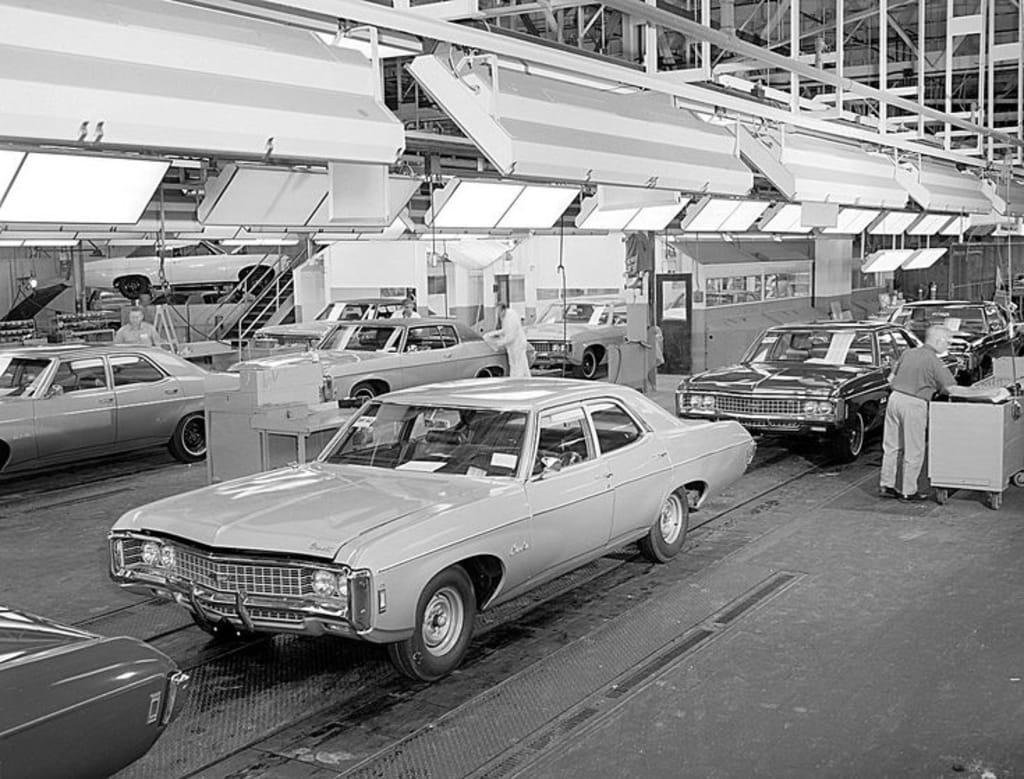
In my current vehicle, which sits low to the ground, I have recently observed a concerning trend. When I am stuck in traffic, I am either unable to see beyond the cars in front of me or I am surrounded by towering vehicles. This phenomenon can be attributed to a significant shift in the production of passenger cars in the United States. Since 1975, the production of sedans and wagons has plummeted, while the production of SUVs has steadily increased. In fact, SUVs and trucks accounted for 80% of all new car sales last year, compared to 52% in 2011. While it is not surprising that Americans prefer larger vehicles, the reasons behind this transformation are not solely cultural. Rather, they can be traced back to a 50-year-old policy that has had a profound impact on the design of US cars.
As I embark on a road trip from Brooklyn, New York to Rhode Island, I aim to uncover the reasons behind the dominance of big cars in America. According to a Washington Post analysis, New York was the 45th state to succumb to the takeover of SUVs and trucks in 2014, while Alaska was the first state to do so in 1988. As I travel, I am struck by the prevalence of SUVs in parking lots and on the road. While Americans have various reasons for choosing larger vehicles, the infrastructure in the US supports this choice. Unlike many other countries, our built environment revolves around cars, with wide roads and ample parking spaces.
One overlooked bias towards big cars is related to the reason SUVs were created in the first place. In the 1970s, there was a shortage of foreign oil in the US, which led the government to set rules for automakers to make cars more fuel-efficient. However, these rules did not apply as strictly to SUVs and trucks, which were exempted from the more stringent standards applied to passenger cars. This regulation created an incentive for carmakers to transform light trucks into vehicles for everyday use, resulting in the birth of the SUV. Automakers have since marketed SUVs more preferentially than passenger cars, putting more research and development into creating more models that fit into the SUV category.
As of 2016, fuel economy standards have shifted, with vehicles still separated by stricter standards for passenger cars and looser standards for light trucks. However, within these categories, larger cars receive weaker rules, incentivizing carmakers to phase out passenger cars in their fleet and make each category bigger. While the US is transitioning to electric vehicles, larger vehicles with higher ground clearance, weight, and height will still be less energy-efficient, whether they are electric or internal combustion-powered. Moreover, the prevalence of big cars poses a threat to pedestrian safety, with one study finding that replacing the growth in SUVs with cars would have averted over a thousand pedestrian deaths.
While the US is unlikely to become a small car country any time soon, there is a desire among younger and politically active individuals to make it so that an SUV is not the default vehicle choice for American families. If we want our roads to look different, we must start by addressing the policy choices that have enabled the dominance of big cars.
About the Creator
Meera's AULOSS
Welcome to Meera's A U LOSS: Your Ultimate Weight Loss ...Explore our engaging articles that provide honest reviews, tips, and inspiring success stories about popular weight loss products' Resource! join us
Keep reading
More stories from Meera's AULOSS and writers in History and other communities.
On the day when women brought Iceland to shut down
In the United States, women receive a remuneration that is 17% lower than that of men, while in Japan, the gender pay gap is 22%. Conversely, Iceland boasts a pay gap of approximately 10%, making it one of the few countries in the world where women are compensated almost equally to men. However, this was not always the case, as in 1975, the gender pay gap in the US was 37%, in Japan it was 42%, and in Iceland it was 40%. To understand how Iceland achieved such progress, it is necessary to examine the events of 1975.
By Meera's AULOSS2 years ago in History
Nanchang: A Modern Symbol of China’s Naval Power
In recent years, the world has closely watched the rapid modernization of the Chinese People’s Liberation Army Navy (PLA Navy). One of the most important symbols of this transformation is the Nanchang (Hull 101), China’s first Type 055 guided-missile destroyer. Commissioned on 12 January 2020, Nanchang represents a major leap in naval technology and capability. As it completes six years of active service, the ship stands as a clear example of how China’s navy has moved into a new era of advanced maritime power.
By sehzeen fatima6 days ago in History
Where the Pulse Ends
© 2026 Sai Marie Johnson The humidity in the city didn’t just hang; it leaned. It was a thick, stagnant soup of diesel exhaust, ozone, and the metallic tang of blood that drifted from the "Compliance Zones." Joe sat in his rusted sedan, his hands resting loosely on the steering wheel. He wasn't gripping it. He wasn't angry. Anger was a chemical spike, a biological inefficiency. Joe was simply... focused.
By Sai Marie Johnson3 days ago in History
Ludacris and Nelly draw backlash over bookings at MAGA-coded music festival
Ludacris and Nelly headlining a mostly right-wing event is good for them. It’s also great for the genre of hip hop. The two rap veterans have showcased their talents on other stages. Why can’t they perform for mostly MAGA folks and grab that bag?
By Skyler Saunders4 days ago in Beat




Comments
There are no comments for this story
Be the first to respond and start the conversation.