
The Abandoned Wealth of Emperor Nero: Gold Amidst Infernos
Emperor Nero, the notorious final sovereign of the Julio-Claudian dynasty, is remembered for his opulence, despotism, and the grand conflagration of Rome. Yet concealed beneath the narratives of indulgence and devastation lies the enigma of his vast imperial treasure. This article explores how Nero accumulated his fortune, the political and architectural endeavors he financed, and the persistent inquiry: What became of Nero’s abandoned wealth following his dramatic downfall?

The Ascendance of a Golden Sovereign
Nero Claudius Caesar Augustus Germanicus ascended to the throne in 54 CE at the tender age of 17. Although youthful, Nero wielded considerable authority, inherited from a complicated lineage of Julio-Claudian rulers tracing back to Augustus. With the Roman Empire at its zenith in terms of territory and commerce, Nero assumed the imperial position during a period of extraordinary affluence.
His mother, Agrippina the Younger, facilitated his rise to power, manipulating court dynamics and eliminating adversaries. However, Nero would soon declare his autonomynot merely through absolute governance but by expending funds at a scale that astonished even the elite of Rome.
The Origins of Nero’s Wealth
Nero’s fortune was derived from various streams:
Imperial Taxation:
Provinces throughout Europe, North Africa, and Asia Minor rendered tribute to Rome. Taxes on agriculture, commerce, and property ownership flowed into the imperial treasury.
Confiscations:
Nero had a notorious proclivity for accusing senators and elites of treason or conspiracy. Their assets were appropriated and added to the state (or his personal) treasury. This strategy both enriched him and eliminated political dangers.
Commerce and Tribute:
The Roman Empire's extensive trading network, particularly in luxury commodities from the Eastsuch as spices, silk, and gemstonesproduced substantial profits. Conquered regions also presented valuable tributes including gold, silver, and enslaved individuals.
Mining and Coinage:
Nero oversaw the empire’s mining activities in Hispania (Spain), Gaul, and the Balkans. He adulterated the Roman currency by diminishing the silver content in coinsan expedient that enhanced imperial liquidity but compromised long-term economic stability.
Nero’s Opulence: The Golden House
One of Nero’s most renowned expenditures of imperial wealth was the creation of the Domus Aurea, or Golden House. Following the Great Fire of Rome in 64 CEwhich some accounts claim Nero instigated, although evidence remains ambiguoushe appropriated a substantial expanse of central Rome to construct his palace.
The Golden House was a residence unlike any other in Roman annals:
Its corridors were adorned with gold leaf and precious gemstones.
Rooms boasted revolving ceilings that showered fragrances and rose petals.
Artificial lakes and expansive gardens encircled the edifice.
A colossal effigy of Nero, the Colossus Neronis, towered outsidesurpassing 100 feet in height.
This architectural wonder epitomized both the pinnacle of Nero’s wealth and the extravagance that alienated Rome’s citizens and senators from him.
Financing Extravagance: Performances and Campaigns
Nero perceived himself not merely as an emperor but as a creator and entertainer. He financed extravagant games, theatrical productions, and musical competitionsmany of which showcased him as the main attraction. Audiences were frequently obligated to attend and applaud his performances.
In 66 CE, Nero initiated an expensive expedition in Greecenot for conquest, but to tour cities and perform. He returned with thousands of accolades and trophies, though they were predominantly symbolic; the journey depleted the state treasury.
The Decline of Nero and the Disappearance of His Wealth
By 68 CE, public discontent, military uprisings, and political opposition reached a pinnacle. The Senate proclaimed Nero a public adversary. Confronted with arrest and execution, Nero took his own life on June 9, 68 CE, reportedly exclaiming, "What an artist dies in me! "
What transpired with his extensive fortune after his demise?
Theories and Historical Narratives:
Confiscated by Successors:
Galba, Otho, and Vitelliuswho succeeded Nero during the chaotic "Year of the Four Emperors"likely appropriated portions of the imperial treasury to support their own aspirations for authority.
Concealed Reserves:
Some speculate that Nero concealed portions of his wealth in subterranean vaults or private villas prior to his death. Treasure seekers have long conjectured about hidden troves beneath the remnants of the Golden House.
Destroyed or Dispersed:
With the conflagration of the palace and plundering by soldiers, a significant portion of Nero’s wealth may have been lost. Priceless artworks, manuscripts, and coins likely vanished amid the turmoil.
Transformed into Public Structures:
Emperor Vespasian, who ultimately restored stability, repurposed the area of Nero’s palace to construct the Colosseum, reclaiming the site for civic use. Some of Nero’s appropriated funds may have subsidized this transformation.
The Quest for Nero’s Treasure Today
Parts of the Domus Aurea have been unearthed in Rome, revealing frescoes, gilded ceilings, and intricate mosaics. However, no treasure troves have been discoveredleading many to surmise they were either looted or remain concealed.
In recent decades, archaeologists and historians have concentrated on subterranean chambers, secret corridors, and locked vaults around the Palatine and Esquiline Hills. Some treasure hunters hypothesize that Roman elites sympathetic to Nero may have interred valuable items, anticipating his return.
Conclusion: A Fortune in Flame and Myth
Emperor Nero’s existence was a narrative of power, creativity, insanity, and lavishness. His wealth, emblematic of both Rome’s grandeur and his personal excess, has transformed into a legendary enigma. Whether buried beneath Rome’s foundations or lost to time, the saga of Nero’s gold continues to captivate scholars and treasure hunters alike.
Ultimately, Nero’s authentic legacy may not reside in what he constructed or amassedbut in how his rule contributed to reshaping the parameters of imperial authority and the risks of unchecked extravagance.
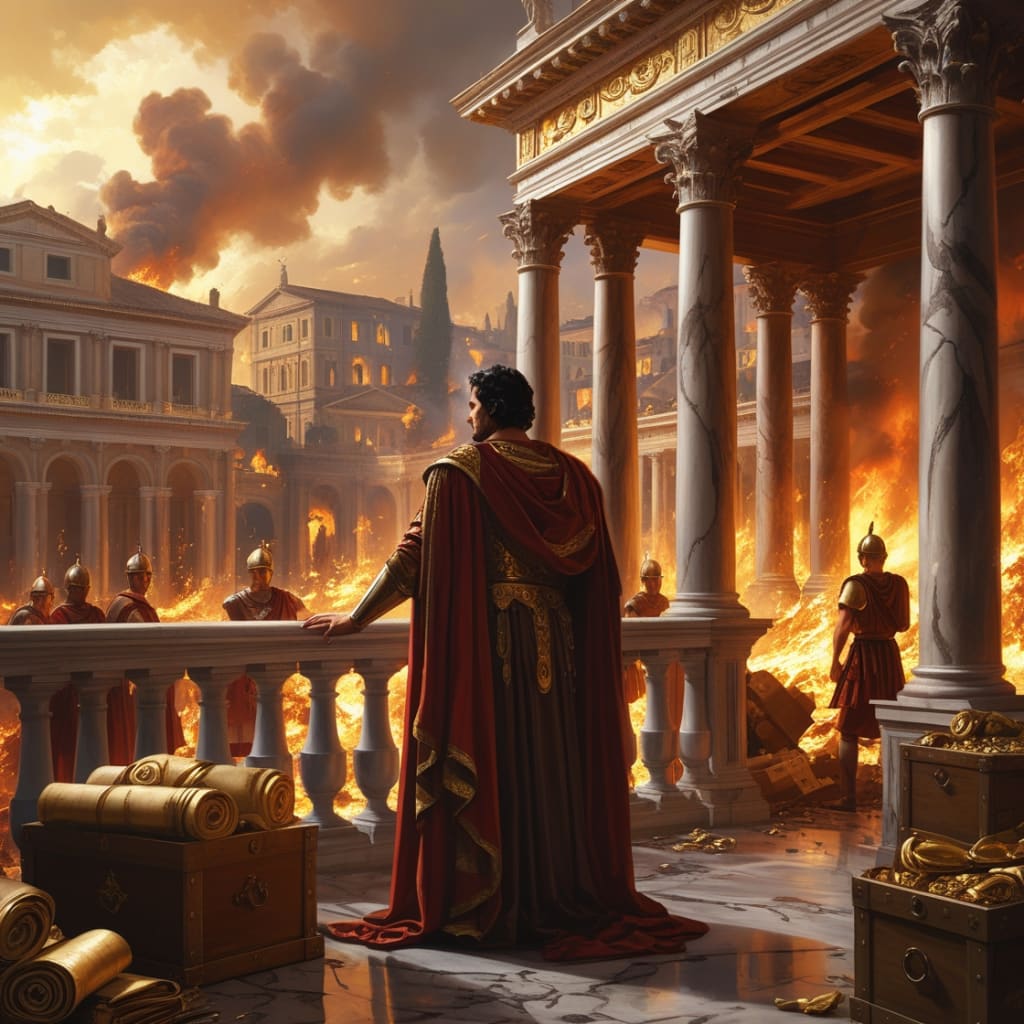
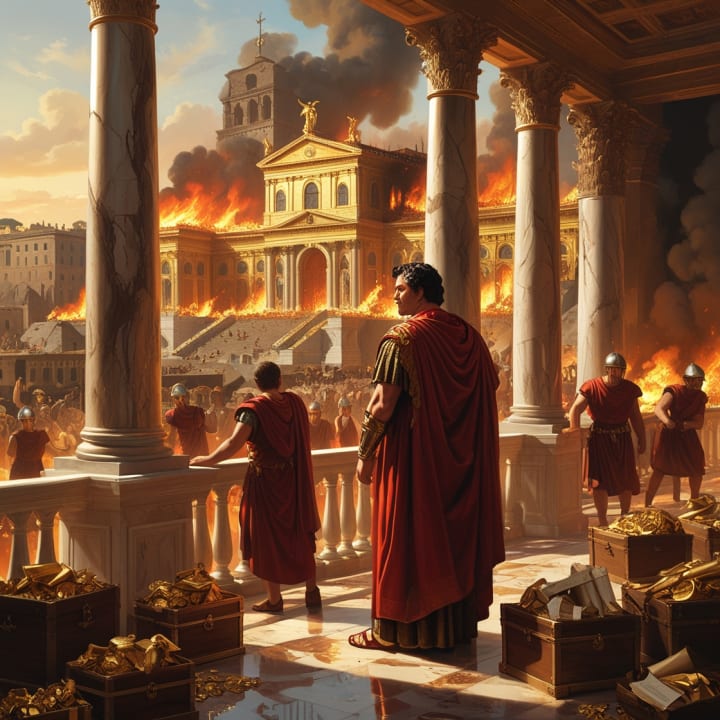
A digital artwork in historical realism manner, illustrating Emperor Nero positioned on a marble balcony surveying the ablaze city of Rome. Behind him, the Golden House shines with gilded mosaics and lofty statues. Roman soldiers pack chests of richesgold, silver, scrollsinto chambers beneath the palace. The tableau encapsulates both magnificence and looming downfall, illuminated by dancing firelight.
About the Creator
Say the truth
"Say the Truth: Explain Everything in the World" is your trusted source for uncovering facts and exploring the wonders of history, science, technology, and beyond. We simplify complex ideas and reveal truths to inspire curiosity .
Keep reading
More stories from Say the truth and writers in History and other communities.
The Concealed Prosperity of Emperor Ashoka: An Enduring Heritage Beyond Wealth
The Ascendancy of Emperor Ashoka Ashoka the Great, descendant of Chandragupta Maurya, rose to the Mauryan throne circa 268 BCE. At its pinnacle, the Mauryan Empire extended from contemporary Afghanistan in the west to Bangladesh in the east, reaching as far south as the Indian peninsula. Ashoka inherited not merely an expansive territory but also a wealth administration system refined by previous Mauryan sovereigns.
By Say the truth 8 months ago in History
How Early Aircraft Failures Created Modern Flight Safety
When we look at modern aviation today with its redundant systems, strict regulations, and impressive safety record it’s easy to forget how fragile flight once was. Early aviation wasn’t built on confidence or certainty. It was built on risk. Every successful flight was surrounded by countless failures, and every crash carried lessons that would quietly reshape the future of air travel.
By Beckett Dowhan4 days ago in History
The Accidents That Quietly Improved Aviation Forever
I used to think aviation history was a story of bold successes, record-breaking flights, sleek aircraft, and triumphant landings. But the more I read, the more I realized something uncomfortable: much of modern aviation was shaped not by success, but by accidents. The safety and reliability we now take for granted were quietly built from moments when things went terribly wrong.
By Beckett Dowhan3 days ago in History
A Dart at Dusk
Seconds ago, the sullen sun set on the two of us… my exuberant furry companion and me. A fresh breeze embraces us, delivering welcome relief from the day’s oppressive heat. His typical stumbling and staggering along — apace with a sloth — has turned into trip-trapping, high-stepping, almost skipping along.
By Angie the Archivist 📚🪶5 days ago in Petlife


Comments
There are no comments for this story
Be the first to respond and start the conversation.