
Territorial Acquisitions in History: From the Louisiana Purchase to the Greenland Proposal
Territorial Acquisitions in History


Introduction
Throughout history, nations have expanded their borders through territorial acquisitions, often driven by economic, military, or strategic interests. Some of these acquisitions were achieved through war, while others were the result of diplomatic negotiations or outright purchases. One of the most notable examples is the Louisiana Purchase, which significantly shaped the future of the United States. More recently, former U.S. President Donald Trump proposed purchasing Greenland, highlighting how territorial expansion remains a relevant topic in global geopolitics. This article explores some of the most significant territorial acquisitions in history, their motivations, and their lasting impact.
The Louisiana Purchase (1803)
One of the most famous land deals in history, the Louisiana Purchase, was an agreement between the United States and France in 1803. For $15 million, the U.S. acquired approximately 828,000 square miles of land, effectively doubling its size. The deal was driven by multiple factors:

French Financial Struggles: Napoleon Bonaparte, engaged in costly European wars, needed funds to sustain his military campaigns.
U.S. Expansion Goals: President Thomas Jefferson sought to secure control over the Mississippi River and expand westward.
Strategic Importance: The acquisition ensured American access to vital trade routes and prevented European powers from gaining a foothold in the region.
The Louisiana Purchase set a precedent for peaceful expansion and laid the foundation for the United States’ growth into a continental power.

The Alaska Purchase (1867)
Dubbed "Seward’s Folly" at the time, the Alaska Purchase involved the U.S. buying Alaska from Russia for $7.2 million. While initially viewed as an unnecessary expense, the acquisition proved immensely valuable due to:
Rich Natural Resources: Alaska later became known for its vast reserves of gold, oil, and natural gas.
Strategic Military Importance: During the Cold War, Alaska played a critical role in U.S. defense against the Soviet Union.

Economic Potential: Over time, the state's fisheries, tourism, and energy sectors have significantly contributed to the U.S. economy.
The Gadsden Purchase (1854)
The U.S. acquired a 29,670-square-mile strip of land from Mexico for $10 million. The primary motivations behind this acquisition were:
Railroad Expansion: The land was ideal for constructing a southern transcontinental railroad.

Border Stability: It helped resolve ongoing boundary disputes following the Mexican-American War.
The Greenland Purchase Proposal (2019)
In 2019, then-President Donald Trump suggested that the United States should purchase Greenland from Denmark. While the proposal was met with widespread skepticism and outright rejection from Danish and Greenlandic officials, it raised questions about modern territorial acquisitions. The motivations behind this proposal included:
Strategic Military Positioning: Greenland is home to Thule Air Base, a crucial site for U.S. missile defense and Arctic monitoring.
Natural Resources: Greenland possesses vast deposits of rare earth minerals, oil, and gas.
Geopolitical Influence: With climate change making Arctic routes more accessible, control over Greenland would enhance U.S. presence in the Arctic.

Although Denmark refused to entertain the idea, the proposal highlighted Greenland’s growing geopolitical significance and the enduring strategic interest in territorial acquisitions.
Conclusion
Territorial acquisitions have played a crucial role in shaping nations and global politics. Whether through purchases, treaties, or conquests, such acquisitions have historically provided economic, strategic, and military advantages. While large-scale land deals are less common in the modern era, Greenland’s case demonstrates that the concept is not entirely obsolete. As geopolitical landscapes shift, territorial negotiations may continue to emerge as a tool for national strategy and influence.
A great book recommendation related to territorial acquisitions is "How to Hide an Empire: A History of the Greater United States" by Daniel Immerwahr.
This book explores U.S. territorial expansion beyond the mainland, including purchases, military conquests, and colonial rule. It provides valuable insights into how territorial acquisitions have shaped global politics and the U.S.'s role in the world. It’s a well-researched, engaging read that complements the topics covered in your article.
About the Creator
Daniel
I love football, history, and music. Football brings excitement, history teaches valuable lessons, and music is my escape. These passions inspire me daily and shape my view of the world.
The Night Walk of Justice
During the golden age of the Islamic Caliphate, when Umar ibn Al-Khattab (RA) was the leader of the Muslim world, the city of Madinah was known for its peace, discipline, and justice. Umar (RA) was not only a powerful ruler but also a humble servant of Allah who feared accountability more than authority.
By The best writer 5 days ago in History
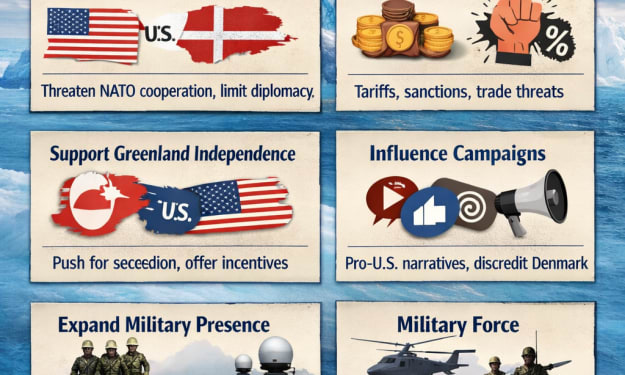
The Hard Ways Trump Could Try to Take Greenland
When Donald Trump was president of the United States, he shocked the world by saying he wanted to buy Greenland. Many people laughed, but others took the idea seriously. Greenland is a huge island in the Arctic. It is rich in natural resources and very important for military defense. Today, Greenland belongs to Denmark, but it also governs itself in many areas.
By sehzeen fatima2 days ago in History



Comments
There are no comments for this story
Be the first to respond and start the conversation.