
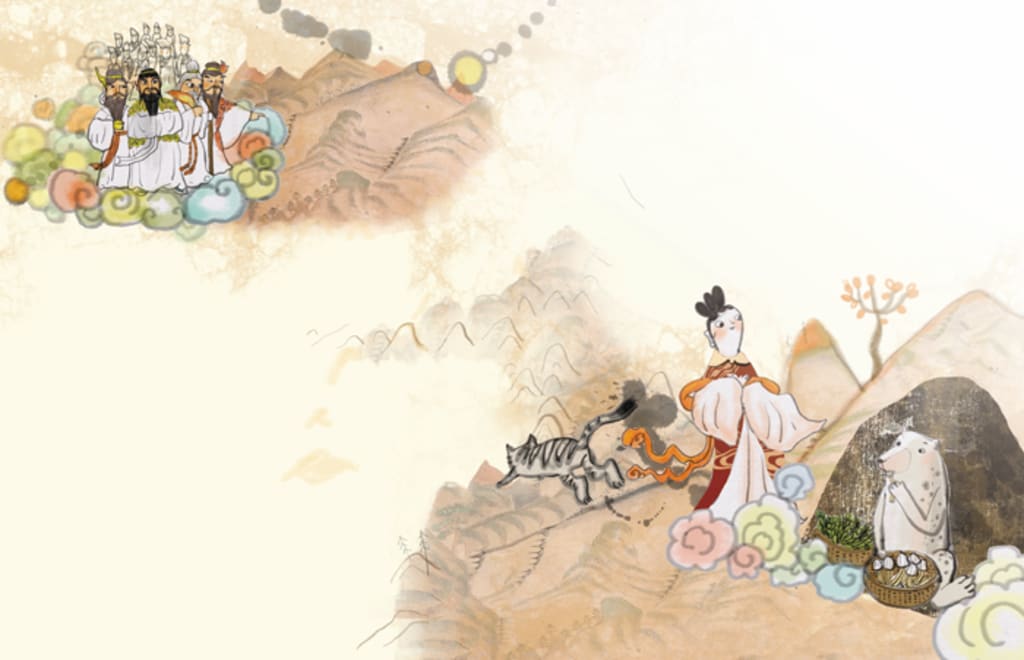
The myth of Tangun, also known as Dangun, is a foundational myth in Korean history and culture. According to this legend, Tangun was the legendary founder of Gojoseon, the first Korean kingdom. The myth holds significant importance in Korean national identity and has been passed down through generations.
The story of Tangun goes like this:
Once upon a time, in the heavenly realm, a god named Hwanung wanted to descend to Earth and live among humans. Hwanung was the son of Hwanin, the ruler of Heaven. He, along with 3,000 followers, descended to a mountain called Taebaeksan, which means "Great White Mountain."
Hwanung wished to establish a kingdom on Earth, and to choose a worthy leader, he devised a test. He set up three trials: one for the animals of the mountain, one for the plants, and one for a bear and a tiger.
Only a bear and a tiger passed the test by following Hwanung's instructions to stay in a cave and eat only garlic and mugwort for 100 days. The tiger couldn't endure the challenge and gave up, but the bear, named Ungnyeo, succeeded. As a reward for her determination, Hwanung transformed her into a woman.
Ungnyeo was grateful for the transformation and expressed her wish to have a child. Hwanung granted her wish, and she gave birth to a son, whom she named Tangun, meaning "Sandalwood King."
Tangun later grew up and became the first king of Gojoseon in 2333 BCE (according to traditional Korean chronology). He established his capital in the region of Pyongyang, in present-day North Korea.
The myth of Tangun has been a source of pride and cultural heritage for the Korean people. It is often celebrated during the Dangun Festival, which takes place on October 3rd, according to the lunar calendar. However, it's essential to note that the story of Tangun is considered a myth, and its historical accuracy is a subject of debate among historians and scholars. Regardless of its historical validity, the legend remains a cherished part of Korean folklore and identity.
Founding of Gojoseon: According to the myth, Tangun's establishment of Gojoseon marks the beginning of Korean history. Gojoseon is considered the first Korean kingdom and is believed to have existed from around 2333 BCE to 108 BCE. While there is archaeological evidence of ancient cultures in the Korean Peninsula, the existence of a specific Gojoseon kingdom remains a topic of scholarly debate.
Mythological Elements: The myth of Tangun contains several common elements found in creation myths worldwide, such as divine beings descending from the heavens, a test or trial to select a leader, and a human-animal transformation. These elements reflect the cultural and spiritual beliefs of ancient Korea and served to provide an explanation for the origins of their society.
Dangun Festival: The Dangun Festival is an annual event celebrated in South Korea on October 3rd of the lunar calendar. It is a national holiday that commemorates the founding myth and celebrates Korean heritage. During the festival, various activities, performances, and rituals take place, emphasizing the importance of Tangun in Korean culture.
Historical Debate: As mentioned earlier, while the myth of Tangun holds a prominent place in Korean culture, its historical accuracy has been a subject of scholarly inquiry. Some historians consider it purely mythological, while others believe it may have roots in ancient legends or early tribal leaders. The lack of written records from that era makes it challenging to confirm or dismiss the details of the myth.
National Identity: The myth of Tangun has been an essential element in shaping Korean national identity and fostering a sense of unity and pride among the Korean people. It symbolizes the deep roots of the Korean civilization and its unique heritage.
Cultural Legacy: Tangun's story and the myth of Gojoseon have influenced various aspects of Korean culture, including art, literature, and popular media. Many Korean cultural symbols and narratives draw inspiration from this mythological foundation.
Impact on Politics: Throughout history, the story of Tangun has occasionally been invoked for political purposes. For example, during times of Korean resistance against foreign rule or colonialism, the myth served as a rallying point to inspire nationalistic sentiment and cohesion.
Despite the historical uncertainties surrounding the myth of Tangun, it remains an integral part of Korean cultural heritage. It showcases the richness of Korean folklore and the enduring legacy of a story that has played a crucial role in shaping the collective consciousness of the Korean people.
About the Creator
Keep reading
More stories from SRIJANA SHAKYA and writers in History and other communities.
RED THREAD MYTH
The Chinese Red Thread, also known as the Red Thread of Fate, is a popular myth and belief in Chinese culture. It is a story that has been passed down for generations and is often associated with the idea of predestined love and destiny. Here are the key myths and aspects of the Chinese Red Thread:
By SRIJANA SHAKYA2 years ago in Art
Power's Sake
When it comes to gaining power, bad people use it to gain more They never gain power to do something with it, they gain power to have it, relish in it, double it down on itself so it grows exponentially and never goes anywhere. Even if you see the people in power commit an atrocity, that is never the true goal. It is a deplorable action for sure but the action itself usually doesn't matter it's the outcome.
By Donny Foley3 days ago in History
Military Strength of Alexander the Great and the Chola Empire: A Historical Comparison
Though separated by more than a thousand years and operating in vastly different geographical and cultural contexts, both forces achieved extraordinary success through discipline, innovation, and strategic brilliance. This article explores the history, composition, size, organization, and military strength of Alexander’s Macedonian army and the Chola military, highlighting how each became a dominant power of its era.
By Say the truth 3 days ago in History
Miss Persephone's Manual to a Seemingly Ordinary Life
Miss Persephone was found at the dining table, her blue eyes swollen, her tears arriving and retreating like the tides of the ocean. Earlier that day, her family had visited her in the retirement home where she had lived for eight years. It was her eightieth birthday.
By Imola Tótha day ago in Fiction




Comments
There are no comments for this story
Be the first to respond and start the conversation.