
Takht Bhai, Echoes of an Ancient Monastery.
Some old villages from the British era in Pakistan.

Narrator (voice-over):
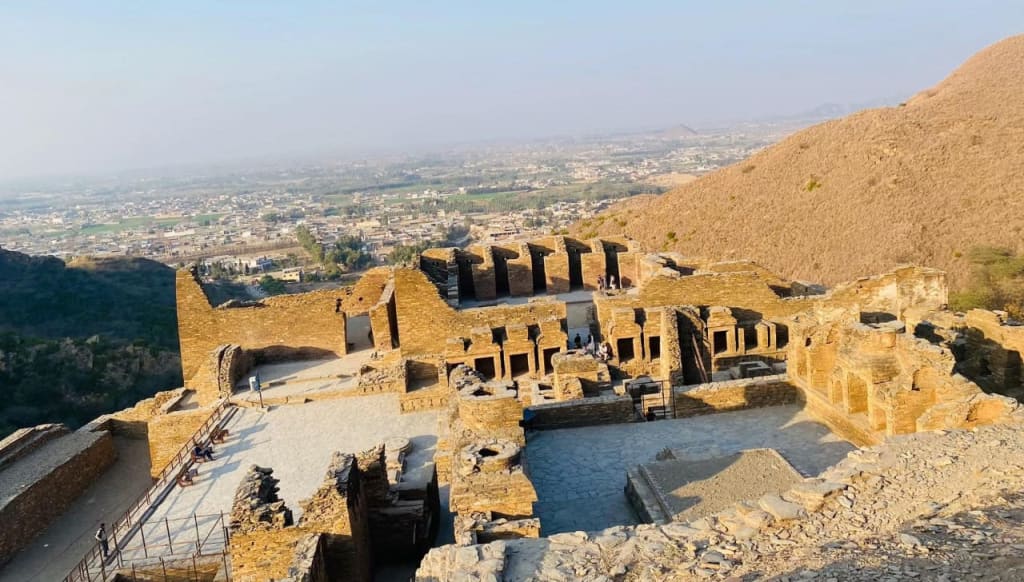
In the heart of Khyber Pakhtunkhwa, Pakistan, lies a place where stones speak and winds carry stories of centuries past. This is Takht Bhai — one of the most remarkable Buddhist monastic complexes of the ancient Gandhara civilization.
Takht Bhai, which means “Throne of the Spring”, stands as a silent witness to a golden age of faith, art, and learning. Its ruins, dating back to as early as the 1st century BCE, are considered one of the best-preserved Buddhist monasteries in the world.
[Cut to: Close-up shots of stone stupas, meditation cells, and intricate carvings on the walls.]
Narrator:
Once, these stones were alive with devotion. Monks clad in saffron robes meditated in these very cells, chanted in assembly halls, and walked these courtyards as they sought enlightenment.
Takht Bhai is part of the Gandhara region, a cradle of Buddhist culture. Gandhara was not just a place but an idea — where Greek, Persian, and Indian influences blended to create a unique artistic and spiritual heritage. The art of Gandhara, found here in Takht Bhai and nearby sites, is world-famous for its graceful sculptures of the Buddha and his disciples.
[Archival photo of British archaeologists in the late 19th century.]
Narrator:
Takht Bhai’s story, however, is also one of survival. As Buddhism declined in the Indian subcontinent after the 7th century CE, the monastery was abandoned. For centuries, it lay forgotten, its stones battered by wind and rain.
In the late 1800s, British archaeologists rediscovered the site. They began excavations, uncovering its stunning architecture and removing many priceless artifacts to museums in India, Britain, and beyond. Some called it preservation. Others called it plunder. But Takht Bhai endured, standing tall through it all.
[Panoramic shot of the ruins at sunset, tourists walking among the stones.]
Narrator:
Today, Takht Bhai is more than just a ruin. It is a UNESCO World Heritage Site, recognized in 1980 for its outstanding cultural value. Visitors from around the world climb its steep steps to marvel at its stupas, its residential quarters, and its peaceful courtyards.
The site is divided into four main areas: the stupa court at the center, surrounded by smaller stupas and shrines; the assembly hall, where monks gathered; the meditation cells, carved into the hillside for quiet reflection; and the residential quarters, where daily life unfolded.
Every stone has a story. Every path once echoed with prayers. And even now, many say you can feel a strange calm here — as if the monks’ meditations never really ended, but linger in the air.
[Cut to: Interviews with locals and tourists.]
Local elder (on camera):
“My grandfather used to say this place is blessed. Even if it’s in ruins, it brings peace to the heart. You come here, you sit, and you feel it.”
Tourist (on camera):
“It’s amazing to think how advanced and beautiful this place was two thousand years ago. The carvings, the architecture — it’s really emotional to stand here.”
[Closing shots: The monastery in twilight, the sky painted in orange and purple hues.]
Narrator:
Takht Bhai is more than a monument of stone. It is a monument of memory — of faith, of art, of the human longing for meaning.
As the winds whisper through its ancient walls, one thing becomes clear: though the monks are long gone, their presence remains. In the silence of Takht Bhai, their prayers still echo, reminding us that some places never die.
why british leave
The British left this place after the partition of India in 1947, as their colonial rule ended. With the creation of Pakistan and India, British control was no longer needed. They handed over power to local governments and withdrew, leaving behind their buildings, villages, and historical traces of their presence.
About the Creator
USA daily update
News, Politics, Technology Updates
Keep reading
More stories from USA daily update and writers in History and other communities.
Google pixel 10 phone launch in next month.
1. Launch & Pricing Strategy 🚀 Google is expected to unveil the Pixel 10 series in August 2025, with several models: standard Pixel 10, Pixel 10 Pro, Pixel 10 Pro XL, and a folding Pixel 10 Pro Fold. Leaked European pricing suggests Google is keeping things competitive:
By USA daily update 8 months ago in History
The Year 1916 in Review: Fun Facts, Trivia, and Historic Highlights
This quick read is a collection of fun facts, trivia, and historic events from the year 1916. Discover the year’s top news stories, most influential people, sports trivia, grocery prices, entertainment news, and much more.
By Gregory DeVictor4 days ago in History
Writing To Succeed
If you want to find something that will help readers find your writing, possibly expand your audience, and maybe even get you noticed for other things, then you’re not alone. But how can you get it done in a world full of want-to-be writers? Look less at what you’re writing now, and more at what other writers have used to boost their views and reads.
By Jason Ray Morton 6 days ago in Writers




Comments
There are no comments for this story
Be the first to respond and start the conversation.