World History
Google’s Digital Ad Monopoly Declared Illegal: What the Landmark Ruling Means for the Tech Giant and the Internet
The Landmark Decision Declares Google's Digital Ad Monopoly Illegal: What It Means for the Internet and the Tech Giant In a major blow to one of the world’s most powerful companies, a U.S. federal judge has ruled that Google operates illegal advertising monopolies that have “substantially harmed” customers, competitors, and the online advertising market as a whole. One of the most significant antitrust rulings against a technology company in recent history is this one.
By Md Shahadat Hossain10 months ago in History
Hamas formally rejects Israeli ceasefire offer
Hamas officials had already indicated to the BBC earlier in the week that they would reject the plan. "Netanyahu and his government use partial agreements as a cover for their political agenda, which is based on continuing the war of extermination and starvation, even if the price is sacrificing all his prisoners [hostages]," Hayya said.
By Sabbir Hossen10 months ago in History
Returning Without Questions
Returning Without Questions They came a little closer to me one odd evening, I recall. Despite its simplicity, the relationship had an odd depth. There was a kind of connection between them that spoke before words, the language of their eyes—even when they were silent in front of each other, they understood each other. However, despite being by each other's side, there are times in life when people move on. There came a time when the two of them moved far away from each other.
By Arshad Ali10 months ago in History
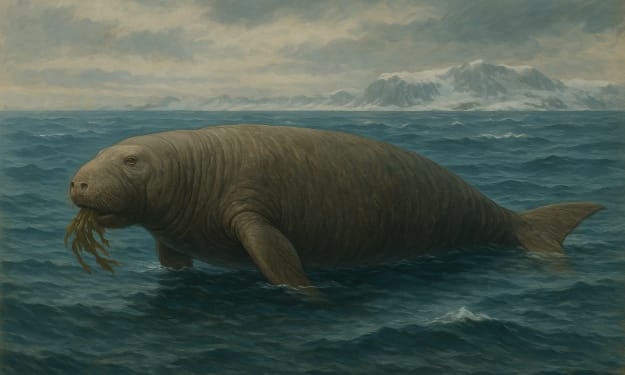
Giants of the Frozen Sea: The Tragic Tale of the Stellar Sea Cow. AI-Generated.
The Stellar sea cow, a massive marine herbivore discovered in the 18th century, is one of the most tragic examples of rapid extinction in recorded history. A close relative of the dugong and manatee, the Stellar sea cow was first documented by German naturalist Georg Wilhelm Steller in 1741 during the Great Northern Expedition led by Danish explorer Vitus Bering. Found in the icy waters surrounding the Commander Islands near the Bering Sea, the sea cow’s tale is a haunting reminder of how quickly human activity can impact fragile ecosystems.
By Say the truth 10 months ago in History
"The Tasmanian Tiger: Echoes of a Lost Predator". AI-Generated.
The Tasmanian Tiger: Echoes of a Lost Predator The narrative of the Tasmanian tiger, or thylacine (Thylacinus cynocephalus), is one of the most heartrending accounts in the records of extinction. Indigenous to Tasmania and once prevalent throughout mainland Australia and New Guinea, this carnivorous marsupial was the largest recognized member of its species. With its characteristic striped lower back, wolf-like cranium, and pouch reminiscent of a kangaroo’s, the thylacine was both a scientific wonder and a cultural symbol.
By Say the truth 10 months ago in History
Hatshepsut's Revenge
Chapter One: The Beginning of Revenge The grand hall of the king's palace was filled with sorrow and hushed whispers. Hatshepsut, the heir to the Egyptian throne, sat beside the body of her late father, the king, trying to conceal her inner turmoil behind a mask of royal grief. She wasn’t just grieving; she was increasingly anxious about the future of her reign following her father’s death.
By mohamed elsayed10 months ago in History
Just How Effective Were Rhodesian Guerrillas?
Rhodesia, a country that is now divided into Zimbabwe and Zambia, with many people today only knowing of its existence as a result of Leonardo DiCaprio's cutthroat character in the 2006 film, Blood Diamond. One thing that you aren't able to learn from the movie, is the 15 year long civil war that tore apart the country's Southern region (present day Zimbabwe.) The Rhodesian Bush War was the result of a multitude of complex political factors, most notably the majority white government declaring independence from Britain without any kind of consent from the crown in 1965, as the South of Rhodesia was a self-governing colony since 1923.
By Jacob Newson10 months ago in History
Bangladesh News
Yes, former President Donald Trump (or any future president) could potentially push for revoking Harvard University’s tax-exempt status, but the process is complex and subject to legal and political constraints. The following is information regarding the law and possible outcomes: 1. The Basics of Harvard's Tax-Exempt Status According to the Internal Revenue Code, Harvard, like the majority of universities, is a 501(c)(3) nonprofit organization, which means that it is not subject to federal income taxes. This status depends on the institution operating for educational purposes and not engaging in excessive political activity or private benefit.
By Md Tanjilur Rahman 10 months ago in History
History of Israel and Palestine
Land, identity, and sovereignty are at the heart of the Israeli–Palestinian conflict, which continues to this day in the historically Palestinian region. Its origins trace back to the late 19th century with the rise of Zionism and Arab nationalism during the decline of the Ottoman Empire. ikipedia The British mandate in the early 20th century and rising tensions Following World War I, the British took control of Palestine under the Mandate system. The 1917 Balfour Declaration expressed British support for a "national home for the Jewish people" in Palestine, leading to increased Jewish immigration. This influx heightened tensions with the Arab population, who opposed the growing Zionist movement and feared displacement. Wikipedia 1947–1949: UN Partition Plan and the First Arab–Israeli War In 1947, the United Nations proposed partitioning Palestine into separate Jewish and Arab states. Jewish leaders accepted the plan, but Arab leaders rejected it. Upon Israel's declaration of independence in 1948, neighboring Arab states invaded, resulting in the first Arab–Israeli war. By the war's end in 1949, Israel controlled a significant portion of the territory, while Jordan and Egypt occupied the West Bank and Gaza Strip, respectively. The Nakba, or "catastrophe," refers to the displacement of approximately 750,000 Palestinians during this time. Reuters
By J P PRINCE 10 months ago in History