Research
Why Titanic didn't had enough lifeboats?
In James Cameron's 1997 blockbuster film, Titanic, there's a memorable moment where Rose, played by Kate Winslet, realizes a critical fact about the lifeboats: "It seems that there are not enough for everyone aboard." The response from Victor Garber's character, Titanic's architect Thomas Andrews, is both confident and poignant: "I have built a good ship, strong and true. She's all the lifeboat you need." Given the foreknowledge of the tragic outcome, this line takes on a bitter irony, embodying the essence of how the Titanic was designed and the fateful errors that unfolded.
By Shubham Bajaj2 years ago in History
FIFA's Tarnished Legacy: Unraveling the Corruption Behind the World Cup
On a chilly December 2nd in 2010, the world of football held its breath as the International Federation of Association Football, known as FIFA, gathered in picturesque Switzerland. This momentous gathering was convened to unveil the future hosts of the prestigious 2018 and 2022 World Cup tournaments. An illustrious audience had assembled, reflecting the political might and fervor behind their respective bids. The scene was set with notable figures like former U.S. President Bill Clinton, a vocal advocate for the U.S. bid, and Prince William championing England's cause. The Dutch Prime Minister and former Belgian Prime Minister stood united with a joint bid.
By Shubham Bajaj2 years ago in History
Why queen Elizabeth 2nd was the queen of 15 countries!?
On November 30th, 2021, history was made as Barbados proudly emerged as the world's newest republic. With a resounding declaration, the transformation was solidified: "From this day and forever, declare Barbados a parliamentary republic." This pivotal moment marked the culmination of a journey that saw Barbados unfurl its own flag, symbolizing the end of a colonial era spanning over 350 years and dissolving its ties to the British royal family. What added an intriguing layer to the event was the presence of none other than Prince Charles, who acknowledged, "It was important that I should join you to reaffirm those things which do not change."
By Shubham Bajaj2 years ago in History
APS Peshawar Attack 2014. Content Warning.
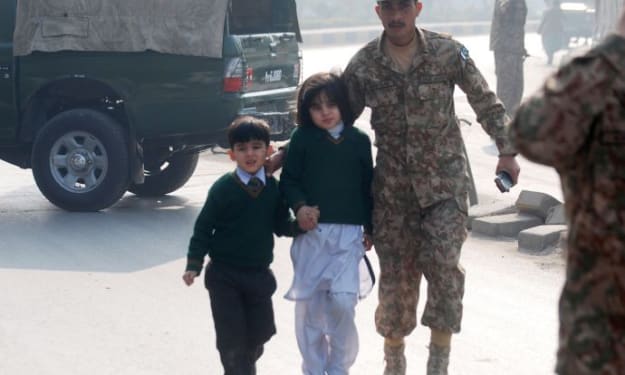
The Army Public School attack in Peshawar, which occurred on December 16, 2014, is a tragic event that left a lasting impact on Pakistan and the world. This attack was carried out by the Tehrik-i-Taliban Pakistan (TTP), also known as the Pakistani Taliban, and resulted in the deaths of over 140 individuals, most of whom were schoolchildren. The attack shocked the nation and galvanized public opinion against terrorism and extremism. In this essay, we will delve into the details of the APS Peshawar attack, its aftermath, and its implications for Pakistan's fight against terrorism.
By Fatima Imran2 years ago in History
The Remarkable Discovery of the Lost Tombs of the Pharaohs
In the heart of the scorching Egyptian desert, an international team of archaeologists embarked on an audacious expedition to unravel one of history's greatest mysteries: the elusive tombs of the Pharaohs that had eluded discovery for centuries. Armed with cutting-edge technology and unwavering determination, they set out on a journey that would rewrite history books and capture the world's imagination.
By mostafa ali2 years ago in History
How the 'lost cities' of amazon were finally found
Meet Percy Fawcett, the intrepid British explorer whose journey into the heart of the Amazon rainforest in 1925 marked the last known communication from him. This was his eighth expedition into the Amazon, driven by a singular objective: the pursuit of a fabled lost city, dubbed "Z". This quest was fueled by age-old rumors that whispered of sprawling cities nestled deep within the dense rainforest, a notion that captured Fawcett's imagination. Yet, despite his unwavering determination, Fawcett's search for "Z" and other mythical cities remained unfruitful, leaving many to believe that the Amazon's untamed wilds were incompatible with the existence of urban centers.
By Shubham Bajaj2 years ago in History
Hidden Histories: Unearthing the British Museum's Looted Artifacts
Welcome to the captivating world of the British Museum, a place that stands as a testament to the ebb and flow of human history. As you step through its grand entrance, you are greeted by a treasure trove of knowledge spanning an impressive two million years. This colossal repository of culture and heritage draws in countless visitors, earning its title as the world's largest museum dedicated to world history.
By Shubham Bajaj2 years ago in History
Why America's police looks like soldiers?
On a balmy June 1st, a protest surged near the iconic White House, brimming with voices raised in peaceful unity. Yet, the scene shifted swiftly as a formidable contingent, adorned in helmets, riot shields, rifles, and even tear gas canisters, moved to confront the demonstrators. The figures in this mix of authoritative presence included a fusion of police and military personnel - Secret Service agents, vigilant Park Police, the steadfast National Guard, the specialized forces of the Prison system, and the vigilant local law enforcement from a neighboring county. The intriguing aspect here is discerning who among these figures represents the police force. This task, however, is made perplexing due to an evolving and unsettling resemblance between America's police officers and its armed forces.
By Shubham Bajaj2 years ago in History
The Evolution of Anesthesia in Medical History
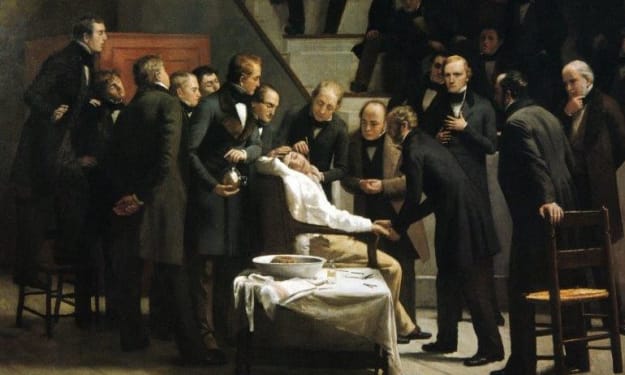
Imagine a time when medical procedures were performed without the comfort of numbing or unconsciousness. It was a time of great suffering, as patients had to endure excruciating pain while doctors hurried to complete their work. In the 1830s, a notable example was Scottish surgeon Robert Liston, celebrated for his incredible speed in the operating room. Picture this: a patient lying on the table, medical students holding them down, and curious onlookers awaiting the surgeon's skilled hands. With swift and precise movements, Liston cut through flesh, sawed through bones, and within mere minutes, an amputation was done. This scene captures the harsh reality of pre-anaesthesia surgeries. Patients had to remain fully conscious throughout the procedure, experiencing every sensation, every cut, and every stitch.
By Anita Nelima2 years ago in History
Debunking common misconceptions about the middle ages
The Middle Ages, a captivating epoch often painted with broad strokes of misinformation, beckons us to delve deeper into its intricate tapestry. A time when knights in shining armor supposedly battled dragons, where ignorance reigned supreme, and hygiene was nearly non-existent. Yet, as we peel back the layers of myths that have shrouded this era, we find a more nuanced and fascinating narrative that defies these simplistic notions.
By Anita Nelima2 years ago in History