Perspectives
Plato: The Beacon of Knowledge
Plato: The Philosopher of Ability and Idealism Plato, one of the greatest philosophers in animal history, is a cornerstone amount in Western thought. Built-in in Athens about 427 BCE, Plato was a apprentice of Socrates and the abecedary of Aristotle, basic a leash that has greatly afflicted philosophy, science, and political theory. His contributions to epistemology, metaphysics, ethics, and political aesthetics abide foundational. Axial to Plato’s aesthetics is his compassionate of knowledge, decidedly his Approach of Forms, which explores the attributes and banned of animal compassionate and perception.
By Say the truth 12 months ago in History
Magic in Ancient Egypt: A Divine Force Intertwined with Life
Introduction Magic, known as heka in ancient Egyptian culture, was more than a mystical practice—it was a cornerstone of existence. Unlike in many later societies where witchcraft was feared or persecuted, the Egyptians revered magic as an integral part of their daily lives, religion, and understanding of the universe. They believed that magic was not only a gift from the gods but also the force that sustained the cosmos and bridged the realms of the mortal and the divine.
By Sajjad Rana Hussain12 months ago in History
Afghanistan: A Nation of Resilience and Transformation
Officially known as the Islamic Emirate of Afghanistan, this landlocked nation has a population of 43.3 million, making it the 36th most populous country in the world. Covering an area of 652,000 square kilometers, Afghanistan ranks 41st in terms of size globally.
By Sajjad Rana Hussain12 months ago in History
The Origins of Love: A Journey Through Time and Emotion
Love is one of the most complex and profound emotions experienced by humans. It has inspired countless works of art, literature, and music, transcending cultures and generations. But where does love come from? What are its origins? To understand love, we must journey through the realms of biology, psychology, and history, uncovering how this powerful emotion has shaped humanity and continues to define our existence.
By Nora Ariana12 months ago in History
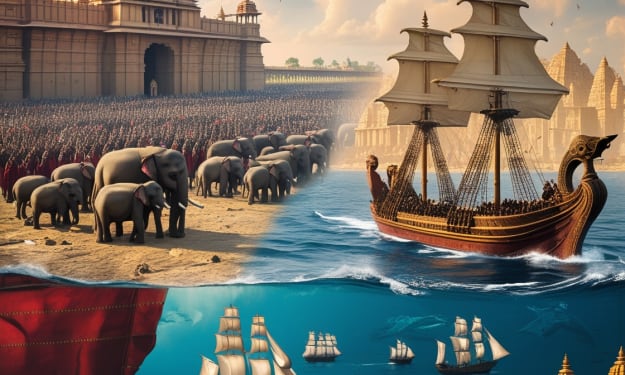
Cholas vs. Mauryans: A Clash of Power and Strategy
"Cholas vs. Mauryan Empire: A Comparative Analysis of Two Indian Powerhouses" The Chola absolutism (circa 9th–13th aeon CE) and the Mauryan Empire (322–185 BCE) angle as two of the best able and affecting empires in Indian history. While the Mauryan Empire is acclaimed for its all-inclusive territorial conquests and authoritative efficiency, the Chola absolutism is acclaimed for its amphibian ascendancy and cultural achievements. This commodity compares their aggressive might, reserves, aegis strategies, tactics, and argosy ability to accept how these two empires anchored their legacies in Indian history.
By Say the truth 12 months ago in History
Colombia
Colombia is a vibrant and diverse country in South America. Known for its rich culture, beautiful landscapes, and warm people, Colombia has much to offer. It is a country full of history, art, and nature, making it a popular destination for tourists and a place of pride for its citizens.
By Farhan Sayed12 months ago in History
Socrates in the Agora: The Philosopher of the People
Socrates’ Enduring Impact on Philosophy While his methods and teachings were revolutionary, Socrates’ philosophical engagements in the Agora also led to tension and resentment among some Athenians. His critiques of traditional beliefs, political leaders, and societal norms made him a polarizing figure.
By Say the truth 12 months ago in History
How to Travel the World for Free (Yes, It’s Actually Possible!)
Years ago, I wouldn't have believed you if you said you could travel the world for free. But today, I've explored far-off places without spending a lot, thanks to smart hacks and resourcefulness. It's not just a dream; it's real!
By Wilson Igbasi12 months ago in History
Exploring The Works of Woman Empowerment by Sarojini Naidu-
Sarojini Naidu, a member of the Constituent Assembly, was dubbed the Nightingale of India. Naidu was appointed Governor of Uttar Pradesh following independence. She became the nation's first female governor of a state as a result. The first female president of Congress was Sarojini Naidu. At 12, she enrolled in the University of Madras, located in present-day Chennai. From 1895 to 1898, she attended King's College in London and then Girton College in Cambridge. She participated in the English suffrage movement during this time. In 1898, she returned to India and wed Govindaraju Naidu, a southern Indian physician she had met in England. Padmaja Naidu, their daughter, accompanied her mother in the fight for Indian independence.
By Hridya Sharma12 months ago in History