Modern
Nineteen Eighty-Four
1984 (also written as Nineteen Eighty-Four) is a powerful and chilling novel written by George Orwell. It was published in 1949, just after World War II, but it talks about a future world that feels cold, controlling, and scary. This book is not only a story—it’s a warning about what could happen if governments gain too much power and people lose their freedom.
By Muhammad Hayat9 months ago in History
Temüjin to Genghis Khan: The Rise of a Conqueror and the Making of an Empire
From Temüjin to Genghis Khan: The Rise of an Empire and Conqueror Few historical figures have evoked such reverence and controversy as Genghis Khan. His early life was a crucible of hardship and betrayal; he was born Temüjin around 1162 in the harsh landscapes near the border of Siberia and Mongolia. However, a leader with unmatched ambition and military prowess emerged from these turbulent beginnings and would build the world's largest contiguous empire. Adversity marked Temüjin's path to power. He suffered from poverty, enslavement, and a constant struggle for survival after being orphaned at a young age and having his family leave him. He did, however, emerge from these trials with a strong resolve and a thorough comprehension of the Mongolian plateau's tribal dynamics. Through a series of strategic alliances and military victories, he began to consolidate his authority, and his charisma and unwavering determination gradually attracted a loyal following. In 1206, a pivotal moment occurred. Recognizing his growing influence and military prowess, a council of Mongol tribes declared Temüjin "Genghis Khan," meaning "universal ruler." This marked the beginning of a Mongol nation that had grown from a collection of feuding nomadic tribes into a powerful military power. The traditional clan structures were torn down under Genghis Khan's radical reforms, and he established a meritocratic system that placed loyalty and skill ahead of lineage. The Yassa, his unified legal code, helped to maintain order and stability in his growing state. Genghis Khan turned his gaze outward now that he had secured his base of power. He had a reputation for both brutal efficiency and strategic brilliance during his military campaigns, which were marked by meticulous planning and exceptional cavalry tactics. As they swept across Asia, the Mongol armies, known for their speed, discipline, and horsemanship, left an indelible mark on the world. The Mongols conquered a significant portion of China in the early 13th century, including the formidable Jin Dynasty. They clashed with the Khwarazmian Empire in Central Asia as a result of their westward expansion, launching devastating campaigns that extended into Persia. Instilling fear and reshaping the political map, Mongol armies under Genghis Khan's command or those of capable generals like Jebe and Subutai pushed as far west as the edges of Europe. Even though the Mongol conquests were frequently accompanied by a great deal of destruction and death, they also accidentally sparked a time of unprecedented interconnectedness throughout Eurasia. Following their initial conquests, the Pax Mongolica, or "Mongol Peace," facilitated trade and cultural exchange along the Silk Road, establishing new and significant connections between East and West. The vast empire was filled with ideas, technologies, and artistic influences that contributed to a time of relative stability and prosperity in many places. In 1227, Genghis Khan was killed while fighting the Western Xia dynasty. The fact that the location of his final resting place is kept a closely guarded secret is evidence of the enduring mystery surrounding his life. He left behind an enormous empire and a legacy that is still up for debate and interpretation. Genghis Khan continues to be an undeniable force in the history of the world, despite being remembered in some regions as a vicious barbarian and in others as a national hero who brought people together. A testament to his extraordinary leadership, military acumen, and unwavering vision, he rose from humble beginnings to become the founder of one of history's largest empires. His impact, which was both destructive and transformative, changed the course of civilizations and has stayed with us today.
By Tafsirul Talukdar luvdo9 months ago in History
The Woman in the Darkness: The Haunting Story of Blanche Monnier. Content Warning.
A Whisper from the Shadows In the heart of 19th-century France, amid cobbled streets and aristocratic elegance, a secret festered behind shuttered windows and thick stone walls. A secret so harrowing, so drenched in silence, that the very air around it seemed to throb with mystery. This is not a tale born from gothic fiction, though it reads like one. This is a true story.
By The Secret History Of The World9 months ago in History
Illuminated Gleam
Hinata was describing the inside of the to everyone. ... There was a couple in the city of Tofko. The girl worked in microbiology and the boy worked in the army. The girl's name was Hinata and the boy's name was Alex. Everything was going on normally. One day, the news came on TV that a meteorite had fallen at the end of the city of Tofko. From where an intense light was coming out. Scientists named the place "Illuminated Gleam". They started their research. All the people were evacuated from the area. The army was given a mission. At first, everyone treated it normally. One day, a group went there. After 1 week, 2 weeks, became one month, but they did not return. After entering there, no contact could be made with them. Another search team went to find the previous group. They also did not return. After that, people started to fear that place. Some people tried to show courage and some people entered the place with self-confidence. But they never came back. One day, Hinata's husband went inside that place. Basically, those who have nothing to lose, no life, go there. Hinata's husband also goes there like everyone else and never comes back. Hinata started missing her husband a lot. Today, Alex has not come home for about 11 months. During this time, Hinata fell in love with one of her colleagues. Then she realized that she was cheating on her husband. Later, she got out of that relationship. After about 1 month, that is, after a long year, Alex came home. Hinata was very happy and hugged Alex and cried, but Alex did not react and did not say anything. Then many people from the army came and took Alex and Hinata away. When Hinata regained consciousness and saw that there was a doctor in front of her. When she asked about her husband, the doctor asked her about Alex. Then Hinata said that Alex had not spoken to her even once since he came home. Then the doctor took her to Alex. He sees that even with all this modern treatment, Alex cannot be cured. Later, the doctor tells him everything. The doctor says that only those who have no hope of life go there. Later, Hinata realizes that Alex knew about her relationship. That's why she was there in anger and pain. Feeling guilty, Hinata decides to go there too. The doctor and 3 girls go with her. Hinata asked doctor why are you going? Then the doctor says that she had cancer. Then everyone leaves. After they enter that place, everything goes dark for them. Suddenly, their senses return. They realize that they have been here for almost 3 days. The surprising thing is that they were in the tent there. They leave all this and go to the place where the meteorite fell. On the road, they are very surprised. Because everything there is genetically changed. When they go further, a crocodile attacks them. But the crocodile could fly and the crocodile's teeth were like sharks. Since Hinata was working on microbiology, she could understand that the crocodile had been mixed with bird and shark DNA. One girl died in the crocodile attack. The others killed the crocodile with great difficulty. They continued to move forward. When they got closer to the sea, they were even more surprised because the trees near the sea had turned into water crytals. When they went further, they saw that instead of deer horns, there were tree branches. They could understand anything normal here. Because the DNA of any plant cannot be changed with animals. They also saw that the flowers of one tree were the flowers of another tree. They got scared. Suddenly, a bear came and ate another girl from their team. Then they could not believe what they saw. They saw that the bear could talk like the girl. They quickly ran away. After going some distance, they saw that their DNA was also changing. A little further ahead, they saw many trees shaped like humans. They realized that almost all those who came here had become trees. Except for the doctor and Hinata, the other 1 girl also turned into a tree in front of them. Then the doctor told Hinata to find a way out and she went to the meteorite. Hinata also followed him. After she went there, she found a camera. After turning on the camera video, she couldn't believe what she saw. Hinata saw her husband turned into a tree in the video. So who is the person from the outside world? She entered the meteorite with a thousand questions in her mind. She saw a hole was pulling her towards him and the doctor going to the hole. She held herself back with great difficulty. But1 drop of blood from her body went into that hole. And from there, a clone of Hinata came out. That clone did the same thing as Hinata. Later, Hinata gave a bomb to the clone and moved away. Later, the bomb exploded and the meteorite along with the clone was destroyed and with it, the effect of this also healed.So,Alex get healthy too. Later, Hinata came to earth and told everyone everything. Finally, she went to her husband and said, "Are you really Alex?" and hugged him.
By Crystal Light 9 months ago in History
Waqf Act 2025: Legislative Divide and Hindu Silence in Bharat
Introduction In Bharat, a nation of 1.4 billion where diversity weaves unity and tension, the Waqf (Amendment) Act, 2025, aimed to curb mismanagement in waqf properties—Islamic endowments for charity—through digitization, audits, and appeal rights. Yet, its passage sparked protests, exposing deep communal tensions. This fourth blog in our HinduInfoPedia series dives into the legislative process behind the Act, the surprising silence of Hindu communities, and the media’s role in amplifying division. Why did a reform meant to address systemic issues become a communal flashpoint, and what does this reveal about Bharat’s governance challenges?
By Jai Kishan9 months ago in History
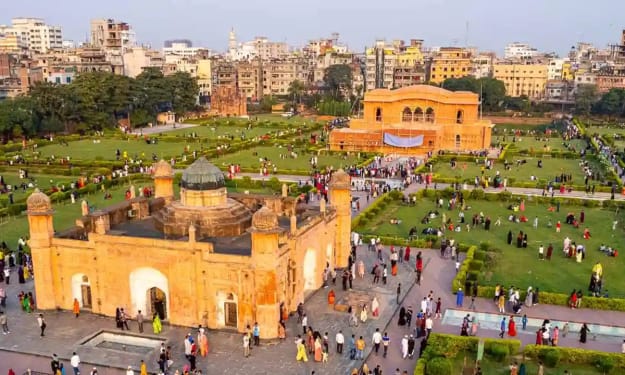
Lalbagh Fort
Lalbagh Fort or Fort Aurangabad, an incomplete Mughal palace fortress at Dhaka on the river Buriganga in the southwestern part of the old city. The river now flows quite a ways from the fort because it has moved further south. D'Oily's painting (1809-11) shows that more than half of this east-west oblong fortress touched the water of the river on its south and southwestern sides.
By Md. Mohorom Ali9 months ago in History
The History of Stress . AI-Generated.
The History of Stress: From Ancient Struggles to Modern Science In today's fast-paced world, the word "stress" is frequently used to describe deadlines, financial stress, or emotional strain. However, stress is not a recent phenomenon at all. The idea has changed over time as a result of cultural shifts, scientific discoveries, and the ever-evolving nature of human existence.
By articelmunaf9 months ago in History
Astronomers Detect a Possible Signature of Life on a Distant Planet
Introduction Astronomers have discovered a potential biosignature in the atmosphere of a distant exoplanet, making a ground-breaking discovery that has the potential to alter our understanding of life in the universe. Scientists have found traces of a gas that is mostly made by living things on Earth using cutting-edge telescopic technology. One of the most compelling hints of extraterrestrial life to date, the findings are not yet conclusive.
By Tech Alamin9 months ago in History
Japanese Retailers Trying to Overcome Soaring Rice Prices.
In Japan, rice is a staple food that is ingrained in its culture and daily diet. However, a number of factors, including climate change, rising production costs, and disruptions to the global supply chain, have caused rice prices to soar in recent years for Japanese retailers. Retailers have been compelled to employ novel strategies as a result of this price increase in order to maintain affordability for customers and ensure sustainable business operations. Reasons for the Rise in the Price of Rice Changes in the climate and natural disasters Rice crops are damaged by typhoons, heavy rains, and droughts, all of which occur frequently in Japan. For instance, in the year 2023, unanticipated floods in important rice-producing regions like Niigata and Akita resulted in significant yield losses, resulting in a decrease in supply and an increase in prices. Rising Costs of Production Global inflation and geopolitical tensions (such as the Russia-Ukraine war) have led to significant increases in the prices of fertilizers, fuel, and labor. Price fluctuations have a direct impact on the costs of domestic rice farming because Japan purchases a significant amount of its fertilizers from abroad. Domestic consumption of rice is declining. Despite rising rice prices, Japan's per capita rice consumption has been falling for decades due to shifting eating habits. Farmers and retailers are put under pressure as a result of this paradox because lower demand results in higher production costs per unit. Issues in the Global Supply Chain Despite the fact that Japan is mostly self-sufficient in rice, price volatility is caused by disruptions in the global food supply chains, such as export restrictions imposed by major rice-producing nations like India.
By Md.Atiqul Islam Emon9 months ago in History