Medieval
The End of College? Employers Drop Degree Requirements in 2025
Introduction For decades, a college degree has been the golden ticket to career success. Employers have long used degrees as a proxy for skills, intelligence, and employability. But in 2025, a major shift is underway: companies across industries are dropping degree requirements in favor of skills-based hiring. This trend raises a critical question: Is this the beginning of the end for traditional college education? As major corporations, tech giants, and even government agencies eliminate degree mandates, the value of a four-year degree is being reevaluated. Rising tuition costs, student debt crises, and the rapid evolution of job skills have forced employers to rethink hiring strategies. In this article, we’ll explore: Why employers are abandoning degree requirements The rise of alternative credentials (bootcamps, certifications, apprenticeships) The potential decline in college enrollment and its economic impact What this means for students, workers, and the future of education Why Employers Are Dropping Degree Requirements 1. The Skills Gap Crisis Many employers struggle to find qualified candidates despite millions of degree holders. A 2024 report by the Society for Human Resource Management (SHRM) found that 45% of employers believe college graduates lack essential job skills. Degrees often emphasize theory over practical application, leaving graduates unprepared for real-world work. Companies like Google, Apple, and IBM have publicly stated that skills and experience matter more than formal education. 2. The Rising Cost of College vs. Diminishing Returns The average student loan debt in the U.S. is $37,000 per borrower, with total student debt surpassing $1.7 trillion. Meanwhile, studies show that many degrees do not guarantee high-paying jobs. Employers recognize that requiring degrees excludes talented candidates who can’t afford college. By removing this barrier, companies tap into a larger, more diverse talent pool. 3. The Shift to Competency-Based Hiring Instead of relying on degrees, employers now use: Skills assessments (coding tests, case studies, portfolio reviews) Micro-credentials (Google Certificates, Coursera, Udacity) Apprenticeships and on-the-job training A 2025 LinkedIn survey found that 72% of employers prioritize skills over degrees, especially in tech, marketing, and healthcare. Alternative Pathways to High-Paying Jobs With degrees becoming optional, workers are turning to faster, cheaper, and more targeted education options: 1. Coding Bootcamps & Tech Certifications Bootcamps (Flatiron School, General Assembly) train students in 3–6 months. Certifications (AWS, CompTIA, Google IT) validate skills without a 4-year degree. Outcome: Many bootcamp grads land $70,000–$100,000+ jobs in tech. 2. Apprenticeships & Earn-While-You-Learn Models Companies like Tesla, Microsoft, and JPMorgan Chase now offer paid apprenticeships instead of requiring degrees. 3. Online Learning & Self-Education Platforms like Coursera, Udemy, and Khan Academy provide affordable upskilling. Self-taught professionals in fields like digital marketing, UX design, and cybersecurity are thriving without degrees. The Decline of College Enrollment & Its Economic Impact 1. Plummeting Enrollment Rates Since 2020, U.S. college enrollment has dropped by nearly 10%. If this trend continues, universities could face: Campus closures (especially small liberal arts colleges) Reduced funding for research and programs Increased competition from alternative education providers 2. The Student Debt Reckoning As fewer students see college as a worthwhile investment, pressure mounts on policymakers to: Cancel or reduce student debt Subsidize vocational training Regulate for-profit colleges 3. The Rise of Corporate Universities Companies like Amazon, Walmart, and Salesforce now offer their own training programs, bypassing traditional education. What This Means for Students & Workers For Current Students: Consider ROI before enrolling—will your degree pay off? Supplement with certifications to stay competitive. Explore apprenticeships and internships for hands-on experience. For Job Seekers Without Degrees: Build a strong portfolio (GitHub, Behance, personal website). Network aggressively—many jobs come from referrals. Leverage free/low-cost upskilling (Google Career Certificates, LinkedIn Learning). For Employers: Focus on skills assessments over pedigree. Invest in training programs to bridge skill gaps. Promote diversity by removing unnecessary degree filters. Conclusion: Is College Still Worth It? The decline of degree requirements doesn’t mean college is obsolete—elite schools and specialized fields (medicine, law) will still demand degrees. However, for many careers, skills and experience are the new currency. In 2025, the education system is at a crossroads. Universities must adapt by offering more affordable, flexible, and job-relevant programs. Meanwhile, workers must continuously learn to stay competitive in a fast-changing job market. The era of "degree inflation" is ending. The future belongs to those who can prove their skills—with or without a diploma.
By Silas Blackwood8 months ago in History
Taylor Swift’s Record-Breaking ‘Eras Tour’ Movie Dominates Streaming
Taylor Swift continues to redefine success in the entertainment industry, and her latest triumph comes in the form of Taylor Swift: The Eras Tour (Taylor’s Version), a concert film that has taken streaming platforms by storm. Originally released in theaters in October 2023, the film shattered box office records before making its highly anticipated debut on Disney+ in March 2024. Since then, it has dominated streaming charts, reinforcing Swift’s unparalleled influence in music, film, and pop culture.
By Silas Blackwood8 months ago in History
History Would’ve Burned: How Fire Shaped Civilizations
Fire is one of humanity’s oldest and most transformative discoveries. Its mastery marked the dawn of civilization, altering the course of history in ways both constructive and destructive. From providing warmth and protection to enabling technological advancements, fire has been a double-edged sword—capable of nurturing societies or reducing them to ashes. This article explores how fire has shaped human history, from prehistoric times to the modern era, and how civilizations have risen, fallen, and adapted in its flames. The Dawn of Fire: Humanity’s First Great Tool The controlled use of fire dates back at least 1 million years, with evidence suggesting that early hominids like Homo erectus harnessed it for warmth, cooking, and protection. Fire allowed early humans to: Cook food, making it more digestible and unlocking greater nutritional value, which may have contributed to brain development. Ward off predators, enabling safer settlements. Extend waking hours by providing light after sunset, fostering social interaction and tool-making. Without fire, human evolution and migration—especially into colder climates—would have been drastically different. Fire and the Birth of Civilization As humans transitioned from nomadic hunter-gatherers to settled agricultural societies, fire became indispensable. 1. Agriculture & Land Management Slash-and-burn farming cleared forests for crops, though it also led to soil depletion over time. Controlled burns were used by Indigenous peoples to manage ecosystems, promoting biodiversity. 2. Metallurgy & Technology The discovery of smelting (extracting metal from ore using fire) revolutionized tool-making, leading to the Bronze and Iron Ages. Fire enabled ceramics and glassmaking, essential for storage, construction, and art. 3. Warfare & Destruction Fire was weaponized early, from flaming arrows to Greek fire (a Byzantine incendiary weapon). Cities like Rome (64 AD) and London (1666) suffered catastrophic fires that reshaped urban planning. Fire as a Cultural and Religious Symbol Beyond its practical uses, fire held deep spiritual significance: Zoroastrianism revered fire as a symbol of divine wisdom. Greek mythology told of Prometheus, who stole fire from the gods to give to humanity. Hindu rituals involve sacred fires (yajna) for purification and offerings. The Industrial Revolution: Fire Powers the Modern World The 18th and 19th centuries saw fire’s role expand exponentially with the advent of: Steam engines (burning coal) powering factories and transportation. Internal combustion engines, leading to automobiles and airplanes. Electricity generation, initially through coal and later gas and oil. However, industrialization also brought pollution, deforestation, and climate change—unintended consequences of humanity’s reliance on fire. Fire in the Modern Age: Control and Catastrophe Today, fire remains both a vital tool and a devastating force: 1. Controlled Use Energy production (natural gas, nuclear reactions). Space exploration (rocket propulsion). Medicine and industry (sterilization, manufacturing). 2. Uncontrolled Disasters Wildfires (exacerbated by climate change) destroy millions of acres annually. Urban fires (e.g., Grenfell Tower, 2017) reveal vulnerabilities in modern infrastructure. Warfare (napalm, incendiary bombs) continues to use fire as a weapon. Conclusion: Will Fire Consume or Sustain Us? Fire has been a defining force in human history—both creator and destroyer. As we advance, the challenge is to harness its power responsibly, mitigating its dangers while leveraging its benefits. From ancient campfires to fusion energy, fire remains at the heart of civilization’s progress. If history is written in flames, then humanity’s future will be shaped by how well we master this primal force—before it masters us.
By Silas Blackwood8 months ago in History
99-million-year-old dinosaur tail found preserved inside amber fossil
**99-Million-Year-Old Dinosaur Tail Found Preserved Inside Amber Fossil** In one of the most extraordinary paleontological discoveries of the 21st century, scientists have uncovered a 99-million-year-old dinosaur tail preserved in amber. This rare and stunning find, unearthed in Myanmar, has provided researchers with a unique glimpse into the ancient world, revealing incredible details about feather evolution, dinosaur biology, and the ecosystems of the Cretaceous period.
By GLOBAL NEWS8 months ago in History
Creative Cruelties
I could not choose one specific moment that history would burn, so I highlighted a few. Each one deserves a more indepth look, for us to appreciate where we come from. But each one also is more than enough for us to know, without doubt, to be better.
By Kelli Sheckler-Amsden8 months ago in History
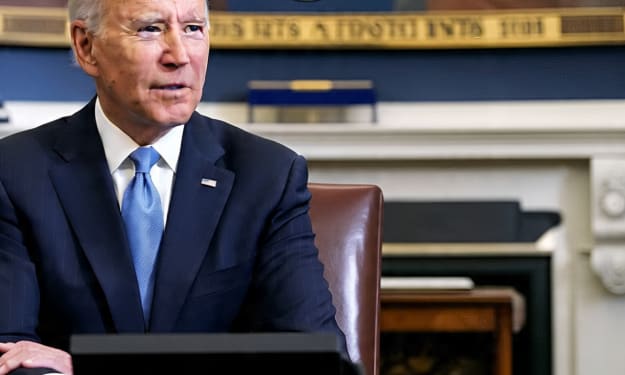
Joe Biden. AI-Generated.
Joe Biden was born on November 20, 1942, in Scranton, Pennsylvania, a small city in the United States. He grew up in a working-class family. His father, Joseph Biden Sr., worked very hard to take care of the family. At times, the family had little money. But they stayed strong and close together.
By Khalil Rehman8 months ago in History
Gerrymandering the Presidency: Why Trump could lose the popular vote in 2020 by 6 percent and still win a second term.
Donald Trump was the clear Electoral College winner in the 2016 election, despite losing the popular vote by a wide margin to Hillary Clinton. Anthony J. McGann, Charles Anthony Smith, Michael Latner and Alex Keena write that, unless the Supreme Court stops congressional gerrymandering, President Trump can guarantee re-election in 2020 – even if he loses by 6 percent. When the US Supreme Court takes up the issue of partisan gerrymandering this year, they will decide not only the fate of popular control in the House of Representatives and many state legislatures, but quite possibly the Presidency as well. If four Republican controlled state governments (Pennsylvania, Michigan, Wisconsin and Florida) change the way they allocate Electoral College votes, President Trump could be re-elected in 2020, even if he loses the popular vote by 6 percentage points. All the states need do is to allocate Electoral College votes by congressional district (like Nebraska and Maine), instead of giving all of the state’s electors to the statewide winner. Of course, this strategy only works to the benefit of the Republicans because the congressional districts in these states are heavily gerrymandered. As we argue in our book Gerrymandering in America, the congressional districts in many states are drawn to advantage the Republican Party. For example, in Pennsylvania in 2012 the Republicans took 13 out of 18 House districts even though the Democrats received more votes. If this partisan gerrymandering were outlawed, then allocating Electoral College votes by congressional district in the four states would actually disadvantage the Republican candidate for President. However, if the Supreme Court continues to allow partisan gerrymandering – as it has since its decision Vieth v. Jubelirer in 2004 – then the plan is highly effective and there is nothing that can stop the four states adopting it. Allocating Electors by congressional district is clearly legal – Nebraska and Maine already do it this way. Furthermore, the Republicans control the state legislature and the governor’s mansion in all four states. How allocating Electors by congressional districts could benefit the Republican candidate Surprisingly, the strategy that is most effective for the Republicans is to change how Presidential Electors are allocated in certain states that voted for Trump in 2016. Of course, the Republicans would get an advantage by allocating Electors more proportionally in states that Clinton won. The problem is that this would require the support of Democrats. For example, Republican legislators in Virginia and Minnesota have already proposed such measures, and Stephen Wolf describes this as an attempt to “gerrymander the electoral college”. The problem is that both these states have Democratic governors, who would surely veto such proposals. Similarly Harry Enten at fivethirtyeight.com shows that if all states allocated Electors by Congressional districts, the Republicans could win the Presidency despite a 5 percent popular vote deficit. Again the problem is that this would require Democratic controlled states to agree to such a system. However, in Pennsylvania, Wisconsin, Michigan and Florida, Republicans control both the state legislature and the
By Silas Blackwood8 months ago in History
🤢The Great Stink of London, Summer 1858: How the Thames River's Filth Nearly Shut Down Parliament and Sparked Sewer Reforms
The Summer That Stank to High Heaven In the sweltering summer of 1858, London became the setting for one of the foulest crises in urban history. For several weeks, an unbearable stench rose from the River Thames, the city's main waterway and open sewer, engulfing the metropolis in a nauseating miasma that no one - not even the powerful lawmakers in the Palace of Westminster - could escape. The event, which became known as "The Great Stink," was more than just a sensory nightmare; it was a pivotal moment in the evolution of public health and urban infrastructure.
By Kek Viktor8 months ago in History
Trump's Speech about Jerusalem: An Analysis on Persuasive Strategies. AI-Generated.
INTRODUCTION Jerusalem is a holy place where several beliefs and faiths live together. Islam, Christianity and Jews live and do worship in that city (BBC, 2017). Its territory surrounds Palestine and Israel. Both countries have been being a great rivalry in an old-world war since 1948 (Margolick, 2008). Donald Trump as the president of USA showed his sympathy toward both a long-world war and it was stated through his political speech. Stobbs (2012) considered that political speeches are written with a very great plan and purpose. As the president of USA, Trump is the most influential person in the world. His word will always provoke great responses from all people over the world. He showed his remark on his speech about Jerusalem on 23rd May 2017. Through his speech, he expected the three religions in Jerusalem, such as Jews, Islam and Christianity can build peace together. On 6th December 2017, Trump declared Jerusalem as the capital city of Israel. It provoked pros and cons from several leaders of nations over the world. He stated that his claim was to stop the war between Israel and Palestine, and to achieve peace. Through his speech, Trump intended to show his power and communicate what he wanted to. Speech is one the ways of having communication (Soedjarwo, 2020). In having communication, the speaker influences hearer to believe in what he says or doing something that he wants to. Alfian, Santi, and Sari (2019) stated that a good communication depends on how speaker can achieve the goal of what he says. Speaker absolutely persuades hearers to achieve the goals of communication. In Persuading hearers, speaker can uses persuasive strategies. Speaker uses persuasive strategies to influence other people through utterance without doing compulsion. Gass and Seiter (2010) stated that persuasion is an attempt to influence hearers motives and attitudes.
By Silas Blackwood8 months ago in History
NASA Confirms Evidence of Alien Life? Latest Findings from Europa Mission
Introduction: The Europa Enigma For decades, Jupiter’s icy moon Europa has captivated scientists as one of the solar system’s most promising candidates for extraterrestrial life. In 2025, NASA’s Europa Clipper mission delivered its most compelling data yet—potential biosignatures beneath the moon’s frozen crust. While NASA has stopped short of declaring definitive proof of life, the evidence has ignited a scientific and philosophical firestorm. This article examines: The shocking findings from Europa’s subsurface ocean How NASA’s instruments detected potential alien biosignatures The scientific debate over what constitutes "proof" of life The ethical and societal implications of confirming extraterrestrial organisms What comes next in humanity’s search for life beyond Earth
By Silas Blackwood8 months ago in History
2024 Election Fallout: Supreme Court Rules on Trump’s Immunity Case
Introduction In a historic decision that could reshape the future of U.S. presidential accountability, the Supreme Court ruled on former President Donald Trump’s immunity case in 2024. The case, Trump v. United States, centered on whether a former president enjoys absolute immunity from criminal prosecution for actions taken while in office. The ruling not only impacts Trump’s multiple legal battles but also sets a precedent for the limits of executive power. This article examines the Court’s decision, its legal and political implications, and the potential consequences for the 2024 election and beyond. Background: The Legal Battle Over Presidential Immunity
By Silas Blackwood8 months ago in History