Lessons
The Ten Plagues of Egypt: Divine Lessons in Exodus
The Ten Plagues of Egypt: Divine Lessons in Exodus In the annals of human history, there exist stories that resonate through the ages—tales of triumph, suffering, and transcendence. Among these, the account of the ten plagues of Egypt stands as a remarkable and enduring narrative, a pivotal chapter in the biblical Book of Exodus. It is a story of liberation, divine intervention, and the profound lessons learned on the arduous path to freedom.
By Raymark Marcos2 years ago in History
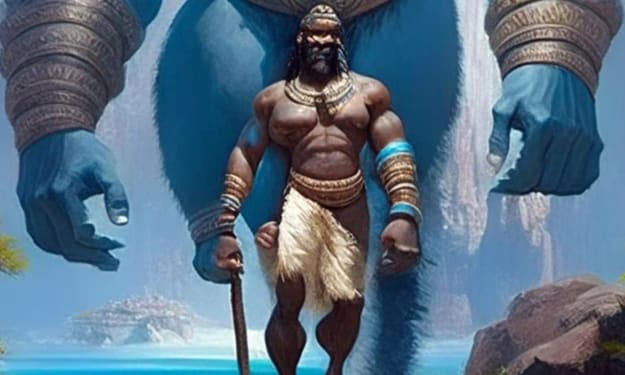
Do you Believe in Lemuria Giants? Were giants real?
The legend of Lemuria and its supposed giants is a captivating and enigmatic chapter in the annals of mythology and pseudo-science. Often regarded as a lost continent, Lemuria has intrigued explorers, writers, and conspiracy theorists for over a century. In this article, we delve into the lore surrounding Lemuria and its alleged giant inhabitants.
By Vasco Duarte2 years ago in History
A Comprehensive Guide to Lord Zeus and Their History!
Lord Zeus, the iconic figure of ancient Greek mythology, is a symbol of power, authority and divine authority. Born to Cronus and Rhea, Zeus was part of the first generation of Olympian gods, and his ascension to the throne was an important moment in the history of mythology
By Manish Sharma2 years ago in History
Newton's Gravity vs Einstein's Gravity
Newton's gravity Why does an apple fall from a tree towards the ground and why does the moon orbit around the Earth? In the 17th century, mathematician and physicist Isaac Newton answers these two questions with a single answer “gravitation”. So what is gravitation? In the universe all objects that possess a mass attract each other. For example the moon attracts the earth and the earth attracts the moon. Now let us imagine a first object A and a second object B separated by a certain distance. Because of gravitation, these two objects attract each other; in this way A will get closer to B and B will get closer to A. If A was more massive then the gravitational pull would be stronger inversely if A was less massive and the gravitational pull would be weaker, this is equally true for B. Following on, if the two objects were more distant the gravitational pull would be weaker and if they were close the gravitational pull would be stronger as such the gravitational pull of one object on another goes away when the two objects are very far apart. Let's now take the example of an apple. The Apple possesses a certain mass and so does the earth so the Apple attracts the earth and inversely the earth attracts the Apple. This is why the Apple and the earth will get closer one to the other up until the Apple touches the ground. Now let's imagine that we throw the Apple in a direction with a certain speed like before the Apple will be attracted to the earth but it will also move in the direction in which it was thrown depending on its speed. The faster the Apple is thrown, the further the Apple falls. Now if we could throw the Apple with a high enough speed we would see that this velocity would counter the gravitational pull and that the Apple would never fall down on the ground this is what happens with the moon and that is why the moon orbits around the earth as well as why the earth orbits around the Sun.
By Mohamed Abdallah Abdoul-Halim2 years ago in History
The Industrial Revolution:
The Industrial Revolution saw a significant transition from agrarian communities to industrialized nations, making it one of the most trans-formative eras in human history. In this 600-word synopsis, we examine the causes, significant innovations, societal effects, and lingering legacies of this historic period.
By The Knowledge 2 years ago in History
Japan's Technological Revolution: From Tradition to High-Speed Innovation
Japan, a land of deep-rooted traditions, might seem like an unlikely hub for cutting-edge technology. However, this paradox is intricately woven into the tapestry of Japan's history, reflecting its remarkable evolution from a feudal society in the 19th century to a global technological powerhouse in the 20th century. One remarkable example of Japan's tech adoption journey is the digital camera, a device that originated in America but was swiftly embraced and dominated by Japanese brands like Sony, Canon, Nikon, Fujifilm, Panasonic, Olympus, and Pentax.
By Perry Allen2 years ago in History
The Last Supper: A Feast of Redemption
The Last Supper: A Feast of Redemption In the heart of Jerusalem, the ancient city steeped in history and holiness, the evening sun cast long shadows over the bustling streets. The city was abuzz with preparations for the approaching Passover, a sacred festival that held deep significance for the people of Israel. But amid the hustle and bustle, a small upper room awaited its moment in history—a room that would become the setting for one of the most profound and enduring moments in Christianity: the Last Supper.
By Raymark Marcos2 years ago in History
"The Curious Door"
PMON STORY: Once upon a time in a land untouched by stories, there was a peculiar town named Whimsyville. In this quaint place, something extraordinary happened every day, yet no one noticed. It was as if the town existed in a bubble, separate from the ordinary tales that filled the rest of the world.
By PMON STORE2 years ago in History
History and Religion of Ancient Greece!
Ancient Greece is a civilization that has fascinated scholars and people worldwide. Its rich history and religious beliefs have shaped the world we live in today. The Greeks were influential in many areas, from philosophy and literature to politics and science. Their cultural achievements are still celebrated today, making Ancient Greece one of the most significant civilizations in history.
By Manish Sharma2 years ago in History
''Unspoken''
There is a silent narrative that speaks volumes in the empty spaces between an article's lines, where words hesitate and punctuation lingers—an unspoken story that reverberates beyond the printed page. It's a story that is weaved into the sentence itself, whispered through linguistic complexity, and hidden inside the poignant pauses.
By Nabila Nazir2 years ago in History
When Russia invaded Ukraine, the “international community” stood back. But is there such a thing? What, if anything, can bring the world together?
When Russia invaded Ukraine, the “international community” stood back. But is there such a thing? What, if anything, can bring the world together?
By Rajesh kumar 2 years ago in History