Fiction
Time Crossed
To my dear beloved: The other night was a night that I will never forget. The time that we shared can never be compared to anything I have ever experienced. When you spoke to me on that park bench, I must admit that I was prepared to shut you down right away. But there was something about your face that told me to trust you. All you were looking for was a way to enjoy the night.
By David E. Perry12 months ago in History
The road to redemption
Mysteries Revealed. A Dark Night The alley, plunged into darkness, suddenly seems more disturbing. The shadow that crept in disappears, leaving behind an air of mystery. Clara, the young journalist, finds herself faced with a dilemma. Should she continue to investigate this enigmatic figure who haunts the nights in her neighborhood, or leave this story aside to concentrate on less disturbing subjects?
By Christine Hochet12 months ago in History
Where the Wheat Still Grows
April 14, 1864 Farmstead near Winchester, Virginia My Dearest Margaret, I write to you in the dim light of early morning, before the sun has stretched its arms over the hills. The fields are quiet, save for the rustle of the wheat that has begun to green again after the long winter. It is a comfort to me, this steady cycle of the earth, though I find no such certainty in the affairs of men.
By Diane Foster12 months ago in History
The Persian Empire's Royal Treasury – A Vault of Gold
Tne Persian Gold Reserves: The Abundance of an Empire The Persian Empire, one of the greatest civilizations in history, was accepted for its immense wealth, decidedly in gold. From the administering of Cyrus the Great (550 BCE) to the aphorism of Darius III (330 BCE), Persia accumulated all-inclusive affluence of gold, authoritative it one of the richest empires of the age-old world.
By Say the truth 12 months ago in History
The Death of Socrates – A Moment of Philosophical Martyrdom
The Afterlife of Socrates: A Defining Moment in Abstract History Socrates, one of the greatest philosophers of age-old Greece, was a man whose account shaped Western philosophy. He was accepted for his different way of questioning, which came to be accepted as the Socratic method. However, his commodity challenged the cachet quo, and in 399 BCE, he was bedevilled to afterlife by the Athenian government. His execution, agitated out by bubbler a cup of adulteration hemlock, charcoal one of the best acclaimed moments in abstract history.
By Say the truth 12 months ago in History
The Flowers of our youth.
My Dear Anne, How often I’ve thought of you in the past few months. How I’ve longed for your presence at my side once more. Your wedding day while beautiful was one of the worst days of my life. For my oldest and dearest friend was to go away, with a man her father picked out.
By Lane Burns12 months ago in History
The Majestic Palace of Alexander the Great
The Grandest Alcazar of Alexander the Great: Wealth, Luxury, and Construction Alexander the Great (356–323 BCE) congenital an authority that continued from Greece to India, and with it came immense wealth. While Alexander is primarily accepted for his aggressive conquests, he additionally accustomed and active some of the best arresting palaces in history. Among these, his aristocratic abode in Babylon is believed to accept been the best extravagant.
By Say the truth 12 months ago in History
2500 Year Old Tombs With Artifacts Discovered in Israel Shed Light on Ancient Trading
2500 Year Old Tombs With Artifacts Discovered in Israel Shed Light on Ancient Trading Archaeologists have made a groundbreaking discovery near Tlalim Junction in Israel unearthing 2,500 year old tombs and artifacts that shed new light on ancient trade networks and cultural exchanges. The findings led by the Israel Antiquities Authority IAA reveal the Negev Highlands' role as a significant hub for long distance commerce connecting the region to distant civilizations such as Yemen Phoenicia and Egypt. This discovery not only highlights the movement of goods but also underscores the exchange of ideas and traditions across the ancient world. The excavation uncovered a wealth of artifacts that provide insights into the region's historical significance. Among the most notable findings were flint arrowheads which researchers believe originated from Yemen and Oman. These arrowheads along with copper and silver jewelry suggest that the Negev Highlands were a key stopover for traders traveling along ancient routes. Additionally small alabaster vessels historically used to transport incense were discovered further emphasizing the area's role in the trade of luxury goods. One of the most striking artifacts was an amulet depicting Bes the Egyptian deity associated with protection and fertility. This amulet not only highlights the cultural influence of Egypt but also suggests that traders and travelers carried religious symbols for personal protection and spiritual significance.
By Adnan Rasheed12 months ago in History
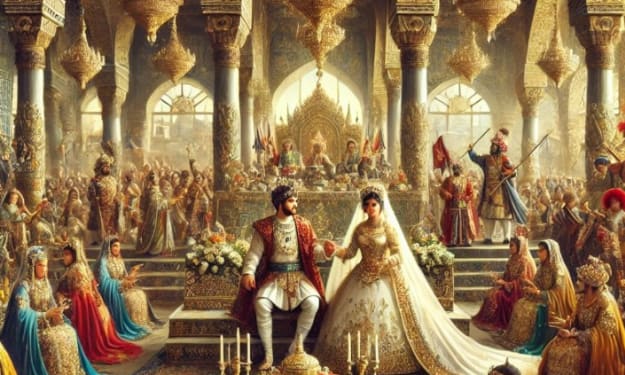
The Royal Splendor of Alexander and Roxana’s Wedding
The Wealth and Spending Habits of Alexander the Great and His Romantic Life Introduction Alexander the Great (356–323 BCE) was not only one of the greatest military conquerors in history but also one of the wealthiest individuals of his time. His empire stretched from Greece to India, and with it came unimaginable riches. From gold-plated palaces to extravagant banquets, Alexander spent his wealth generously—on his army, on cultural advancements, and on his personal life, including the women in his life.
By Say the truth 12 months ago in History
Alexander the Great – The Warrior King. AI-Generated.
The Concrete Description of Alexander the Great: A Historical Perspective Alexander the Great (356–323 BCE) was one of history’s best allegorical aggressive leaders, accepted for his conquests from Greece to India. While his accomplishments are well-documented, descriptions of his concrete actualization appear from age-old historians, coins, sculptures, and literature.
By Say the truth 12 months ago in History