Events
"Muhammad bin Qasim: The Teen General Who Changed History"
Muhammad bin Qasim, a young and ambitious general, played a crucial role in the early Islamic expansion into the Indian subcontinent during the 8th century. His conquests are primarily associated with the region that is now part of Pakistan. The story of Muhammad bin Qasim's conquest of Sindh is a significant chapter in the history of the Indian subcontinent.
By urooj fatima2 years ago in History
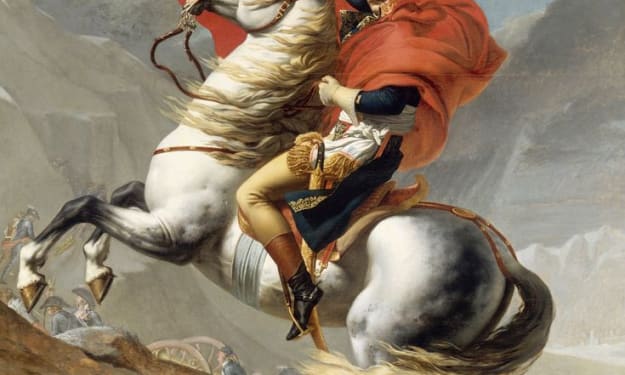
Napoleon Bonaparte
Napoleon Bonaparte: The Rise and Fall of a Conqueror Napoleon Bonaparte, a name that reverberates through history as one of the most influential and controversial figures of the 18th and 19th centuries. Born on August 15, 1769, on the island of Corsica, Napoleon's life unfolded against the backdrop of the turbulent times of the French Revolution. From his early years to his meteoric rise to power, his military campaigns across Europe, and ultimately, his downfall at the Battle of Waterloo, Napoleon's story is one of triumph and tragedy.
By Maria_TheOneAndOnly2 years ago in History
UNSOLVED MYSTERIES OF THE EARTH
On the bottom of our planet lies the frigid land of Antarctica, the coldest and most inhospitable continent in the world, stretching over 5 million square miles. Antarctica is covered in ice sheets that breach more than a mile deep. The average daily temperature is negative 49 degrees Fahrenheit, and wind speeds can reach over 100 miles per hour. Today, the only inhabitants of this barren landscape are scientists who work in research stations scattered across the continent. Mainstream geologists have long believed that ancient humans never settled on Antarctica because of its hostile climate. However, in 2016, satellite images revealed a curious formation emerging from the ice that some researchers believe could be a man-made pyramid. Recently, there have been reports of huge pyramids in Antarctica, jutting out of the ice and snow, resembling those in Egypt but dwarfing them in size. One has a perfectly square base that is two kilometers square in each direction. Is it possible, therefore, that our ancestors did reach the Antarctic continent and perhaps even settled there? A man-made pyramid beneath the Antarctic ice raises intriguing questions. If such an incredible notion is true, it naturally begs some questions: How was such a massive structure built on Antarctica? When was it done, and by whom? Geologists have told us that Antarctica has been under ice for many millions of years. However, evidence suggests that certain areas could have been ice-free until perhaps 4000 BC. Polynesian stories describe this strange land with white rocks emerging from the water, icebergs, seals, penguins, resembling what we now know as Antarctica. The Polynesian people believed this was the place of the ancestors, claiming it as their origin. In 2017, German geologists collected core samples from the Antarctic seafloor, revealing evidence of a past climate that could support vegetation thousands of years ago. This discovery raises the possibility that the Antarctic continent, with its hidden secrets, could tell us a lot about the Earth. Cairo, Egypt, a plateau west of the Nile River, is the Giza necropolis, perhaps the most famous collection of ruins in the world. Constructed during ancient Egypt's fourth Dynasty around 2550 BC, these limestone monuments attract thousands of tourists every day. The Great Sphinx, a massive statue, has been an object of fascination and wonder for thousands of years. The Sphinx is the most recognizable statue globally, and its scale is immense. Standing 240 feet long, 66 feet tall, and 62 feet wide, it raises many questions. Archaeologists believe that the Sphinx was sculpted around 2500 BC by Pharaoh Khafre. However, some researchers dispute this, pointing to evidence of water weathering on the Sphinx's body, suggesting a much older origin, possibly dating back to the end of the last ice age circa 10,000 BC. This challenges conventional timelines and invites a reevaluation of the Sphinx's true age. Cincinnati, Ohio, just outside the city, is the home of Greg and Dana Newkirk. Their ordinary-looking home contains a basement room filled with a collection of strange objects believed to be cursed. The Newkirks inadvertently started collecting cursed objects, gaining a reputation for dealing with the bizarre. The collection includes haunted relics, each with its own story of misfortune. One notable object is the Crone, a wooden effigy found in the Catskills, believed to be cursed and too dangerous to keep. The Newkirks embarked on a journey to return it to its origin, performing a ritual to remove its curse. The Crone was left in the Catskills, where its dangerous influence could no longer harm others. Jordan River Valley, near the Dead Sea, hides the ruins of an ancient city, known as Tall el-Hammam. Archaeologists propose that this may be the biblical city of Sodom, destroyed by fire and brimstone according to the Bible. Geographical and physical evidence on-site aligns with the biblical description of Sodom's destruction. The site's layer shows signs of an airburst event or meteor explosion, with thermal damage, microspherules, and a high concentration of rare Earth elements. The story of Lot's wife turning into a pillar of salt adds a intriguing connection to the theory of a meteor explosion. Pompeii, Italy, in 79 A.D., witnessed a catastrophic volcanic eruption that preserved the city in a state of suspended animation. One of the remarkable discoveries is the Villa De Papyri, a Roman luxury villa buried with a library of more than 1800 papyrus scrolls. Recent advancements in technology, such as virtual unwrapping, have enabled scientists to digitally scan and read these ancient texts without physically opening them. The scrolls contain philosophical, literary, and historical texts, offering a glimpse into the intellectual pursuits of ancient Romans. The potential discovery of original letters from the Apostle Paul adds a layer of historical and religious significance to the Villa's library. These scientific techniques provide a forensic understanding of history, unraveling secrets that have remained hidden for centuries.
By NICHOLAS MURIUNGI2 years ago in History
Collapse Of Ancient Egypt
Ancient Egypt was once a powerful empire, known for its Great Pyramids and Sphinx. However, today all that remains are ruins. The downfall of Ancient Egypt is a complex story. Did conquest, civil war, climate, or plague lead to their demise? To understand their end, we must go back to their beginning. How did Egypt become a powerhouse? The answer lies in climate change. The region was once a lush ecosystem, filled with large animals and birds. Tribes settled there, domesticating animals and developing tools. The Badarian people were the first tribe in the area, followed by the Naqada who built a large city. Location was key, as the Naqada controlled the Nile valley and trade. They established relations with Nubia and Mesopotamia, traded their crafts, and developed a system of written symbols. This civilization was on the brink of becoming an empire.
By Nduki Darlington2 years ago in History
Terrifying Moments: Ukraine Drones Destroy Russian Troops Near Avdiivka
In 2022, the Kremlin can afford to lose about 50 tanks per month without depleting its overall arsenal of around 3,000 frontline tanks. However, currently the Russians are losing 60 tanks per month, and that number may increase as the 239th tank regiment enters battle. The tank units face dangers such as minefields, artillery, and drone kill zones. In October, the Russian Field armies around Avdiivka held back their armor and sent in infantry on foot due to heavy losses.
By Nduki Darlington2 years ago in History
1935 - The Year My Dad And Elvis Were Born
Introduction This is one of a series of posts about years with significant events that coincide with the number of the Vocal story. I am going to miss many, like Jesse Owens at the 1936 Olympics. According to testimonies Hitler did not snum Owens but his own President did. This does not make Hitler a good man.
By Mike Singleton 💜 Mikeydred 2 years ago in History
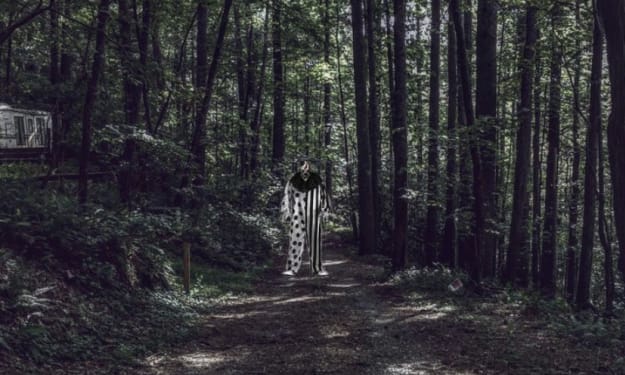
I See Clowns...
I am a millennial. For reference, a millennial is a person born between 1981 and 1996. There are many things that our generation has lived through that generation Z and the current generation (gen X) either do not remember or do not know about. Let's go back to the early 2000s, shall we? It was an interesting time to be alive, cell phone use was on the rise. Apple gave us the iPod and the iPhone and changed how we listened to music. No more did we have to download music from LimeWire or carry our compact disk players in our pockets and walk a certain way so the song wouldn't skip too much. Pagers were on their way out. Only doctors or street pharmacists had them mostly. Caller ID was now a service that came standard instead of having to pay a separate fee for it. So many new technologies and different ways to seemingly improve one's life.
By Latoya Giles 2 years ago in History