
Napoleon Bonaparte
The Rise and Fall of a Conqueror

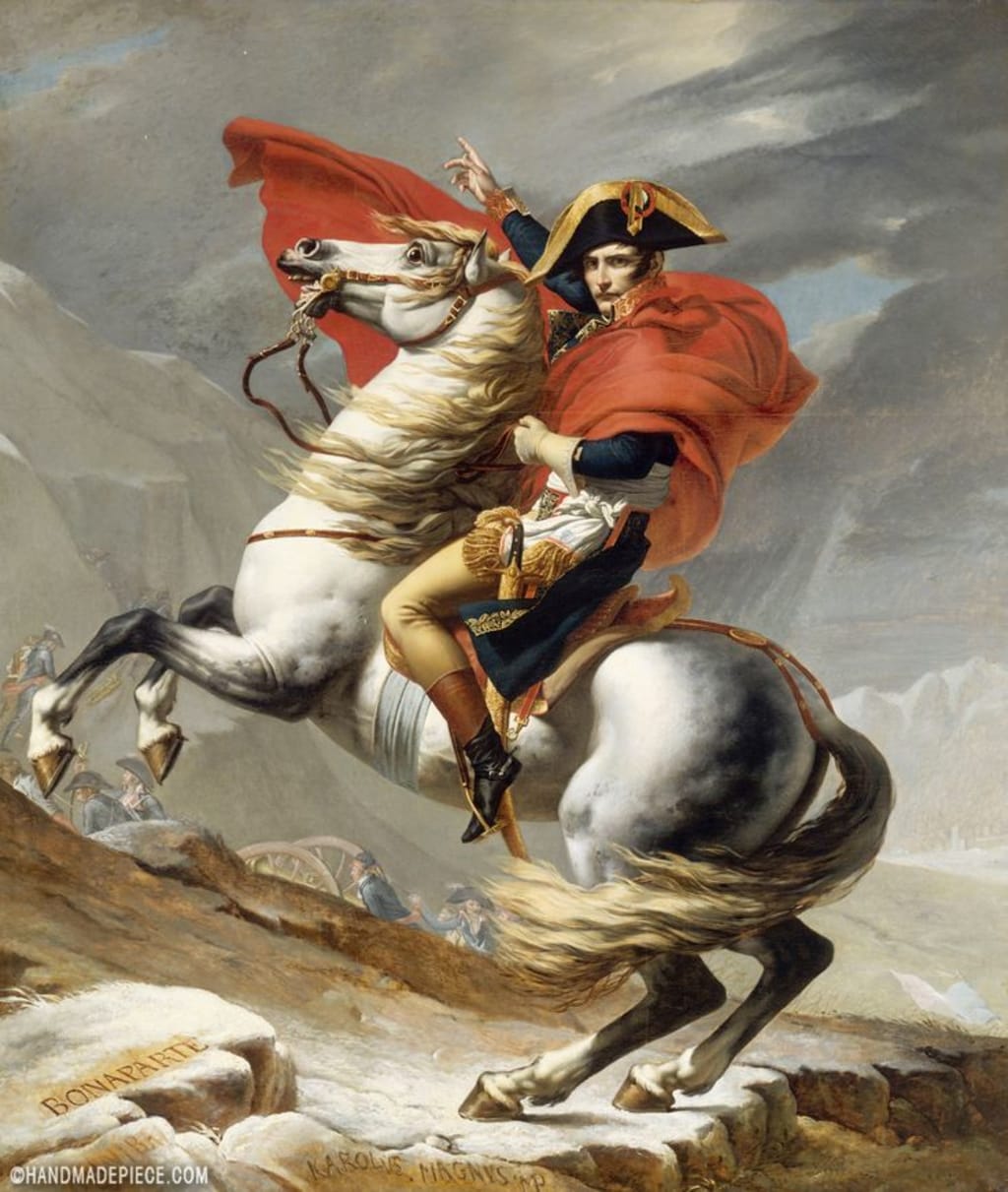
Napoleon Bonaparte: The Rise and Fall of a Conqueror
Napoleon Bonaparte, a name that reverberates through history as one of the most influential and controversial figures of the 18th and 19th centuries. Born on August 15, 1769, on the island of Corsica, Napoleon's life unfolded against the backdrop of the turbulent times of the French Revolution. From his early years to his meteoric rise to power, his military campaigns across Europe, and ultimately, his downfall at the Battle of Waterloo, Napoleon's story is one of triumph and tragedy.
Corsica, just before Napoleon's birth, had been conquered by French forces, making him and his family subjects of King Louis XV. At the age of nine, young Napoleon was sent to a military school in France. Excelling in math and history, he received a commission as an officer in the artillery division of the French Army after seven years of training.
As the French Revolution unfolded in 1789, Parisian mobs stormed the Bastille, marking the beginning of profound political and social changes. The revolution culminated in the removal of the monarchy, the establishment of a republic governed by the Convention, and the execution of Louis XVI. This tumultuous period, known as the Reign of Terror, saw Napoleon gaining fame for his victories against Royalist and anti-Republic forces.
Napoleon's military prowess and strategic acumen propelled him to prominence. Celebrated as a war hero after defeating Royalist forces at the port of Toulon, he continued to earn favor with the new government through subsequent victories. In a turn of events reminiscent of Emperor Palpatine in Star Wars, Napoleon was appointed Commander in Chief of the French Military.
In 1799, he orchestrated the Coup d'état of 18 Brumaire, dismantling the existing government and establishing a new one called The Consulate, with himself as First Consul. This marked the beginning of his consolidation of power and the transformation of the French government into the First French Empire in 1804, with Napoleon declaring himself Emperor.
Napoleon's military campaigns extended far beyond Europe. In 1802, he sent forces to the West Indies to secure and protect France's interests, marking the beginning of his aspirations for an empire in the Americas. However, realizing the inadequacy of his navy against the British, he sold the Louisiana Territory to the United States in the famous Louisiana Purchase of 1803.
Despite facing challenges, including assassination attempts such as the "Infernal Machine" plot in 1800, Napoleon continued to expand his empire. Victories in Europe, including the Battle of Austerlitz in 1805, solidified his control over vast territories. However, the invasion of Russia in 1812 proved to be a turning point, with the harsh Russian winter forcing a retreat and marking the beginning of Napoleon's decline.
By 1814, a coalition of European forces defeated Napoleon, forcing him to abdicate the throne. Exiled to the island of Elba, he managed to escape in 1815, marking the "Hundred Days" when he briefly reclaimed power. The Battle of Waterloo in the same year, however, led to his final defeat. Napoleon was exiled again, this time to the remote island of Saint Helena in the South Atlantic Ocean.
On Saint Helena, Napoleon's life took a tragic turn. He died on May 5, 1821, at the age of fifty-one, succumbing to cancer. Initially buried on the island, his remains were later moved back to France. Napoleon's legacy persists, with myths and conspiracy theories surrounding his death and tales of his extraordinary accomplishments.
Napoleon Bonaparte's legacy is a complex tapestry of military brilliance, political innovation, and a thirst for conquest. His contributions include popular reforms such as free secondary education and the establishment of the Bank of France, yet his expansionist ambitions and wars reshaped the geopolitical landscape of Europe.
While some view him as a visionary leader who brought progress to the territories under his rule, others see him as a power-hungry conqueror whose actions led to immense suffering. The myths surrounding his life, from his height to conspiracy theories about his death, only add to the enigma of Napoleon Bonaparte.
In the annals of history, Napoleon Bonaparte remains a captivating and polarizing figure, leaving an indelible mark on the course of European and world events during a pivotal era. His story continues to be debated and analyzed, and the echoes of his conquests and defeats reverberate through the pages of history.
About the Creator
Maria_TheOneAndOnly
Hello, my name's is Maria; I'm a teenager who likes making articles and I found this site perfect to share them. I hope you like the stories I make. Thank you!
Keep reading
More stories from Maria_TheOneAndOnly and writers in History and other communities.
The Enduring Wisdom of "art of war"
Title: The Enduring Wisdom of "The Art of War": Sun Tzu's Timeless Insights on Strategy and Leadership "The Art of War," attributed to the ancient Chinese military strategist and philosopher Sun Tzu, stands as a timeless masterpiece in the realms of strategy, leadership, and conflict resolution. Composed during the tumultuous Warring States period of China around the 5th century BCE, this ancient treatise has transcended its original military context to become a source of inspiration and guidance in diverse fields such as business, politics, and interpersonal relationships. This article delves into the enduring wisdom encapsulated within the pages of "The Art of War" and explores its continued relevance in the modern world.
By Maria_TheOneAndOnly2 years ago in Art
3 Times Ordinary Objects Did Something Deeply Unsettling
Objects surround us every day. They make life easier, more comfortable, or more entertaining. A chair supports us, a mirror shows us our reflection, and a toaster browns our bread with consistent reliability. Most of the time, they behave exactly as expected.
By Enoch Sagini2 days ago in History
When Allies Disagree: How Global Partnerships Are Being Redefined
When Allies Disagree: How Global Partnerships Are Being Redefined For much of the modern era, global alliances appeared firm and predictable. Powerful countries formed blocs, promised mutual support, and stood together during times of war and crisis. But in today’s world, those alliances are changing. Recent disagreements between long-standing partners show that global cooperation is no longer based on automatic loyalty—it is increasingly shaped by national interests, public opinion, and long-term stability.
By Wings of Time about 18 hours ago in History




Comments
There are no comments for this story
Be the first to respond and start the conversation.