Discoveries
Unveiling the Hidden Archives
Introduction In the heart of Chicago's Field Museum, a remarkable treasure trove awaits discovery – a collection of over 11 million fluid specimens, each meticulously preserved in glass jars. From bonnet head sharks to majestic Komodo dragons, this unique basement archive houses a fascinating array of life forms, frozen in time through the meticulous work of scientists and researchers. These specimens are more than just preserved relics; they serve as a testament to the natural world's diversity and the tireless dedication of those committed to unraveling its mysteries.
By Stella Oehtam2 years ago in History
Get behind Oppenheimer's secret city!
"Now i am become death, the destroyer of worlds" P.O. Box 1663 was registered as an address in Santa Fe, New Mexico, during 1943. Over the ensuing years, approximately 300 infants... had their birthplace documented as... P.O. Box 1663 on their birth certificates. This substitution was due to the true location being kept confidential.
By Shubham Bajaj2 years ago in History
Top 5 Mind-Blowing Scientific Discoveries of the Last Decade
Introduction The past decade has ushered in a remarkable era of scientific exploration, unveiling groundbreaking discoveries that have reshaped our understanding of the universe. Researchers across various fields have delved deep into uncharted territories, challenging assumptions and illuminating the mysteries that surround us. From distant planets to the tiniest particles, humanity's quest for knowledge has led to awe-inspiring revelations. In this article, we'll delve into five of the most astonishing scientific breakthroughs that have captivated our imagination and expanded our horizons during the last ten years.
By Stella Oehtam2 years ago in History
Title: Human Spontaneous Combustion: . Content Warning.
Introduction The notion of human spontaneous combustion has captured the imagination of writers, storytellers, and curious minds for centuries. The idea that a person could suddenly burst into flames without any apparent external cause is a tantalizing mystery that has found its way into folklore, literature, and even scientific discussions. However, despite its intriguing allure, the concept of human spontaneous combustion remains largely relegated to the realm of myth and speculation due to the lack of empirical evidence and scientific plausibility.
By Lynn Myers2 years ago in History
Unveiling the Mysteries of Bee Hives: A Journey into the Intricate World of Bee Societies and Survival Strategies
Bees made their first appearance on Earth around 130 million years ago, and their survival over the ages is a result of their intricate societal structure and teamwork. Within their colony, each bee has its own distinct role and responsibility. Some bees engage in building and repairing the hive, others guard it, some clean the environment, and there are those dedicated to gathering food. If we were to explore the inner workings of a bee hive, we would observe a complex system in action.
By Ichendu Victor2 years ago in History
History of Chocolate. Top Story - August 2023.
At the beginning of the article, you are going to read a short history of chocolate here. Move back to the past about 4000 years, where you can find the initial point of chocolate. It is obtained from a plant named cacao. These plants were initially found in Mesoamerica. From there, chocolate traveled to Spain and then to Europe. Afterward, it came back to America and the rest of the world.
By lary michael2 years ago in History
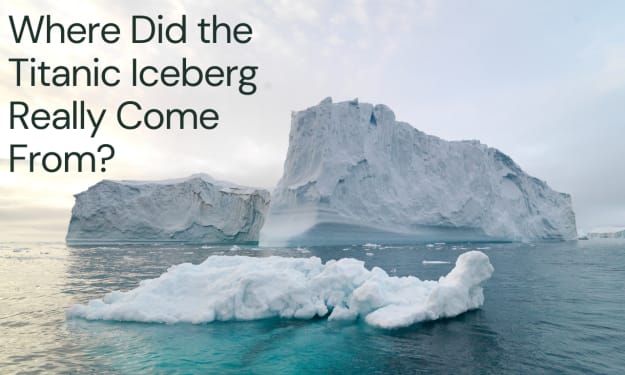
Where Did the Titanic Iceberg Really Come From?
A beam of electric light pierces the darkness above the serene waters of the Atlantic Ocean. The Titanic sails quietly through the waves, its passengers asleep. Suddenly, a colossal white figure appears in the light beam – the faithful iceberg is about to collide with the legendary ship. This event occurred on April 14, 1912, just two days before an unusual elliptically shaped iceberg would be photographed. This iceberg, formed from snow that fell 100,000 years ago, likely originated from a cluster of glaciers in Southwest Greenland. Modern computer modeling and historical data help trace its journey.
By Danesh Kumar Thiyagarajan2 years ago in History