Biographies
The Posthumous Execution of Oliver Cromwell. Top Story - December 2023.
Some events from history are so strange that we should all take a moment, look back, and collectively say WTF. This is one of those. It's about a man so hated that his corpse was dug up for the sole purpose of mutilating it because being dead wasn't good enough (bad enough?) for those who hated him. Can you think of anything more hate-fueled that could happen to a dead body?
By J.A. Hernandez2 years ago in History
10 archaelogical tools that scientists never discovered their purpose
1. The Enigmatic Crystal Carvings The mesmerizing allure of ancient crystal carvings continues to baffle scientists. The crystalline nature of these artifacts poses a unique challenge, as their composition often defies easy identification. Without comparable crystal artifacts from the same cultural context, scientists struggle to draw parallels and establish a framework for understanding the purpose behind these intricate carvings. The lack of inscriptions or accompanying artifacts compounds the mystery, leaving researchers without the linguistic or contextual clues essential for unraveling their enigma.
By Kelly Munala Brookes2 years ago in History
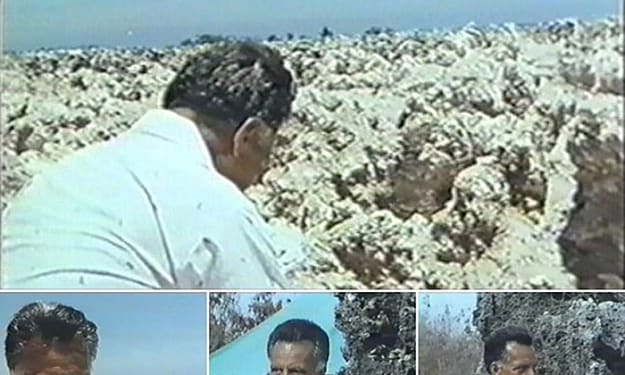
Banaban Landowners Visit their homeland
This 'Snippet’ of Ocean Island history was supplied by Banaban Heritage Society (BHS) [1] member, Marion Laritz from an article written by a fellow Island resident, Mr. R. Williams and published in the local newsletter, The Nautilus, Volume 2, Edition 3, November 1967.
By Stacey King2 years ago in History
Frederic Fletcher Webb . Content Warning.
~~~~~~~~~~~~~~~~~~~~ Early Life ~~~~~~~~~~~~~~~~~~~ His name was Frederic Fletcher Webb. You probably have never heard of his name before. I hadn't learned of him too long ago, either. But why would we? He wasn't found by name in any history books. He was found in the hidden pages of ancestry and of American history events. Mine to be precise. He was my 2 times great-grandfather, my grandmother's grandfather. And American history became very real to me as his story unfolded.
By Shirley Belk2 years ago in History
Napoleon Bonaparte: A Complex and Fascinating Figure
Napoleon Bonaparte, born Napoleone Buonaparte on August 15, 1769, in Ajaccio, Corsica, was a French military and political leader who rose to prominence during the French Revolution. He became First Consul of France in 1799 and Emperor of the French in 1804. Napoleon's military campaigns were some of the most successful in history, and he conquered much of Europe, establishing the largest European empire since the Roman Empire. However, he was ultimately defeated by the British and their allies at the Battle of Waterloo in 1815 and exiled to the island of Saint Helena in the South Atlantic, where he died on May 5, 1821, at the age of 51.
By Suresh Chand2 years ago in History
Nefertiti Uncovered: The Stunning Sovereign Who Won Egypt's Love
In the enchanted embroidery of old Egyptian history, one name gleams like a gem - Nefertiti, the sovereign who managed with power as well as emanated a supernatural stunner. As we raise a toast to the 1,400th commemoration of her rule, we should leave on an excursion through the ways of the world to disentangle the life and riddle of this enamoring sovereign.
By Edgar Omwamwa2 years ago in History
'Out of the Trenches by Christmas
At 1:15 p.m. on December 4, 1915, one of the most powerful and popular men in the country arrived at a pier in Hoboken, New Jersey. Waiting for him were thousands of spectators and well-wishers to see him on his journey. Through a circus atmosphere that one paper called “so grotesque as to be beyond belief,” Henry Ford, dressed in a brown overcoat, derby hat, and carrying a walking stick, pushed his way through the crowd to board the cruise liner he commissioned for one specific purpose — to bring peace to a world at war.
By Randall G Griffin2 years ago in History
The People's Palace: The White House as a Monument to Democracy
Introduction The White House, an iconic symbol of the United States presidency and American democracy, stands proudly in the nation's capital, Washington, D.C. This historic structure is not just the residence of the President of the United States; it is a monumental nexus of political activity, a museum of American history, and an emblem of the resilience of a nation's ideals. Its walls have witnessed over two centuries of history, having been home to every U.S. President since John Adams in 1800. The White House is more than a mere building; it is a living, breathing testament to the American journey.
By Rajeshkumar G2 years ago in History