Ancient
Windmills of Mykonos: The History of a Landmark. AI-Generated.
The windmills of Mykonos are more than just a picturesque element of the Greek island's landscape; they are a historical landmark that tells the story of the island's economic and cultural development. These iconic structures, with their whitewashed cylindrical shapes and wooden sails, have been a defining feature of Mykonos for centuries, symbolizing the island's rich heritage and its adaptation to the natural environment.
By Marveline Merab2 years ago in History
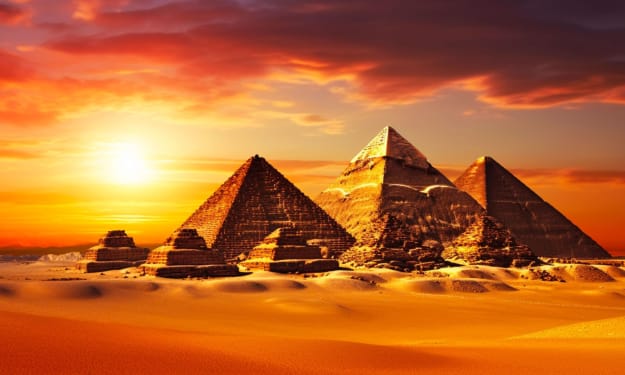
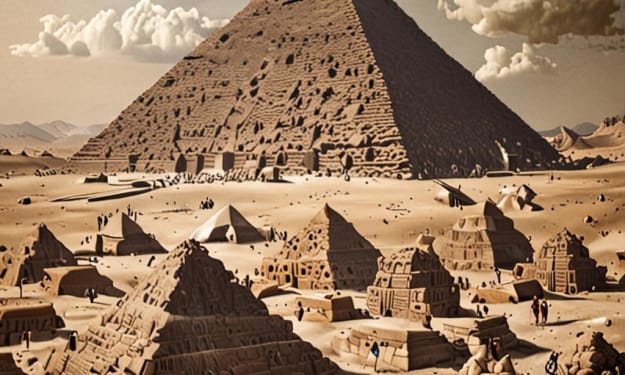
Who hid from us the secret of building the pyramids . . .
The Japanese came to Egypt in 1977 to try to simulate the small pyramid with the same style and tools as the Pharaohs, and they stopped immediately and returned to Without Raid because the experiment failed resoundingly from the first moment, not because they were unable to lift the stones or even move them or just rinse and trim them, but because they were not They could not even cut it from the mountains surrounding the Mokattam area, using the same tools of the Pharaohs that the researchers assumed !!!!
By Mosap Homa2 years ago in History
Puquios: The Ancient Aqueducts of the Nazca. AI-Generated.
The Puquios, the ancient aqueducts of the Nazca, stand as a remarkable testament to the engineering ingenuity and environmental adaptation of a civilization that thrived in one of the driest regions on Earth. These sophisticated water systems, developed over 1,500 years ago, allowed the Nazca people to sustain agriculture and community life in the arid Peruvian desert. The mystery of the Puquios and their effectiveness continues to fascinate researchers and historians, shedding light on the advanced technological capabilities of the ancient Nazca civilization.
By Marveline Merab2 years ago in History
How effective was Roman ballista?. AI-Generated.
The Roman ballista, a powerful and precise siege engine, stands as a testament to the engineering prowess and military ingenuity of ancient Rome. This artillery weapon, resembling a large crossbow, was pivotal in both offensive and defensive operations, offering a combination of range, accuracy, and devastating impact that made it a formidable tool in Roman warfare. Understanding the effectiveness of the Roman ballista involves examining its design, operational use, and historical impact on battles and sieges.
By Marveline Merab2 years ago in History
Ancient Device for Determining Taxes Discovered in Egypt. AI-Generated.
The recent discovery of an ancient device used for determining taxes in Egypt has captivated historians and archaeologists alike, shedding light on the sophisticated administrative practices of early civilizations. This remarkable find, unearthed in a previously unexplored site in the Nile Delta, reveals the advanced level of economic and bureaucratic management in ancient Egypt, showcasing their ingenuity and systematic approach to governance.
By Marveline Merab2 years ago in History
Ancient Greeks Invented World's First Telecommunications Device. AI-Generated.
The ancient Greeks are renowned for their contributions to philosophy, art, and science, but their innovations in technology are often overlooked. One of the most fascinating and lesser-known achievements is their invention of what could be considered the world’s first telecommunications device. This device, known as the hydraulic telegraph or “water telegraph,” was an ingenious system for long-distance communication, predating modern telecommunications by over two millennia.
By Marveline Merab2 years ago in History
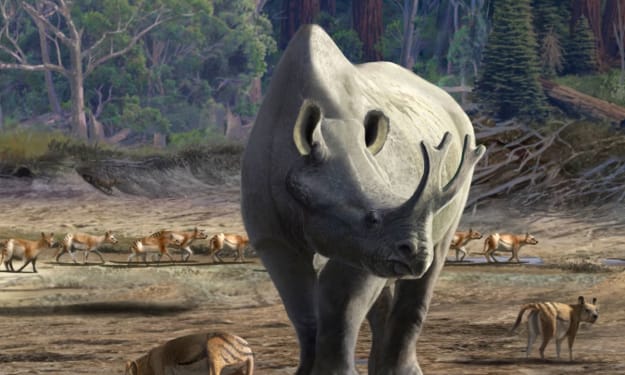
Megacerops: A Glimpse into the Ancient Past
Introduction Megacerops, often known by its older name Brontotherium, is an extinct genus of odd-toed ungulates (perissodactyls) that roamed North America during the late Eocene epoch, approximately 37 to 34 million years ago. These massive, rhinoceros-like creatures are a fascinating subject for paleontologists and enthusiasts alike due to their unique characteristics, evolutionary significance, and the rich fossil record they left behind. This blog explores the detailed history, ecology, and evolution of Megacerops, providing a comprehensive understanding of this remarkable genus.
By Mohammed thanvir2 years ago in History
Three Times When Humanity Could Disappear
Ancient civilizations and prophets from around the world have consistently predicted the demise of humanity and the Earth. The calendar of the Maya, the ancient civilization of America, ended on December 21, 2012. At that time, the whole world awaited the end of the world, but it did not happen. However, the prophecies of the famous French soothsayer Michel Nostradamus are detailed until the year 3797. Does this mean that life on Earth will end then, and should we believe such predictions at all? Incidentally, the death of our planet will occur when the Sun goes out, plunging the world into darkness, but this will not happen for at least another billion years. Some even believe in the possibility of black holes forming in the Large Hadron Collider, but that is beyond the realm of fantasy. What catastrophes have threatened and could threaten humanity in the future?
By Vitalii Petrov2 years ago in History
What happened to Oedipus. AI-Generated.
In spite of the fact that Oedipus would avoid passing, conquer the tremendous Sphinx, the truth would demonstrate his most prominent challenger. When Oedipus' mother gave birth to him,Her spouse, had gotten a prediction from Apollo's prophet prognosticating that he would pass on at the hands of his claim child. Decided to elude this destiny, Laius had the newborn's lower legs penetrated, and requested a shepherd to forsake him on Mount Cithaeron ,But divine predictions can be very adamant. The shepherd took feel sorry for on the child and gave him to another shepherd— this one from Corinth. He chosen to grant it to the childless Corinthian lord and ruler, They called the boy Oedipus, or “swollen-foot,” and raised him as their own.Years passed, till one night, a inebriated reveler told Oedipus that he was not Polybus and Merope's child by birth— an affirmation they staunchly denied. But the seeds of question burrowed into Oedipus' intellect. He cleared out to look for guide from Apollo's prophet at Delphi, who instep conveyed a profoundly aggravating prediction:
By Agness Munava2 years ago in History
The Wonders of Ancient Egypt
Ancient Egypt, a civilization that flourished for millennia, continues to captivate modern imaginations with its rich tapestry of history, culture, and technological achievements. Stepping back in time, one uncovers a world of majestic pyramids, enigmatic artifacts, and intricate rituals that reveal the sophisticated society of the Pharaohs.
By Pavitradevi 2 years ago in History