Ancient
Bangladesh
The History and Culture of Bangladesh: A Tapestry of Resilience and Rich Tradition Bangladesh, a country located in South Asia, boasts a rich and diverse history along with a vibrant cultural heritage. Nestled on the northern coast of the Bay of Bengal and bordered by India and Myanmar, Bangladesh has long been a crossroads of civilizations, religions, and trade. The history and culture of this land reflect centuries of change, struggle, creativity, and resilience.
By Nabir Mondol10 months ago in History
The History of Stress . AI-Generated.
The History of Stress: From Ancient Struggles to Modern Science In today's fast-paced world, the word "stress" is frequently used to describe deadlines, financial stress, or emotional strain. However, stress is not a recent phenomenon at all. The idea has changed over time as a result of cultural shifts, scientific discoveries, and the ever-evolving nature of human existence.
By articelmunaf10 months ago in History
Knights of the Sun
Chapter One: The Beginning of the Journey The morning was bright in Cairo, where Nahlah sat in her office at the Egyptian Museum of Antiquities, staring at a mysterious artifact in her hands. It was part of an ancient puzzle, one of the hidden secrets she had discovered during her latest archaeological expedition. She sighed deeply, trying to decipher the symbols engraved on its surface.
By mohamed elsayed10 months ago in History
The Mysteries of the Bermuda Triangle: Fact, Fiction, and Fascination. AI-Generated.
The Bermuda Triangle, also referred to as the Devil's Triangle, is one of the most fascinating and enigmatic places on Earth. Spanning a loosely defined area in the Atlantic Ocean between Bermuda, Florida, and Puerto Rico, it has captivated the imagination of adventurers, scientists, and conspiracy theorists alike. Stories of mysterious disappearances, strange phenomena, and legends have built an aura of intrigue around this triangular stretch of ocean. While the Bermuda Triangle's reputation is partially based on myths, it continues to inspire curiosity and debate.
By Noob Hacker10 months ago in History
Fictional radha character
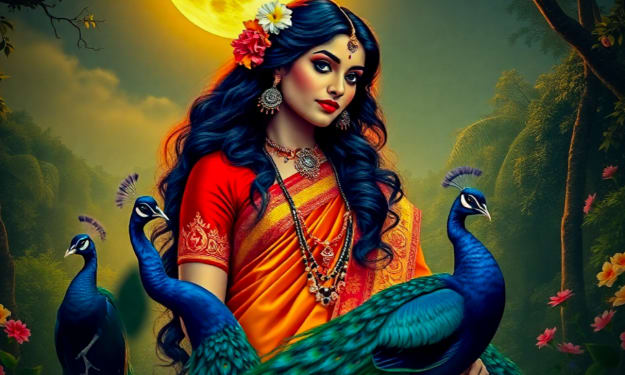
One of the Atharvaveda's Upanishads is referred to as the Goplatpan. It revolves around worshiping Krishna in his cowherd (gopa) form. Compared to the majority of other Upanishads, its composition appears to be significantly more contemporary. It says that cowherds and gops (milkmaids) surround Krishna, but the meanings of these terms are not the same as the common understanding of them. Gop is interpreted as the power of ignorance (avidy kal) in this text. The commentator offers the following explanation: "Gopyantiti gopya planaaktaya," which translates to "those who protect — the powers of preservation." Furthermore, the phrase "gopjanavallabha" refers to "he who is the lord of the powers of preservation, representing ignorance and its aspects, and who directs them — that is, God." As a result, the meaning of the word "gop" in the Upanishad is symbolic; neither the "rsa-lil," which is Krishna's divine dance with the gops, nor the name Radha are mentioned even once. One prominent gop is mentioned, but her name is Gndharv, not Radha. Her significance comes from philosophical inquiry rather than romantic play. Radha is not mentioned in any ancient texts, with the exception of the Brahma-vaivarta Pura and Jayadeva's poetry. Radha's name is absent from any of the five chapters of the Bhagavata Purana that describe the rsa. Even though the name "Radha" is deeply ingrained in Vaishnava traditions and is frequently mentioned in their commentaries, the original texts do not mention her. In one section, the poet writes that the gops inferred from the footprints that Krishna had gone into seclusion with a particular gop to show their jealousy. However, this too is merely a mistake brought on by jealousy. Krishna's disappearance is all that is mentioned; Radha, let alone Krishna, is not mentioned. Radha is not mentioned anywhere in the Bhagavata Pura, not just in the rasapadyya. She is also not mentioned in the Vishnu Pura, the Harivaa, or the Mahabharata. However, Radha has emerged as a central figure in contemporary worship of Krishna. The name of Krishna, his temples, and his idols are now considered incomplete without Radha. Radha even takes precedence over Krishna in many Vaishnava texts. Therefore, where did she originate if she is not mentioned in the Mahabharata, Hariva, Vishnu Pura, or Bhagavata Pura? Radha is first mentioned in the Brahma-vaivarta Pura. H.H., a scholar, says: Wilson, it would appear to be the most recent Pura. It has a style that is similar to contemporary Bhattacharya writers. Even tales about goddesses like Shashthi and Manasa are included. As previously stated, the original Brahma-vaivarta Pura is thought to have been lost. An entirely new theological framework is presented by the current state. Krishna is typically regarded as a representation of Vishnu. However, Krishna is said to have created Vishnu in this Pura, despite the fact that he is not Vishnu's avatar. Krishna lives in Goloka, at the far superior rsa-ma-ala, whereas Vishnu lives in Vaikuntha. It is believed that Krishna created not only Vishnu but also Brahm, Rudra, Durga, Lakshmi, and all other gods and beings. Cows (go), cowherds (gopa), and gops, all considered to be superior to the gods, live in his home, Goloka. Radha, Krishna's adored goddess, sits atop Goloka. Radha was created by Krishna prior to the rasa-mala. Her name is derived from "r," which comes from "rsa," and "dh," which comes from "dhtu," to make "Radha." Radha reigns over this celestial Goloka, which is a poetic reinterpretation of the Vrindavan portrayed by earlier poets. Goloka also has a rival gop named Viraj, just like in contemporary Krishna-jtrs (folk plays). Radha has a rival gop named Chandravali. Krishna is led to Chandravali's bower in the plays known as "Mnabhjan Jtrs," which are plays in which Radha is purged. He is similarly transported to Viraj's grove in Goloka. In the Brahma-vaivarta Pura, Radha is overcome with jealousy and rage, just like she is in plays. In order to confront Krishna at Viraj's temple, Radha travels in a chariot. She is refused entry by Shridma (or Sridm), the gatekeeper. Viraj melts and becomes a river in fear of Radha. She is resurrected and her form is restored by Krishna. Viraj eventually bears seven sons as a result of their blissful union with the Lord of Goloka. However, she cursed them because they ruined her joy and turned into the seven oceans. However, when Radha found out about Krishna and Viraj, she became enraged and scolded Krishna, wishing for him to be born on Earth. Radha's actions enraged Shridma, who rebuked her. Shridma was then cursed by Radha to be born an asura (demon). In turn, Shridma cursed Radha to be known as a woman of bad reputation (kalakin) and to be born on Earth as the wife of Raja (as in the folk plays Ayn Ghosh). Consider this, dear readers: Radha was later "imported," so to speak, despite the fact that her very existence is absent from the foundational scriptures. Not only was she imported, but she also humiliated Krishna and drove him out of Goloka. While Krishna asserts in the Gita that he descends to Earth to slay evil and uphold righteousness, the Pura asserts that he came as a result of an immoral love affair in a previous birth.
By Pranto Debnath10 months ago in History
Silent Genocide: The Hidden Massacre of Balochistan. AI-Generated.
The Concealed Afflictions: The Balochistan Massacre – An Overlooked Episode of Contemporary History In spite of being one of the least addressed atrocities of the contemporary period, the persistent turmoil and purported massacres in Balochistan stand as a distressing reminder of the muted agony of a populace ensnared in the realm of politics and power. This article reveals the concealed particulars of decades of discord in the Baloch region, examining its historical origins, political conflicts, and the human toll that persistspredominantly disregarded by international media and historical narratives.
By Say the truth 10 months ago in History
Ancient Thebes History Myths and Legacy of the Powerful Greek City State
Ancient Thebes History Myths and Legacy of the Powerful Greek City State Explore the rise mythological roots and historical significance of Thebes one of ancient Greece’s most influential and legendary city states.
By Adnan Rasheed10 months ago in History