
The Emperor Who Wouldn't Die: China's First Ruler and His Obsession With Immortality
The Real Game of Thrones: Ancient Chinese Warlord Poisoned By His Own 'Elixir of Life
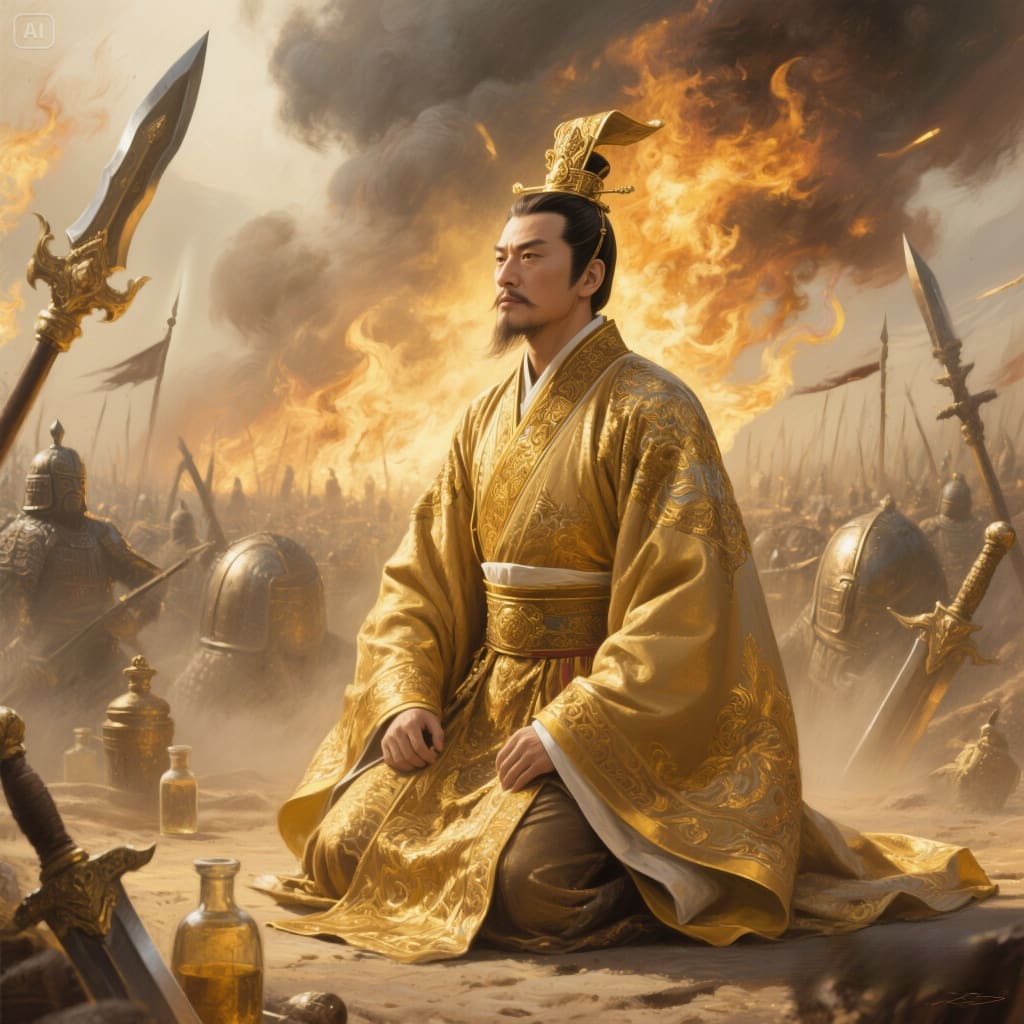
In the grand tapestry of ancient Chinese history, the story of Emperor Qin Shi Huang's quest for immortality is one of the most fascinating chapters. This emperor, who unified the six warring states, standardized the script and the axle width of chariots, and built the Great Wall, was a pioneer in many ways. However, even with all his power, he was haunted by a very human fear— the fear of death. His relentless pursuit of eternal life led to one of the most mysterious historical expeditions: the legendary journey of Xu Fu, who led a fleet with thousands of young boys and girls in search of the elixir of life.
### The Emperor's Longing for Eternal Life
Qin Shi Huang (259 BC - 210 BC) was a ruler full of contradictions. He was a visionary leader who ended the chaotic Warring States period and established the first centralized empire in Chinese history. Yet, he was also known for his ruthlessness. Despite his unparalleled power, he was constantly shadowed by the fear of death. Historical records indicate that as he grew older, his dread of death intensified. Assassination attempts, rebellions in various regions, and the inevitable process of aging all drove him to desperately seek the secret of immortality.
Qin Shi Huang's obsession with eternal life was not a sudden whim. During the Warring States period, the coastal regions of Yan and Qi were filled with tales of immortals. Alchemists claimed that there were three divine mountains in the East China Sea—Penglai, Fangzhang, and Yingzhou—where immortals lived and where the elixir of life could be found. These stories deeply influenced the young emperor. According to the "Records of the Grand Historian" (Shiji), shortly after unifying the six states, Qin Shi Huang began frequent eastern tours. Part of the reason was to intimidate the remnants of the former states, but another significant motive was to search for the legendary immortals and the elixir of life.
At that time, it was believed that beyond the East China Sea lay the Penglai Fairyland, where the elixir of life grew. Driven by this belief, Qin Shi Huang repeatedly sent alchemists to search for it. The most famous of these expeditions was led by Xu Fu. It is worth noting that Xu Fu was not the first alchemist sent by Qin Shi Huang. Before him, others like Lu Sheng and Hou Sheng had been dispatched to find the elixir, but all had returned empty-handed. However, these failures only deepened the emperor's determination.
### The Mystery of Xu Fu's Journey
According to Sima Qian's "Records of the Grand Historian," the alchemist Xu Fu claimed to know the location of Penglai Island. He told the emperor that the immortals demanded a tribute of three thousand young boys and girls, skilled craftsmen, and precious gifts in exchange for the elixir of life. This demand, though seemingly absurd, reflected the contemporary imagination of the divine world—pure young boys and girls symbolized piety, while skilled craftsmen represented the essence of human civilization.
Xu Fu's background is also intriguing. He was likely a renowned alchemist from the state of Qi, proficient in navigation and medical knowledge. When he petitioned the emperor, he vividly described the Penglai Fairyland: "In the sea, there are three divine mountains named Penglai, Fangzhang, and Yingzhou, where immortals reside." This description, which combined existing myths with his own imagination, successfully convinced Qin Shi Huang.
Desperate for the elixir, the emperor agreed to Xu Fu's request. Around 219 BC, Xu Fu set sail with a massive fleet, never to be heard from again. The scale of this expedition was remarkable for its time. It included dozens of large ships, thousands of crew members, and a substantial supply of food, medicine, and daily necessities. Such a large-scale maritime journey was unprecedented in the world's navigation history at that time.
The fate of Xu Fu has been a subject of endless speculation. Some say he reached Japan, where he is still revered as "Xu Fu." There are Xu Fu tombs and shrines dedicated to him in places like Wakayama Prefecture. Although Japan's ancient texts, the "Nihon Shoki" and the "Kojiki," do not directly mention Xu Fu, his legend persists in Japanese folklore. Others believe he perished at sea or established a utopia far away from the Qin dynasty. In recent years, scholars have suggested that he might have reached the Korean Peninsula or the Ryukyu Islands. Regardless of his ultimate destination, Xu Fu's disappearance only deepened the emperor's obsession.
### The Emperor's Descent into Madness
With Xu Fu's disappearance, Emperor Qin Shi Huang's behavior became increasingly erratic. His actions revealed the extreme reactions of a man at the pinnacle of power facing the threat of death:
He began to travel in secret, constantly changing routes to evade "death." According to the "Records of the Grand Historian," Qin Shi Huang constructed secret passages between his palaces in the vicinity of Xianyang. He frequently altered his travel plans, keeping even his closest ministers in the dark about his exact whereabouts. This almost paranoid behavior reflected his intense fear of death.
More tragically, he consumed mercury-laden "elixirs," which likely contributed to his death at the age of 49. Not only did he send alchemists to search for the elixir, but he also gathered them in Xianyang to concoct potions. These potions often contained toxic substances such as mercury and cinnabar. Modern archaeological findings reveal that the mercury content in Qin Shi Huang's mausoleum is unusually high, which is likely evidence of the prevalence of alchemy at that time. Long-term consumption of these "elixirs" undoubtedly hastened the emperor's demise.
When some alchemists and Confucian scholars began to question the possibility of immortality, the emperor resorted to the most extreme measures of suppression. In the infamous "Burning of Books and Burying of Scholars" incident, over 460 alchemists and Confucian scholars were buried alive. This atrocity was both an attempt to unify thought and a manifestation of the emperor's pathological response to his fear of death.
Ironically, his fear of death accelerated his own demise. Modern tests have shown that the mercury content near Qin Shi Huang's mausoleum is unusually high, likely originating from the "elixirs of life" he consumed. Archaeologists have determined that the mercury content in the center of the mausoleum is dozens of times higher than that of the surrounding areas, corroborating Sima Qian's account of "using mercury to create rivers and seas."
### The Historical Context of the Quest for Longevity
Qin Shi Huang's pursuit of immortality must be understood within the intellectual context of the Warring States to the Han dynasty period. During this time, the ideas of immortality and the Five Elements theory merged to form a unique culture of longevity. Alchemists from the coastal regions of Yan and Qi promoted the "technique of spiritual dissolution and transformation," claiming that one could achieve immortality through the consumption of elixirs and practices like breathing exercises.
This belief was particularly appealing to Qin Shi Huang due to the medical knowledge of the time. People had already observed the special effects of certain minerals and plants but were unaware of their toxicity. The mystery of the ocean also fueled the imagination of a fairyland beyond the sea. Qin Shi Huang made several eastern tours to the coast, where he inscribed stones and erected monuments, mentioning "extending life" and "the way of immortality."
It is worth noting that Qin Shi Huang was not the only ancient ruler to pursue immortality. Later emperors such as Emperor Wu of Han and Emperor Taizong of Tang were also fascinated by alchemy and the elixir of life. However, what set Qin Shi Huang apart was his integration of personal pursuit with state projects. The large-scale maritime expedition of Xu Fu would not have been possible without the support of the state.
### The Cultural Impact of the Xu Fu Legend
The legend of Xu Fu's journey has had a profound impact on the cultural sphere of China and East Asia. In Japan, Xu Fu is revered as the disseminator of agricultural, medical, and textile technologies. In the Xu Fu Park in Shirahama, Wakayama Prefecture, there is a monument marking the "landing site of Xu Fu." Annual commemorative events are held, and some even believe that Xu Fu is the legendary Emperor Jimmu of Japan.
In Jeju Island, South Korea, there are also legends about Xu Fu, claiming that he landed in Seogwipo to search for the herb of immortality. These legends reflect the cultural exchanges of ancient East Asia and demonstrate the enduring vitality of the Xu Fu story.
In Chinese literature and art, the story of Xu Fu's journey is a frequently used theme. From the Tang Dynasty poet Bai Juyi's poem "The Vast Sea" to modern film and television productions, the image of Xu Fu has been reinterpreted time and again. These works often use the story to satirize contemporary issues, exploring the relationship between power and desire, and ideals and reality.
### The Quest for Longevity from a Scientific Perspective
From a modern scientific standpoint, Qin Shi Huang's quest for immortality was doomed to fail. However, some of his practices inadvertently propelled technological advancements. In their attempts to concoct elixirs, alchemists conducted numerous chemical experiments, which can be seen as the embryonic During its transmission over time, the story was imbued with even more mythological elements. This interweaving of history and legend is a hallmark of ancient Chinese history.
Today, as we stand before the Mausoleum of Emperor Qin Shi Huang, or read the tale of Xu Fu's eastward journey, we can't help but ponder: What if Qin Shi Huang had truly found the elixir of immortality? How would history have been rewritten? But history knows no "what ifs." This emperor, who pursued eternal life, ultimately became dust in the annals of history, leaving behind only an eternal legend of his obsession with longevity.
About the Creator
男厨
"History nerd & foodie uncovering ancient gossip & snack stories. Did Tang Dynasty BBQ with wine? Was Cixi a sugar addict? Let's make history deliciously fun!original humor and themes
Keep reading
More stories from writers in History and other communities.
The Spanish Donkey: A Dark Instrument of Punishment in European History
History is often told through kings, wars, and revolutions. But hidden between those grand narratives are quieter, darker stories. Stories of ordinary people, unnamed in records, who experienced history not as progress, but as pain. One such story is tied to an object known as the Spanish Donkey, also called the Wooden Horse, an instrument of punishment used in parts of Europe during the late medieval and early modern periods.
By Salman Writes5 days ago in History
Frederick the Great: Winning When Surrounded
Few leaders in history have faced danger as relentlessly as Frederick II of Prussia, better known as Frederick the Great. He ruled a small, newly elevated kingdom with powerful enemies on every border, a limited population, and an army that could never afford large losses. Yet time and again, Frederick survived—and often triumphed—when surrounded by foes who should have crushed him. His genius was not conquest for its own sake, but the art of winning when defeat seemed inevitable.
By Fred Bradford4 days ago in History
~ Fired ~
— Ai Intrusion ~ Are you Next ~ Is Ai Evolution after your job? — Few workplaces haven't been affected. Ai is in supermarkets, at doctors' offices, and even monitoring farms. I just can't think of anything this machine is not getting into, can you? For instance: Education ~ Law and Tech jobs will one day have a major influence or be taken over by these inanimate machines, with accuracy and vigor. From mechanics' diagnoses to a wide variety of everyday jobs, including fast food workers, with this input having the ability to cut their unnecessary work hours. I'm certain all of us have been touched by this with our short stories and colorful headings, have you? Even comments are very questionable 'Non-Robot' insertions.
By Jay Kantor5 days ago in Journal


Comments
There are no comments for this story
Be the first to respond and start the conversation.