
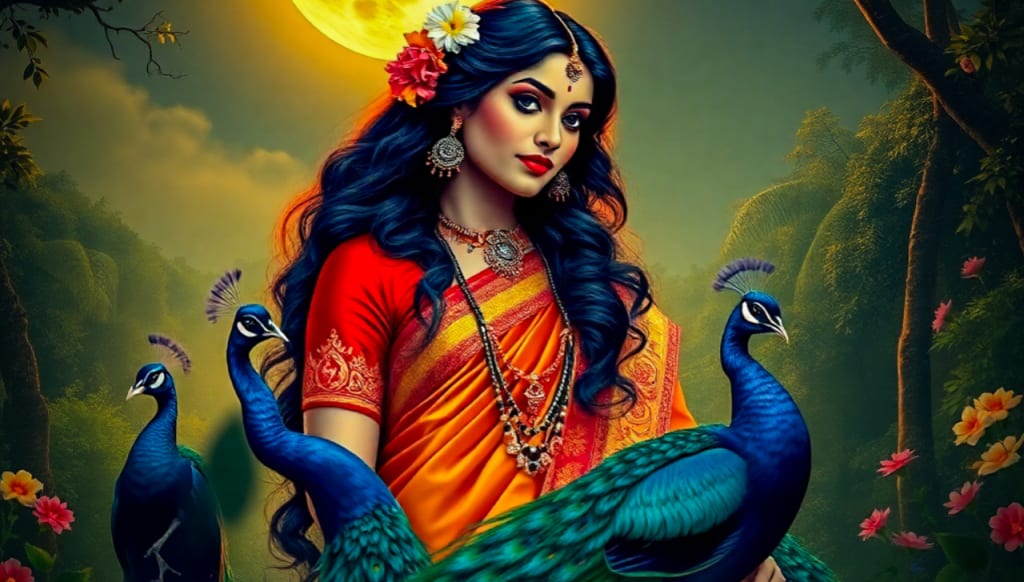
One of the Atharvaveda's Upanishads is referred to as the Goplatpan. It revolves around worshiping Krishna in his cowherd (gopa) form. Compared to the majority of other Upanishads, its composition appears to be significantly more contemporary. It says that cowherds and gops (milkmaids) surround Krishna, but the meanings of these terms are not the same as the common understanding of them. Gop is interpreted as the power of ignorance (avidy kal) in this text. The commentator offers the following explanation: "Gopyantiti gopya planaaktaya," which translates to "those who protect — the powers of preservation." Furthermore, the phrase "gopjanavallabha" refers to "he who is the lord of the powers of preservation, representing ignorance and its aspects, and who directs them — that is, God." As a result, the meaning of the word "gop" in the Upanishad is symbolic; neither the "rsa-lil," which is Krishna's divine dance with the gops, nor the name Radha are mentioned even once. One prominent gop is mentioned, but her name is Gndharv, not Radha. Her significance comes from philosophical inquiry rather than romantic play. Radha is not mentioned in any ancient texts, with the exception of the Brahma-vaivarta Pura and Jayadeva's poetry. Radha's name is absent from any of the five chapters of the Bhagavata Purana that describe the rsa. Even though the name "Radha" is deeply ingrained in Vaishnava traditions and is frequently mentioned in their commentaries, the original texts do not mention her. In one section, the poet writes that the gops inferred from the footprints that Krishna had gone into seclusion with a particular gop to show their jealousy. However, this too is merely a mistake brought on by jealousy. Krishna's disappearance is all that is mentioned; Radha, let alone Krishna, is not mentioned. Radha is not mentioned anywhere in the Bhagavata Pura, not just in the rasapadyya. She is also not mentioned in the Vishnu Pura, the Harivaa, or the Mahabharata. However, Radha has emerged as a central figure in contemporary worship of Krishna. The name of Krishna, his temples, and his idols are now considered incomplete without Radha. Radha even takes precedence over Krishna in many Vaishnava texts. Therefore, where did she originate if she is not mentioned in the Mahabharata, Hariva, Vishnu Pura, or Bhagavata Pura? Radha is first mentioned in the Brahma-vaivarta Pura. H.H., a scholar, says: Wilson, it would appear to be the most recent Pura. It has a style that is similar to contemporary Bhattacharya writers. Even tales about goddesses like Shashthi and Manasa are included. As previously stated, the original Brahma-vaivarta Pura is thought to have been lost. An entirely new theological framework is presented by the current state. Krishna is typically regarded as a representation of Vishnu. However, Krishna is said to have created Vishnu in this Pura, despite the fact that he is not Vishnu's avatar. Krishna lives in Goloka, at the far superior rsa-ma-ala, whereas Vishnu lives in Vaikuntha. It is believed that Krishna created not only Vishnu but also Brahm, Rudra, Durga, Lakshmi, and all other gods and beings. Cows (go), cowherds (gopa), and gops, all considered to be superior to the gods, live in his home, Goloka. Radha, Krishna's adored goddess, sits atop Goloka. Radha was created by Krishna prior to the rasa-mala. Her name is derived from "r," which comes from "rsa," and "dh," which comes from "dhtu," to make "Radha." Radha reigns over this celestial Goloka, which is a poetic reinterpretation of the Vrindavan portrayed by earlier poets. Goloka also has a rival gop named Viraj, just like in contemporary Krishna-jtrs (folk plays). Radha has a rival gop named Chandravali. Krishna is led to Chandravali's bower in the plays known as "Mnabhjan Jtrs," which are plays in which Radha is purged. He is similarly transported to Viraj's grove in Goloka. In the Brahma-vaivarta Pura, Radha is overcome with jealousy and rage, just like she is in plays. In order to confront Krishna at Viraj's temple, Radha travels in a chariot. She is refused entry by Shridma (or Sridm), the gatekeeper. Viraj melts and becomes a river in fear of Radha. She is resurrected and her form is restored by Krishna. Viraj eventually bears seven sons as a result of their blissful union with the Lord of Goloka. However, she cursed them because they ruined her joy and turned into the seven oceans. However, when Radha found out about Krishna and Viraj, she became enraged and scolded Krishna, wishing for him to be born on Earth. Radha's actions enraged Shridma, who rebuked her. Shridma was then cursed by Radha to be born an asura (demon). In turn, Shridma cursed Radha to be known as a woman of bad reputation (kalakin) and to be born on Earth as the wife of Raja (as in the folk plays Ayn Ghosh). Consider this, dear readers: Radha was later "imported," so to speak, despite the fact that her very existence is absent from the foundational scriptures. Not only was she imported, but she also humiliated Krishna and drove him out of Goloka. While Krishna asserts in the Gita that he descends to Earth to slay evil and uphold righteousness, the Pura asserts that he came as a result of an immoral love affair in a previous birth.
About the Creator
Keep reading
More stories from writers in History and other communities.
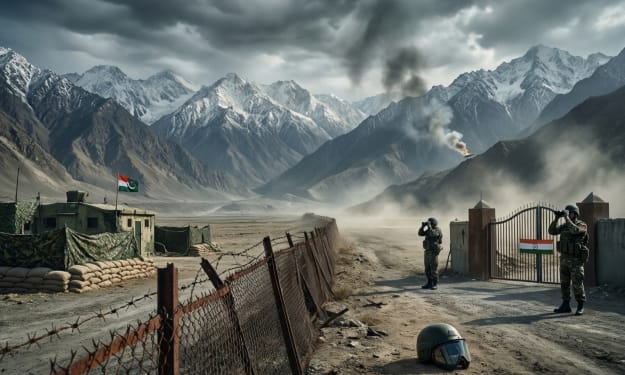
South Asia on Edge: Why Small Crises Carry Big Global Risks
South Asia on Edge: Why Small Crises Carry Big Global Risks South Asia is one of the most sensitive regions in the world today. It is home to a very large population and includes countries with strong militaries and nuclear weapons. Because of this, even small problems can turn into serious crises very quickly. Tensions, mistrust, and long history make the region fragile, and the whole world watches closely when situations become tense.
By Wings of Time 4 days ago in History
Should We Not Try to Get Too Political?
Here's something you often hear people say, "I try not to get too political." I understand the sentiment and I sympathize with it... while at the same exact time, I completely disagree with the notion. Whether it's referring to social media or wherever, it's kind of unavoidable. You can attempt to sidestep it, not engage, leave the less important things for actual politicians to discuss... you can want it to not take over your life, your conversations, your relationships, and that makes perfect sense.
By Stephen Kramer Avitabilea day ago in Writers
Why Black History Matters in America?
The United States of America is celebrating their 250th anniversary in 2026. I'm proud to be an American and as someone who was born here, I wouldn't imagine myself living anywhere else. This is a country where opportunities are possible. Where anyone can be successful in anything they desire to do. Equality, community, and togetherness are the backbones of what America is and should be about. However, we have an administration who wants to erase and disregard those who have made positive, meaningful impacts in our country, specifically Black figures, such as Martin Luther King, Jr., Rosa Parks, and Maya Angelou. President Trump and his administration have been constantly complaining and fighting against what they call the "Woke agenda". They use this excuse as a distraction from other issues they refuse to address, such as the high cost of living, climate change, and inflation. That equality is dividing America, when in reality, it's bringing us together. Being woke is not tied to a specific political party. No matter where you stand on the political spectrum, you can still care about other people and their plights. Compassion and empathy for others isn't tied to a political party, either. We were taught as children to treat others the way we want to be treated and not judge others because they're different from us. Caring about others isn't a personal attack on your beliefs. It doesn't make you any less of a person. People who are easily offended over African American figures, past or present, or anything related to it, are grasping at straws. Current and future generations need to know who people like Harriet Tubman and Shirley Chisholm were, especially in the classroom. Black History is part of American History. It should be recognized, not hidden or forgotten. Besides, you can't shield children from everything, just because your feelings are easily hurt.
By Mark Wesley Pritchard 4 days ago in The Swamp



Comments
There are no comments for this story
Be the first to respond and start the conversation.