

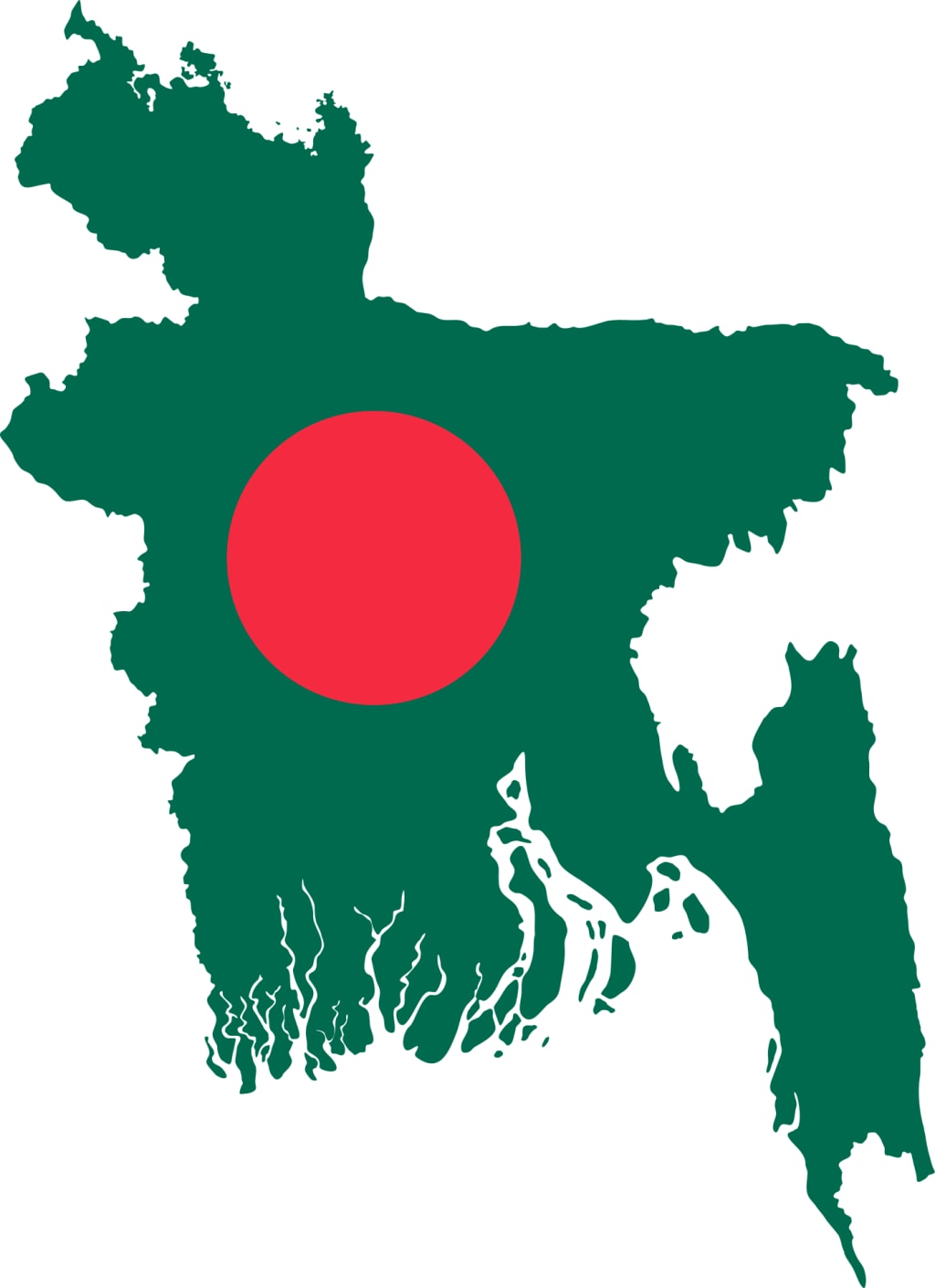
Once upon a time, in the lush green delta where the Ganges and Brahmaputra rivers meet the Bay of Bengal, there lay a land rich in culture, language, and resilience. This land, known today as Bangladesh, has a history that stretches back thousands of years, marked by kingdoms, conquests, colonialism, and ultimately, a hard-won independence.
Ancient Roots
The story of Bangladesh begins in ancient times. Around 3000 years ago, people began settling in the fertile plains of Bengal. The region was part of powerful empires like the Maurya and Gupta, where Buddhism and Hinduism flourished. The city of Pundranagara (present-day Mahasthangarh) was one of the earliest urban centers, a testament to Bengal’s early civilization.
During the 13th century, Muslim rulers arrived, beginning with Turkish and Afghan conquerors. Islam spread through the work of Sufi saints who preached peace and equality, blending with the local culture. For centuries, Bengal remained a prosperous province under the Delhi Sultanate and later the Mughal Empire. The Mughals especially cherished Bengal for its wealth in silk, muslin, and rice.
The Colonial Chapter
In the 18th century, the British East India Company took control after the Battle of Plassey in 1757. The rich lands of Bengal were now under colonial rule. The people suffered under heavy taxation and famine, including the devastating Bengal Famine of 1943, which killed millions.
Though oppressed, the spirit of the people never faded. Bengali intellectuals and reformers led cultural and educational movements during the 19th century, sparking a Bengal Renaissance. The region became a hotbed for anti-colonial activities, with figures like Surya Sen and Subhas Chandra Bose emerging from its soil.
The Partition and Pakistan Era
In 1947, when the British left India, the subcontinent was divided based on religion. East Bengal, with a Muslim majority, became part of the newly formed Pakistan as East Pakistan, while West Bengal went to India. But the people of East Pakistan soon realized that they were being treated as second-class citizens by the West Pakistani rulers.
One of the most striking moments of resistance came in 1952. The Pakistani government tried to impose Urdu as the sole national language, ignoring Bengali, the mother tongue of the majority. On February 21, students in Dhaka protested. Police opened fire, killing several. This became known as the Language Movement, and it sparked a deep sense of identity among the Bengali people. To this day, February 21 is observed as International Mother Language Day.
The discrimination continued through the 1960s—economic neglect, political exclusion, and cultural suppression. In the 1970 elections, the Awami League, led by Sheikh Mujibur Rahman, won a landslide victory. But the Pakistani military refused to hand over power. Tensions boiled over.
The Liberation War
On the night of March 25, 1971, the Pakistani army launched Operation Searchlight in Dhaka, killing thousands of civilians. This brutal crackdown marked the beginning of the Bangladesh Liberation War.
Sheikh Mujibur Rahman was arrested, but the people of East Pakistan declared independence on March 26, 1971. A provisional government was formed, and the Mukti Bahini (freedom fighters) began a guerrilla war against the Pakistani military. Millions of people fled to India as refugees.
After nine months of bloodshed and resistance, the tide turned. In December, India intervened, supporting the Bangladeshi cause. On December 16, 1971, Pakistani forces surrendered in Dhaka. Bangladesh was born—free, proud, and sovereign.
The Struggles of a New Nation
The birth of Bangladesh came at a great cost. The war left the country devastated—economically ruined and emotionally scarred. Yet, the people were determined to rebuild. Under the leadership of Sheikh Mujib, the country took its first steps toward recovery. However, political turmoil soon followed. Mujib was assassinated in 1975, leading to years of military rule and instability.
Despite the setbacks, democracy eventually returned in the 1990s. Bangladesh began to find its footing, navigating a complex path of development. The rivalry between the Awami League and the Bangladesh Nationalist Party (BNP) shaped much of the political landscape.
Modern Bangladesh
Today, Bangladesh is one of South Asia’s most remarkable success stories. Once labeled a "basket case," it is now a rising economy, known for its booming garment industry, microfinance innovations, and impressive strides in healthcare and education. The country has achieved significant progress in poverty reduction, gender equality, and digital technology.
But challenges remain—climate change threatens the low-lying delta; political tensions persist; and ensuring freedom of expression continues to be a struggle. Yet, the resilience of the Bangladeshi people endures.
A Land of Spirit and Soul
The story of Bangladesh is not just one of struggle—it is also one of spirit. From poets like Rabindranath Tagore and Kazi Nazrul Islam to the bravery of its martyrs and the energy of its youth, Bangladesh is a nation built on courage, culture, and hope.
And so, the story of Bangladesh continues, shaped by its past, living in its present, and dreaming boldly for its future.
About the Creator
Antor Raz
Hello dear my name is Antor Raj
story writing
The Astrologer Prime Minister
The king was seated among his courtiers. A competition was ongoing among them to bring good news to His Majesty. The king was delighted, for every piece of good news was like honey to his ears. He felt that he was the most successful ruler in the world. In his kingdom, even lions and goats drank from the same waterhole.
By Sudais Zakwan3 days ago in History
Fifteen Dead After Philippines Ferry With 300 Passengers Sinks
: At least 15 people have died and hundreds have been rescued after a passenger ferry carrying more than 300 people sank early on Monday, January 26, 2026, off the coast of the southern Philippines, authorities said. The tragedy has sparked a massive search and rescue operation, highlighted persistent safety concerns in inter‑island maritime travel, and left families anxiously awaiting news of loved ones.
By Salaar Jamali2 days ago in History


Comments
There are no comments for this story
Be the first to respond and start the conversation.