
Still Standing: The Secret Strength of America's Oldest Constitution
How a 1787 document continues to govern a modern superpower — and why it hasn’t broken yet

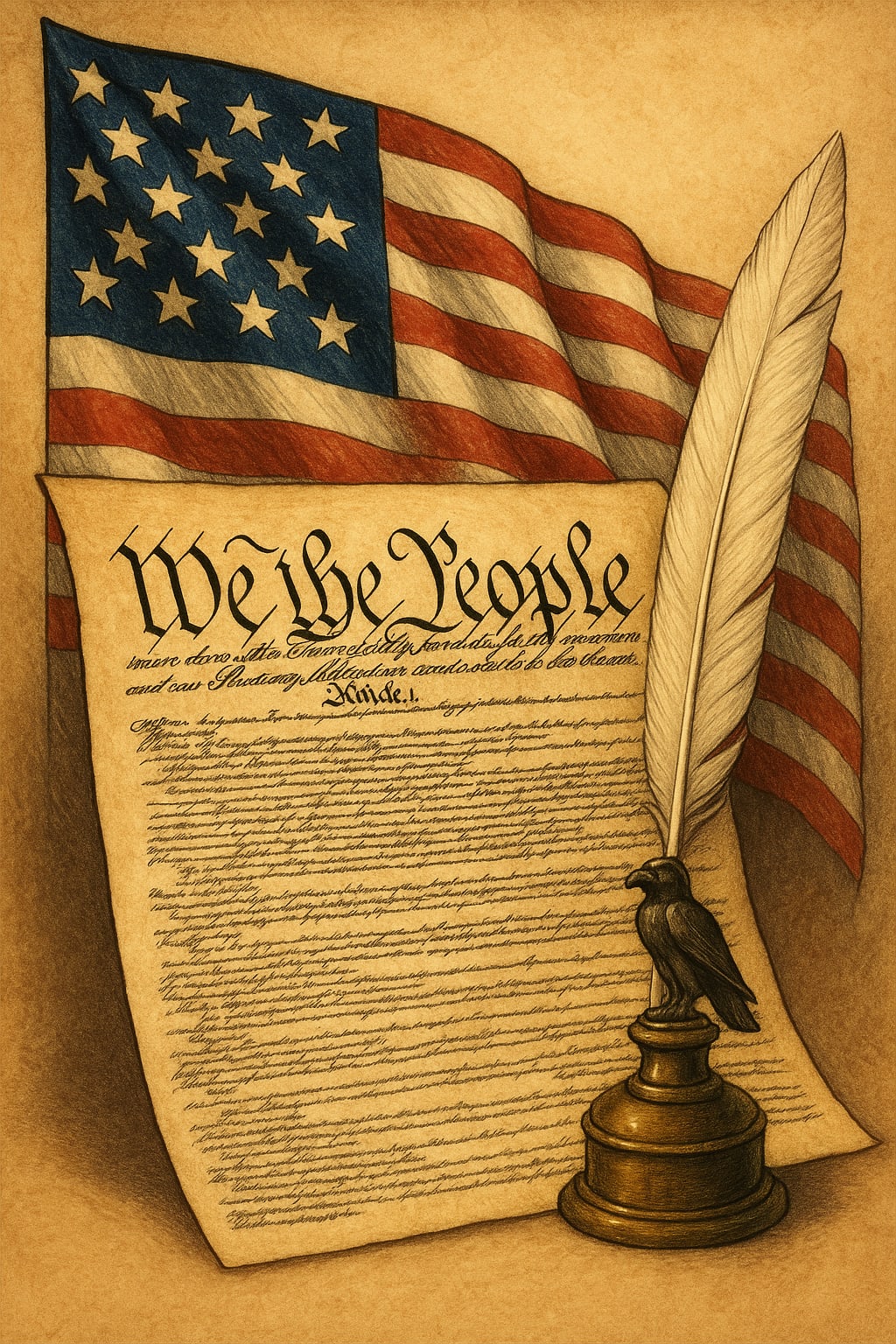
In a world where revolutions rewrite regimes and constitutions rise and fall with political tides, the United States stands as an outlier. Since 1787, the same foundational text — drafted by men in powdered wigs and handwritten on parchment — has governed a nation that now spans 50 states, commands the world’s largest economy, and faces 21st-century problems unimagined by its authors. The U.S. Constitution is the oldest surviving written constitution in the world. But why has it endured? What makes this centuries-old document still capable of navigating the complex political, legal, and social dynamics of a modern, often divided nation?
To understand its resilience, one must look beyond the ink and the clauses. The American Constitution’s strength comes not from its infallibility, but from a unique combination of design, mythos, and institutional flexibility that allows it to evolve — without ever fully losing sight of its original purpose.
A Rigid Frame with Flexible Joints
The U.S. Constitution is a masterclass in structural balance. Its framework is intentionally rigid: it defines a clear separation of powers between the executive, legislative, and judicial branches, enshrines federalism as a core principle, and creates a complex system of elections, representation, and lawmaking. These foundations have remained remarkably stable. Yet, within this hard scaffolding lies a surprisingly soft interior — vague wording, open-ended concepts, and principles meant to guide rather than dictate.
Terms like “due process,” “equal protection,” and “necessary and proper” are not legal technicalities but rather constitutional invitations to reinterpretation. This vagueness was intentional. The Framers — men like James Madison, Alexander Hamilton, and Gouverneur Morris — understood they were not writing for their time alone. They designed a framework capable of surviving societal transformation: industrialization, civil war, global warfare, technological revolution, and mass immigration.
This ambiguity has allowed courts, legislators, and the public to reshape the application of constitutional rights without ever changing the basic text. Whether dealing with digital privacy, reproductive rights, or the limits of executive power, the Constitution has remained a living reference — always old, but never outdated.
In short, it is not a blueprint but a set of constitutional guardrails. The rules of the game remain constant, even as the players and the playing field evolve dramatically.
Amendable — But Not Easily
Most modern constitutions are amended frequently or replaced entirely within decades. In contrast, the U.S. Constitution has been amended only 27 times in over 230 years — and ten of those amendments were passed as a single package in 1791 (the Bill of Rights). Why so few changes? Because changing the Constitution is intentionally difficult.
To amend the document, a proposal must pass both chambers of Congress by a two-thirds majority, and then be ratified by three-fourths of the states — currently 38 out of 50. This process ensures that only amendments with broad, national consensus make it through. It prevents partisan majorities or regional passions from rewriting fundamental rights on a whim.
This resistance to change can be frustrating. Critics argue that it slows progress, enshrines outdated norms, and protects structural inequities (such as the Electoral College or the Senate’s disproportionate power). And yet, this same difficulty has insulated the Constitution from the instability that often plagues systems too easily altered.
Each successful amendment marks a true national turning point: ending slavery (13th), establishing birthright citizenship (14th), granting women the vote (19th), lowering the voting age to 18 (26th). These changes were hard-fought, not lightly passed — and their permanence is part of what gives them such democratic weight.
Amendability, then, is not merely a mechanism for change. It is a filter — ensuring that the Constitution evolves, but only when society as a whole is ready to change with it.
The Power of Interpretation: A Living Document
The Constitution may not change often on paper, but in practice, it changes every time the Supreme Court issues a ruling. The U.S. legal system is based on common law, where precedent and judicial interpretation play a crucial role. This means that constitutional meaning is constantly being refined, challenged, and redefined.
Throughout American history, the Court has interpreted the Constitution in ways that fundamentally reshaped national life. In Brown v. Board of Education (1954), it struck down racial segregation in schools. In Roe v. Wade (1973), it recognized a constitutional right to abortion — a right later reversed in Dobbs v. Jackson (2022). In Obergefell v. Hodges (2015), it legalized same-sex marriage nationwide.
These decisions didn’t rewrite the Constitution — they reinterpreted it. And while this process is sometimes seen as judicial overreach, it also allows for necessary flexibility. The document remains formally unchanged, yet capable of supporting modern standards of equality, liberty, and privacy.
The tension between originalism (interpreting the Constitution strictly by its 18th-century meaning) and living constitutionalism (adapting it to present-day values) is a central debate in American legal culture. But that tension itself is a sign of vitality: it shows that the Constitution continues to engage citizens, scholars, and courts in a dialogue across time.
A Civic Religion: The Constitution as Symbol
In many countries, constitutions are bureaucratic instruments — necessary legal blueprints. In the United States, the Constitution is more than that. It is a foundational myth, a symbol of national identity, and an object of civic faith. Americans pledge allegiance not to a monarch or party, but to “the Constitution of the United States.”
This symbolic power gives the document a kind of sacred status. Politicians invoke it in speeches, judges reference it as moral authority, and even protests often frame their grievances as demands for “constitutional rights.” From school classrooms to Supreme Court chambers, the Constitution is everywhere — not just as law, but as cultural narrative.
That reverence serves as a stabilizing force. Even in moments of deep political crisis — such as Watergate, the disputed election of 2000, or the Capitol riot on January 6, 2021 — the solution is not to discard the Constitution, but to defend it. In that sense, it functions like a national conscience, constantly referred to in times of doubt or division.
Its survival, then, is not just legal — it is emotional, educational, and symbolic. Few documents in the world inspire that kind of cross-generational loyalty.
Checks, Balances, and the Design That Endures
The Constitution’s structural design remains one of its most ingenious features. The separation of powers ensures that no single branch of government can dominate the others. The system of checks and balances — where each branch can limit or veto the actions of the others — forces negotiation, compromise, and accountability.
This architecture is not flawless. Gridlock is common. Legislation can stall for years. Presidents can be impeached but not removed. And yet, the system has repeatedly proven its resilience under pressure.
It has withstood civil war, presidential overreach, foreign invasion, economic collapse, and mass civil unrest. It is designed not for efficiency, but for durability. The slowness of the process is often a safeguard against tyranny.
Moreover, the federal structure — dividing power between states and the national government — allows for regional experimentation. States can serve as laboratories for policy innovation, adopting different laws on healthcare, education, climate, or criminal justice. This diversity helps absorb national tensions without requiring a constitutional overhaul.
In short, the Constitution is not a barrier to political evolution. It is a carefully balanced framework that forces that evolution to be deliberate, measured, and collective.
Conclusion: An Old Document That Knows How to Adapt
The U.S. Constitution is not eternal, infallible, or unassailable. It has been stretched, bent, and tested repeatedly. And yet it remains — not as a relic, but as a functioning framework for democratic governance in a country that has changed beyond what any 18th-century mind could imagine.
Its survival is not a miracle. It is the result of careful design, cultural reverence, and an ongoing commitment to adapt the old words to new realities. In a turbulent and often unstable world, the Constitution’s endurance is not just a historical curiosity — it is a model of how foundational texts can evolve without collapsing.
What began as an experiment in Philadelphia in 1787 has become something rarer still: a living document that governs not because it is perfect, but because it continues to grow.
About the Creator
Alain SUPPINI
I’m Alain — a French critical care anesthesiologist who writes to keep memory alive. Between past and present, medicine and words, I search for what endures.
Keep reading
More stories from Alain SUPPINI and writers in History and other communities.
Mastering French Without Losing Your Sanity: A Realistic Guide for Beginners
Learning French can feel like solving a Rubik’s Cube blindfolded. The tricky pronunciation, the never-ending grammar rules, and the surprising exceptions make it seem impossible. But don’t worry—equipping yourself with key expressions and effective strategies can turn frustration into fluency. Let’s simplify French and make learning enjoyable.
By Alain SUPPINIExclusive • 11 months ago
Can the United States Leave NATO?
Can the United States Leave NATO? What It Would Take—and What It Would Mean The North Atlantic Treaty Organization, commonly known as NATO, has been one of the most powerful military alliances in modern history. Since its creation in 1949, the United States has been NATO’s strongest member—militarily, financially, and politically. But in recent years, debates have grown louder about whether the U.S. should remain in the alliance. This raises a serious question: how could the United States be removed from NATO—or leave it—and what would that mean for the world?
By Wings of Time 6 days ago in History




Comments
There are no comments for this story
Be the first to respond and start the conversation.