
Sir Syed Ahmed Khan: The Man Who Taught Muslims How to Rise After the Fall
After the 1857 tragedy, when Muslims were broken and defeated, he chose the pen over the sword — and changed the destiny of a generation

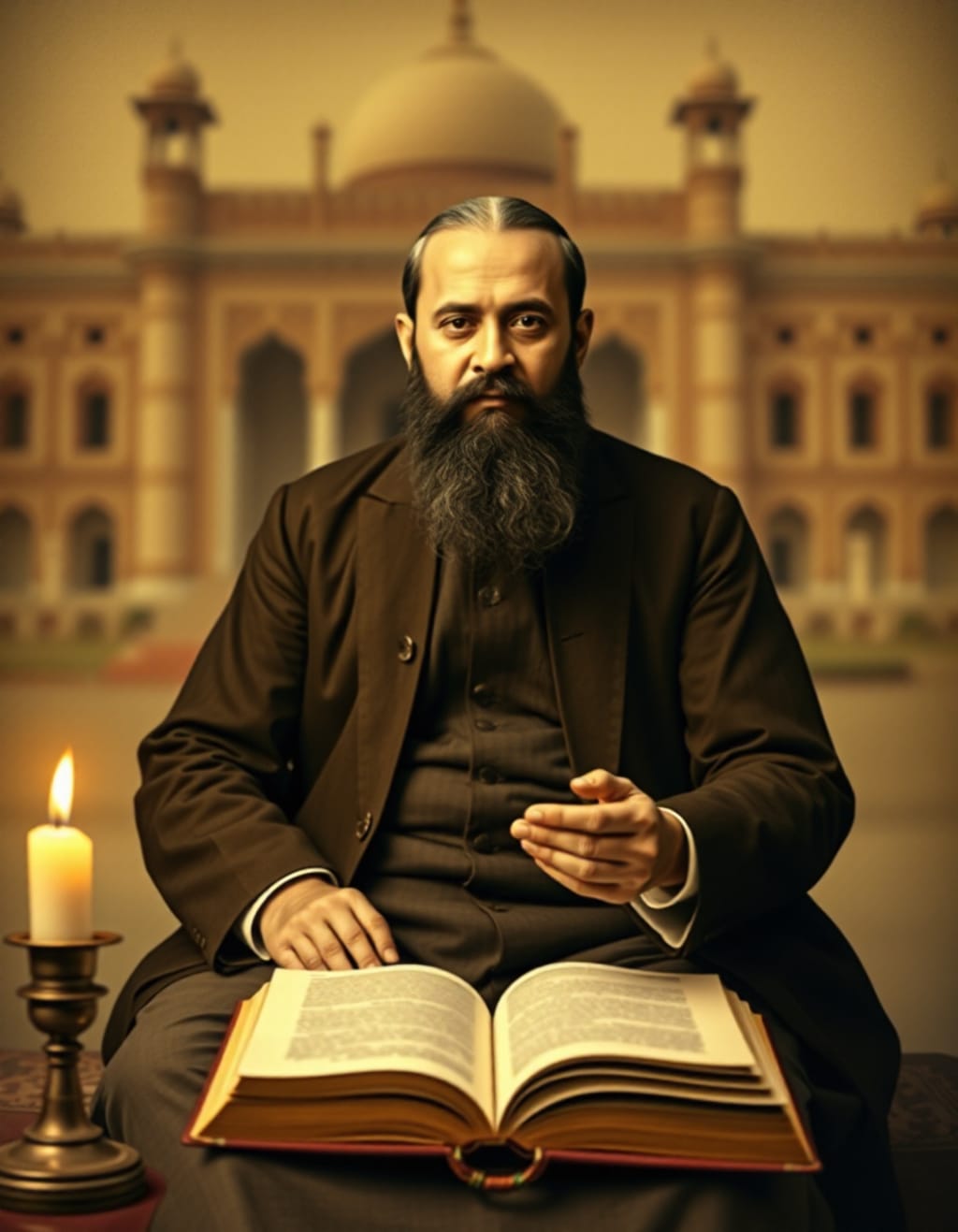
In the heart of colonial India, when the Mughal Empire had fallen and the Muslim identity stood bruised, there emerged a visionary — a man who did not pick up arms in rebellion, but picked up a pen. A man who believed that the soul of a nation could be healed through education. That man was **Sir Syed Ahmed Khan**.
Born on **October 17, 1817**, in Delhi, into a family of Mughal nobility, Syed Ahmed Khan was nurtured in an environment of culture, poetry, and Islamic scholarship. He grew up speaking Persian and Urdu, absorbing the literary richness of Delhi's golden age. But he would soon witness that golden age turn into ash.
---
### The Fall of the Mughals and the Rise of Pain
In **1857**, India erupted in what the British called the **Sepoy Mutiny** and what many Indians remember as the **First War of Independence**. For Muslims, it was a double tragedy. They were blamed for leading the rebellion, and the British crackdown on the Muslim community was severe and merciless.
Syed Ahmed Khan, then a civil servant in the British administration, watched his people suffer. The once proud Muslim aristocracy was now jobless, uneducated, and viewed with suspicion. A deep cultural and psychological trauma had gripped the community.
He realized that unless something changed — unless Muslims embraced modern education, reason, and reform — they would be left behind permanently in the new world order shaped by British rule.
So he made a decision.
Not to fight with swords.
But to **fight ignorance** with **education**.
---
### The Pen That Challenged Two Worlds
Sir Syed’s vision was not without resistance. From one side, conservative Muslims called him a traitor for supporting English education. On the other, the British distrusted him because of his roots in Mughal nobility.
But he believed that reform was the only path forward.
He began writing. His works included:
* **"Asbab-e-Baghawat-e-Hind" (The Causes of the Indian Revolt)** — in which he dared to tell the British that their own injustices caused the 1857 uprising.
* **"Tahzib-ul-Akhlaq"** — a magazine aimed at social reform within the Muslim community.
* He wrote books defending Islam against Christian missionaries and Orientalist scholars, proving that faith and reason were not opposites.
He was not just defending Muslims. He was **redefining them**.
---
### Aligarh: A Seed of Revolution
Sir Syed knew that one book, one school, one idea could ignite a revolution. In **1875**, he founded the **Mohammedan Anglo-Oriental College** in Aligarh, which would later become **Aligarh Muslim University (AMU)**.
This was no ordinary institution.
* It was based on the model of Oxford and Cambridge.
* It taught modern science, mathematics, English, history — **alongside Islamic studies**.
* It was open to debate, rational thinking, and cultural pride.
Aligarh became the intellectual heartbeat of a rising Muslim middle class — lawyers, teachers, civil servants, and reformers emerged from its classrooms. The college created a new generation of Muslims who were confident in both their **religious roots** and **modern knowledge**.
---
### Not Just a Reformer — A Bridge
Sir Syed’s life was one of balance. He walked a tightrope between tradition and modernity, faith and logic, East and West.
He respected the Quran, but believed in **ijtihad (independent reasoning)**.
He promoted Urdu as the language of Muslim identity but urged learning English for survival in the new India.
He believed in the peaceful coexistence of Hindus and Muslims, yet foresaw the political differences that might arise.
He wrote:
> “India is a beautiful bride, whose one eye is Hindu and the other Muslim. If both eyes work together, only then will she see.”
---
### Legacy Beyond Lifetimes
Sir Syed Ahmed Khan passed away on **March 27, 1898**, but his ideas never died.
His educational movement paved the way for the Muslim League, and eventually, the Pakistan movement. Many of the early leaders of modern Muslim politics in India and Pakistan were students or admirers of Aligarh.
His vision created a **cultural awakening**, one that restored dignity to a defeated people. Where others saw no hope, he planted seeds of progress.
Even the British, once suspicious, began to admire his courage and intellect. Queen Victoria knighted him in 1888 — hence, he is remembered as **“Sir” Syed Ahmed Khan**.
---
### Final Words: The Torch He Carried
Sir Syed’s life teaches us that sometimes, real revolution doesn’t come from fire and fury — it comes from wisdom and patience. From building schools, writing books, reforming minds.
He didn’t raise a sword.
He raised a **generation**.
Today, as Aligarh Muslim University continues to educate students from all over the world, his spirit still walks those corridors.
Sir Syed once said:
> “Do not show the face of Islam to others; instead, show your character. They will be impressed by Islam itself.”
In the age of defeat, he chose light.
In the age of silence, he chose words.
In the age of fall, he taught how to **rise**.
That is why he is not just a reformer.
He is a **rebuilder of hope**.
And his story still whispers to every Muslim child:
> *“You are not lost. Learn. Rise. Reclaim your destiny.”*
About the Creator
rayyan
🌟 Love stories that stir the soul? ✨
Subscribe now for exclusive tales, early access, and hidden gems delivered straight to your inbox! 💌
Join the journey—one click, endless imagination. 🚀📚 #SubscribeNow
Savoy Hotel – Mussoorie: The Colonial Luxury Hotel Where an Unsolved Murder Still Walks the Corridors
The First Night: Beauty Wrapped in Silence Mussoorie looks peaceful from a distance. Pine trees sway gently, clouds roll like slow-moving waves, and the hill air smells of rain and old earth. But as evening falls, the silence becomes heavier—almost watchful.
By Gaurav Gupta4 days ago in History
Is NATO Facing Its Biggest Crisis Yet?
Is NATO Facing Its Biggest Crisis Yet? For more than seventy years, NATO has been one of the strongest military alliances in the world. Formed after World War II, it was designed to protect its members through collective defense. An attack on one was considered an attack on all. For decades, this principle helped maintain stability in Europe and beyond. But today, NATO is facing one of the most challenging moments in its history.
By Wings of Time 8 days ago in History
Silver Screen Magic with Mae West
American actress and singer Mae West became a popular film actress during the Great Depression. She started entertaining in vaudeville, then performed on Broadway, and finally went to Hollywood. She signed up with Paramount Pictures and made her debut in the 1932 film “Night After Night.” She also starred in musicals, comedies, and crime dramas. The American Film Institute named her one of the best classic Hollywood actresses.
By Rasma Raisters6 days ago in Geeks


Comments (1)
This article about Sir Syed Ahmed Khan is really eye-opening. It's amazing how he chose education over arms to fight for his community. I can only imagine the resistance he faced from both sides. It makes me wonder how he managed to stay so determined. We should learn from his example and see how education can be a powerful tool for change even in difficult times.