
Sincerely...
The Quiet Power of Handwritten Letters

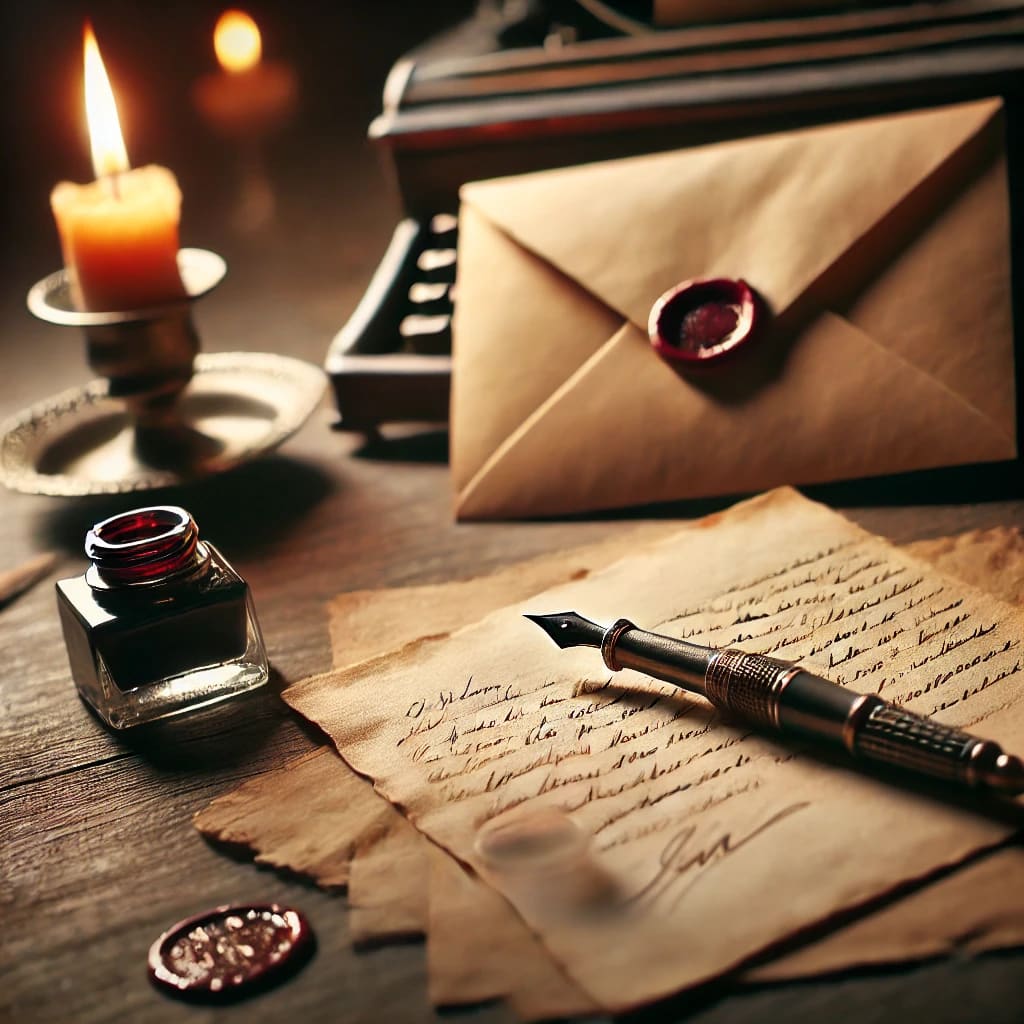
There was a time when words had weight. When ink on paper carried a permanence, an intimacy that no digital message could replicate. A time when writing a letter was not just an act of communication, but an act of presence—a deliberate offering of thought, time, and self. Today, that time is nearly gone. The handwritten letter has become an artifact, a relic of a slower world, replaced by the efficiency of texts, emails, and instant messaging. And with it, something deeply human has been lost.
Think about the last time you held a letter in your hands. Not a bill, not a flyer, but a real letter. Maybe it was from a friend, a relative, a love long past. The way the ink pressed into the fibers of the paper, the way the handwriting carried personality—curved and looping, sharp and deliberate, rushed or careful. The way it smelled, the way it felt. There is something undeniably personal about a letter, something that technology has never quite been able to capture.
Letters carry history. In archives and museums, the most treasured artifacts are often handwritten. Love letters from soldiers on the frontlines, carefully preserved. The hurried notes of revolutionaries, written in secret. The final words of historical figures, written in shaking hands. These are not just words. They are fragments of a life, pieces of a moment captured in ink, carrying across time in a way no email ever could.
Throughout history, letters have shaped civilizations. Cicero, the Roman statesman and philosopher, used letters as a tool for intellectual discourse and political influence. His letters to Atticus not only provided a window into the Roman Republic but also highlighted the role of personal correspondence in shaping political thought. Pliny the Younger’s letters to Emperor Trajan served as an official record of governance, a means of documenting Roman administrative policies and offering insight into the concerns of the empire. These letters endure as some of the most valuable historical records of the time.
During the Renaissance, Petrarch championed letter writing as a means of intellectual exchange, using his correspondence to bridge the gap between antiquity and modern humanist thought. His 'Epistolae familiares' revealed his reflections on life, morality, and literature, influencing generations of thinkers. Similarly, the Founding Fathers of the United States relied heavily on letter writing. John and Abigail Adams’ correspondence offers an intimate look into the revolutionary era, blending personal affection with discussions of governance, equality, and nation-building. Abigail Adams’ famous plea to her husband—"Remember the Ladies"—was a demand for women’s rights embedded in a letter, an enduring example of how private words can carry public significance.
Even in times of war and exile, letters remained an essential form of communication. Virginia Woolf, an advocate for literary and personal correspondence, argued in A Room of One’s Own that letters were a vital means of understanding women’s history. Letters written during World War I and World War II, exchanged between soldiers and their families, carried not just news of survival but deep emotional expressions of longing, hope, and love. These documents serve as irreplaceable records of human resilience.
There is a slowness to letter writing that is almost radical in today’s world. It requires patience, intention. You cannot backspace a thought, you cannot instantly deliver it with the tap of a button. You must sit with your words, consider them, commit them to paper. And then you must wait—wait for the letter to arrive, wait for a response. This waiting, this anticipation, is part of the magic. It forces reflection, it forces presence. It reminds us that not everything should be immediate.

Handwriting itself is intimate. Unlike the uniformity of typed text, handwriting carries the mark of its writer. It is uniquely yours—imperfect, human. It betrays emotion in a way that fonts cannot. The hurried scrawl of excitement, the careful precision of love, the heavy, slanted letters of grief. Even mistakes, crossed-out words, smudges—these imperfections tell a story of their own.
Some of the most profound human connections have been built on letters. Lifelong friendships formed through correspondence. Love that deepened across distances, carried by ink and folded pages. Some of history’s greatest minds—philosophers, poets, revolutionaries—communicated not through fleeting conversation, but through letters that took weeks, months to arrive. And yet, those words endured.
But letters are disappearing. Schools no longer teach cursive. Stationery stores are closing. The mailbox is no longer a place of anticipation, but a dumping ground for junk mail and bills. We have gained efficiency, but lost depth. We have gained speed, but lost patience. We have gained constant connection, but lost the kind of connection that lingers, that is carefully chosen, that is meant to be kept.
Perhaps it is time to bring the letter back. To sit down with pen and paper, to write not because we must, but because we can. To send a letter not for its efficiency, but for its permanence. To create something real in a world that is increasingly fleeting.
A handwritten letter is an act of defiance. It is a refusal to let slowness die, a refusal to let intimacy be erased by convenience. It is a quiet rebellion against the disposable nature of digital communication. It is a way of saying: I was here. I thought of you. And that, in the end, is something worth remembering.
Imagine receiving a letter unexpectedly in the mail. The feeling of running your fingers along the edge of the envelope, wondering what words have been carried to you. The moment you break the seal, unfold the paper, and take in the ink-stained thoughts of someone who took the time to write to you. It is a moment frozen in time, a tangible piece of someone's heart and mind delivered straight to your hands.
Even the act of writing itself is transformative. The sound of pen scratching against paper, the slow unfolding of thoughts as you put them into words, the final period placed with a sense of completion. Unlike an email hastily typed and sent, a letter holds intention. It demands mindfulness, an awareness of what you want to say and how you want to say it. It does not allow for impulsiveness, but instead, it fosters reflection.
The beauty of letters lies in their permanence. They can be tucked away in a drawer, slipped between the pages of a book, carried in a wallet. They endure. Decades later, they can be rediscovered, read anew, carrying the voice of the past into the present. They hold not just words, but history, memory, and emotion. How many texts or emails can claim the same?
And so, maybe it is time. Time to buy a sheet of paper, a pen, and to write something meant to last. Time to resist the fleeting and embrace the lasting. Time to remind someone they are worth more than a quick message on a screen. Because in a world that is forgetting how to slow down, a handwritten letter is a powerful thing.
About the Creator
Aiden Sage
I may appease you. I may offend you. But this I promise you—I can choose because I am real.
Keep reading
More stories from Aiden Sage and writers in History and other communities.
Food's Nasty Business
There was a time when food was just food—something to sustain life, nourish the body, and fuel the mind. But that time is gone. Today, food is something else entirely. It’s a tool, a product, a weapon. It has been manipulated, industrialized, and repackaged into something almost unrecognizable. And not by accident.
By Aiden Sageabout a year ago in Longevity
The Hitler Mystery: DNA Secrets and the Century-Old Rumor of the Dictator’s Anatomy
For over eighty years, one of the most persistent pieces of historical trivia has been a schoolyard rhyme and a medical mystery: the claim that Adolf Hitler suffered from a specific physical deformity. While once dismissed as mere British wartime propaganda, modern forensic science, rediscovered medical records, and DNA analysis have reignited the conversation. Was the "one testicle" myth a clever psychological warfare tactic, or was it a medical reality that shaped the psyche of the 20th century’s most notorious tyrant?
By Irshad Abbasi a day ago in History



Comments
There are no comments for this story
Be the first to respond and start the conversation.