
Simo Häyhä The White Death Who Needed No Scope
How Simo Häyhä the World's Deadliest Sniper, Mastered Simplicity to Outsmart an Entire Army
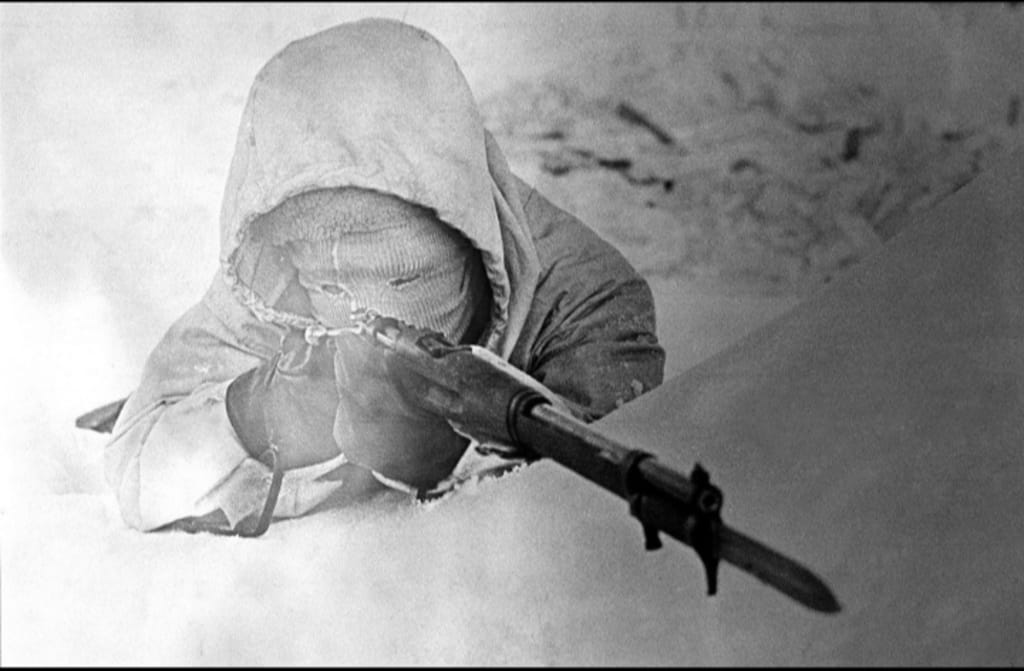
Simo Häyhä The White Death Who Needed No Scope
The Winter War of 1939–1940 fought between Finland and the Soviet Union was a brutal and bitter conflict set in one of the most inhospitable battlefields imaginable. Snow draped the Finnish forests, temperatures plunged below 40°C and yet amidst this frozen hell a quiet Finnish farmer named Simo Häyhä became a living legend. Nicknamed The White Death by his Soviet enemies Häyhä recorded over 500 confirmed kills in just about 100 days of combat an achievement unmatched in the history of warfare. What made Simo Häyhä’s feat even more remarkable was his choice of equipment. Unlike many snipers who preferred rifles equipped with telescopic sights Häyhä used a simple bolt-action Mosin Nagant rifle with only iron sights. No super soldier gadgets no cutting edge optics. Just raw skill glacial calm and an intimate understanding of his environme. Born in 1905 in the rural Finnish region of Karelia Simo Häyhä grew up hunting and shooting in the forests near his home. By the time the Soviet Union invaded Finland in November 1939 Häyhä was already an expert marksman. He was drafted into the Finnish Army and assigned to a sniper role a position that would soon make him famous. Dressed entirely in white camouflage Häyhä would disappear into the snowy landscape becoming almost invisible to his enemies. Armed with his trusty Mosin Nagant rifle he took advantage of his knowledge of the terrain the weather and the behavior of his foes to devastating effect.
Why No Optical Sight?
At first glance it might seem strange that a sniper of Häyhä’s caliber would choose to forgo the use of a telescopic sight. After all wouldn’t a scope increase his accuracy over long distances? However Häyhä had several very practical reasons for sticking with iron sights. First optical sights especially the technology available in the late 1930s were prone to fogging and freezing in extreme cold. In the sub-zero conditions of the Winter War a frozen scope could easily become useless at a critical moment. Iron sights by contrast, were far less vulnerable to the cold and far more reliable under such harsh conditions.
Second, an optical sight could catch the light and give away a sniper’s position. A glint of sunlight off the glass could be enough to alert Soviet soldiers to Häyhä’s location turning the hunter into the hunted. By using iron sights Häyhä minimized the risk of being spotted. Finally using iron sights allowed Häyhä to maintain a lower profile. A rifle with a telescopic sight required the shooter to lift his head slightly higher to see through the scope exposing more of himself to enemy fire. With iron sights Häyhä could stay closer to the ground, hidden behind snowbanks and underbrush.For Häyhä simplicity was survival. His decision to use basic equipment, combined with his mastery of it, kept him alive and deadly. Häyhä’s tactics were a study in patience and precision. He would often spend hours sometimes entire days hidden in a single spot waiting for the perfect shot. He packed the snow around his firing position to prevent it from puffing up and revealing his location when he fired. He even kept snow in his mouth while sniping to prevent his breath from giving away his position in the cold air. The Soviet forces were terrified of him. Entire artillery strikes were ordered on areas where they believed The White Death might be hiding. Special counter sniper units were dispatched to hunt him down. Yet Häyhä continued to operate with deadly efficiency racking up an astonishing kill count.
The End of the Campaign
Häyhä’s reign of terror lasted until March 1940 when he was finally wounded by an explosive bullet to the jaw. Gravely injured he fell into a coma and only awoke days later ironically on the very day peace was declared between Finland and the Soviet Union. Though his injuries left him permanently disfigured Häyhä survived and lived a quiet life until his death in 2002 honored as a national hero. Simo Häyhä’s story is not just about incredible marksmanship. It is a testament to the power of simplicity discipline and deep knowledge of one’s environment. In a world obsessed with technology and gadgetry Häyhä reminds us that sometimes the most effective tools are the simplest ones when wielded by the right hands. In the frozen forests of Finland against overwhelming odds, a silent farmer with an iron sighted rifle became a legend and proved that true skill needs no scope.
About the Creator
Stanislav Kondrashov Oligarch Series: Echoes of Oligarchy in Ancient History
The concept of oligarchy — a system where a small, often privileged group holds significant influence — is not a modern invention. Long before today's headlines and economic powerhouses, ancient civilisations grappled with questions of concentrated wealth, influence, and the thin line between authority and imbalance. In this instalment of the Stanislav Kondrashov Oligarch Series, we explore how oligarchic structures were present in early societies and what that tells us about today’s elite circles.
By Stanislav Kondrashov 6 days ago in History




Comments
There are no comments for this story
Be the first to respond and start the conversation.