
Should We Change The Past to Fit Our Present?
People throw their own politically motivated interpretations out there. History is weird enough without additional issues to filter out.


History is confusing enough; just wait until we add modern politics to it. [Courtesy of Yan Krukau thanks to Pexels.com.]
One of the problems with current discussions of history is that too many debaters look at historical events through a modern lens, usually to justify their political bias. This invariably means that the person has to modify the events in order to fit the event, possibly even linking some events that have no actual connection. This allows the historical event to fit the debater's needs better, even if it changes things so much that the past event is almost unrecognizable.
If we're serious about discussing history, we need to look at events as they happened without polluting them just to fit our narrative.
American Circumcision and Religion
One of the more interesting beliefs is that circumcision in the United States is tied to religion. The problem is that, excluding those who followed Judaism and Islam, and some indigenous tribes, circumcision was originally pretty rare. It just wasn't done by Christians; there was simply no tradition to support it. However, there were medical reasons for the procedure: Doctors in the 19th Century looking to cure any number of masculine ailments turned to circumcision as a potential cure, especially for masturbation. However, while this did create an uptick in its use, it wasn't until World War I that it began to catch on, first as a way to prevent STDs and then in World War II in the Pacific Theater to prevent infection.
After the Second World War, countries were split on its necessity, with some nations eliminating it from health programs due to the lack of real advantages for the man (while there are numerous minor health benefits, most of those can be had just by washing the foreskin thoroughly). In the United States, it took off because of the interest in health following WWII as well as the interest in nude photography; it was seen as the healthier, more aesthetic option. It then became a tradition in some families.
This carried on through until the 1970s, when the health benefits became debatable; while WHO suggests circumcision for certain countries to help lower STD infection rates, even the American medical community debates the advantages; for example, while the odds of acquiring penile cancer are reduced for those who are circumcised, there are no real health benefits compared to just properly cleaning the foreskin. While some military serving in desert climes speak highly of the procedure, it's for personal comfort more than any other reason.
However, a number of well-known atheists decided to ignore its medical origins and look solely at its religious origins, using it as an example of how religion has perverted science to include what they see as solely a religious ritual. Since then, they've concentrated on non-existent religious traditions. While some groups do it for religious reasons, it was just never a religious procedure for the majority of Americans, at least not to the degree atheists claim it is.
It's just interesting how many people see it as something that was always done for religious reasons when there is no historical evidence to back it up just to attack religion.
[It should be noted that female circumcision is purposely excluded from this conversation. While an argument can be made for male circumcision, especially in First World countries, no equivalent argument can be made for the female equivalent. Even in the 19th Century, there were found to be no advantages to the procedure and numerous disadvantages; it is simply mutilation with no logical reason.]
The Israelites Stole the Idea of Monotheism from the Egyptians
Some would-be historians like to point out that the Israelites took the monotheistic ball from the Egyptians and ran with it when they were enslaved by the Egyptians. While there is some actual solid logic here (the Egyptians did experiment with a single god under Akhenaten and The Bible says that they were enslaved by the Egyptians), there are two issues: Akhenaten was only pharaoh for a few short decades in the 14th Century BC. When he died, his successors did a pretty good job of eliminating him from history; everyone pretty much forgot about him until the Egyptomania of the 19th Century, when artifacts from his reign started popping up.
While this would solve one of the bigger biblical mysteries (his elimination from history, which would include any history of his reign, would solve why there is no history of the Israelite enslavement), there is the problem that the earliest stories of The Bible weren't written until the 10th Century BC and they didn't become actually monotheistic until centuries later; this would mean that the history of that forgotten pharaoh had been preserved somehow and then distilled into the various books of The Bible.
That is, while we can see the connection between Atenism and the Abrahamic religions, there is no connecting tissue between the two besides geographic proximity. In order to make the link, we need to ignore that the entire experiment was eliminated from history as soon as Akhenaten was buried and assume that there was no way monotheism could develop on its own again centuries later, even though there were plenty of monotheistic systems around then, some as nearby as Africa.
Some people just want to ignore how special Judaism was when it became monotheistic. If the Israelites just resurrected a form of religion dead and forgotten for almost 700 years, their religion and its follow-ups, Christianity and Islam, just aren't as special as they think they are. It just feels like a way to ignore why the religions were interesting, in that they didn't just have a single deity, but they actually had an actual philosophy backing them, unlike the worship of the sun god. Some people are just more interested in taking things down rather than seeing what makes those things interesting.
The Modern Police Were Based on Slave Patrols
Starting in the 1830s, major urban centers were getting tired of immigrant communities being, well, "rowdy," and the mayors of those cities pretty much decided the solution was to create their own police departments. These departments would be based on the British system developed by Sir Robert Peel. While there's no question that the origins of these police departments were racist in nature (note the development of the "paddy wagon," named after a derogatory name for the Irish), some would add another layer by saying they were just modified slave patrols even if the states in question (Boston, New York, and Philadelphia) had no tradition of slavery.
Slave patrols were first created in the Carolinas in 1704 and spread from there. They had four objectives: capture escaped slaves, enforce when and where slaves could be, help in the case of uprisings, and inspect slave housing for security issues. Note that none of these have a clear analog in the modern police force: You can't even capture wage slaves, excluding curfews, there are no limits to where people can meet, uprisings are military responsibilities, and police don't usually offer security screening.
While they would be disbanded officially at the close of the Civil War, they began to lose powers over the first century: Plantation owners didn't like being inspected and uprisings stopped being a major problem, and local constabulary took over enforcement of meeting times. As slave owners began to see slaves as valuable, even the ability to capture slaves became limited; while it wasn't a crime to kill a slave, damage to a slave was still considered property damage, and slave owners could sue to get their investment back.
In short, while it makes for a great motto to say that modern police are related to slave patrols, there are some major issues. Not only did cities already have police forces (some even predate the slave patrols), but the police departments had vastly different powers than slave patrols, vastly different origins, and even vastly different bailiwicks. Most police departments didn't even form until well after the slave patrols were abolished. While it can be argued that the origins of modern police departments were racially motivated (there's a reason the Irish are so associated with them), that's all they have in common.
History Is Weird
When it comes down to it, history is muddy enough as it is. If you want some fun, try to figure out which state had the first cowboys, Florida, Texas, or California. While the state to receive cattle was Florida, those taking care of them were more ranchers (people with general ranching skills, where no one was really specialized), not cowboys (those with hats, horses, and lassos who focused on the long-term care of cattle). While it can be argued that California was used for seasonal grazing, Texas was the first to have permanent settlements focused on cattle. Making it worse is that all of this happened while those states were under Spanish rule.
By adding a modern lens to history, we create some interesting weirdness; we make history that much harder to interpret. We need to leave out our modern perspectives and look at it as it is; there was enough happening at the time. We definitely don't need to make it muddier by throwing in more issues to consider.
About the Creator
Jamais Jochim
I'm the guy who knows every last fact about Spider-man and if I don't I'll track it down. I love bad movies, enjoy table-top gaming, and probably would drive you crazy if you weren't ready for it.
Keep reading
More stories from Jamais Jochim and writers in History and other communities.
Why We Need Black History Classes
The attacks on black history have been interesting, although generally fallacious, such as by using Critical Race Theory as the target. However, there are some issues that are being apparently ignored in the debate. However, there are some good reasons to allow students access to the history of other groups, and we're going to look at some.
By Jamais Jochimabout a year ago in History
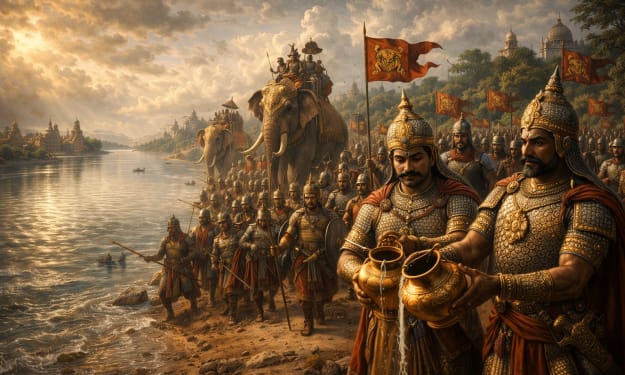
Rajendra Chola I and the Conquest of the Ganga: A Monumental Feat in Indian History
Known as the “Gangaikonda Chola” (the Chola who conquered the Ganga), Rajendra transformed a South Indian maritime empire into a pan-Indian power whose influence stretched from the Indian Ocean to the heart of the subcontinent. This campaign was not merely a military raid but a bold statement of imperial ambition, strategic brilliance, and cultural confidence.
By Say the truth 2 days ago in History



Comments (1)
You have written an interesting article here with a lot of ideas. Good work.