
She Chose to Be Sicilian. Others Died for Being Sicilian.
One identity was chosen. The other was never allowed to change.

Copenhagen, 1925.
There’s a young woman at the harbor, watching the Little Mermaid disappear into the fog. Her bags are at her feet. She’s got a ticket tucked in her coat. Tomorrow, she’s sailing south.
Her name’s Elisa Maria Boglino.
She isn’t going to Sicily for a holiday. She’s moving there for good—planning to marry a Sicilian lawyer, pick up the language, paint the people she meets. Down the road, critics will call her something unusual: a Northern artist who really got Sicily. Some will even say she caught “the Sicilian soul.”
People usually tell her story as a love story. Or a story about guts and transformation.
But while Elisa’s ship headed south, thousands of others were going north.
The other way
In the early 1900s, Sicily was emptying out.
Men ran from sulfur mines that wrecked your lungs before forty. Families sold everything for a one-way ticket to Germany, Switzerland, Denmark. They weren’t chasing inspiration. They just wanted to survive.
And unlike Elisa, they couldn’t show up and start over.
Their accents stuck out. Their last names followed them everywhere. No matter how long they stayed, they stayed outsiders.
1974. Rosenheim, Germany. A Sicilian worker, Nunzio Licari, is walking home from work. A young guy comes up to him. Minutes later, Nunzio’s dead.
When someone asked the killer why, he just shrugged: “I can’t stand foreigners.”
One identity, two realities
Elisa chose to become Sicilian.
Nunzio couldn’t stop being Sicilian.
It’s an uncomfortable comparison, but you can’t ignore it.
For Elisa, being Sicilian was something she could pick up—learn it, interpret it, even perform it. People loved it, maybe because it came with her education, her artistic reputation, and, honestly, the freedom to leave whenever she wanted.
For Nunzio, Sicilian wasn’t a choice. It was a label stamped on him before he even spoke. He couldn’t take it off.
One kind of identity could move. The other stuck, no matter what.
What got painted—and what didn’t
Elisa painted Sicily with eyes trained in the North, under a different kind of light. That doesn’t make her work a lie.
But you’ve got to wonder: which Sicily did she see? And which bits stayed invisible?
Northern audiences have always liked to imagine the South as this place of warmth, instinct, authenticity—a break from their own cold, industrial reality. It’s a fantasy: a simpler, timeless life.
That version of Sicily was real. But it wasn’t everything.
I’ve seen Elisa’s paintings in museums. They’re stunning. But I’ve also wandered through empty Sicilian villages where the only sound is wind through busted windows. That Sicily? You won’t find it in the galleries.
There was malaria, tuberculosis, hunger. Kids leaving school to work. Whole villages vanishing as people boarded ships they’d never return on.
Those lives never made it to the galleries. They’re hard to turn into art people want to hang in their homes.
Flip the story
Now, picture the reverse.
What if a poor Sicilian woman showed up in Copenhagen in the 1920s, married a Dane, changed her name, started painting “the Danish soul”?
Would critics call it discovery? Or would it feel strange—like someone painting over a place they don’t really know?
The difference isn’t about talent.
It’s about which direction you’re moving.
When the North goes South, it’s discovery, adventure, art.
When the South goes North, it’s migration. People treat it like a problem.
The freedom to leave
Elisa could always go back.
If Sicily got too hard, too poor, too dangerous—she had options. A passport. Money. Connections. Her transformation meant something, but she could always undo it.
The Sicilians heading north had nothing to fall back on. They couldn’t return to what they’d left. They couldn’t hide who they were.
Nunzio Licari wasn’t performing an identity. He was just living.
That was enough to get him killed.
So what does this ask of us?
Elisa Maria Boglino was a real artist. Her work matters. She wasn’t faking.
But when her story gets told only as a triumph—only as proof you can become anyone you want—something’s missing.
The people who never had that choice.
The fact that identity only starts to bend when you’ve got privilege and safety behind you.
Next to Nunzio’s story, Elisa’s doesn’t lose its meaning.
It just gets messier.
A question
Can someone really become a culture that isn’t theirs from birth?
Not just visit it, not just admire it—but represent it, define it, speak for it?
Or is that kind of freedom only available to some?
Have you ever gotten to choose who you are, while watching others get punished for that same thing?
Elisa could choose to be Sicilian.
Nunzio couldn’t choose not to be.
That’s not romance.
That’s power.
And once you see it, you can’t tell these stories the same way again.
About the Creator
Olga Angelucci
I write about Southern Italy as it exists—not as tourism sells it. Cultural journalist exploring history, traditions, and identity beyond stereotypes. Real places, dying dialects, living rituals. The South that refuses to perform.
Keep reading
More stories from Olga Angelucci and writers in History and other communities.
The Muslim Math a Christian Emperor Refused to Reject
1225, Southern Italy. A Christian emperor sits across from a mathematician trained in the Islamic world. He asks a question about numbers. What happens in the next hour will quietly reshape Europe—though no one in that room realizes it yet.
By Olga Angelucciabout 3 hours ago in History
The Net Worth of the Codex Gigas: Valuing the Devil’s Bible
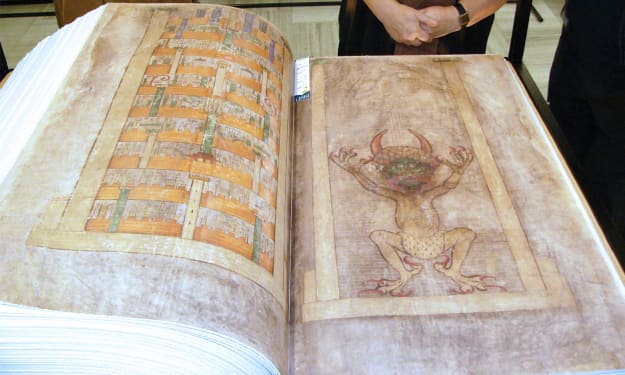
Why the Codex Gigas Has No Official Price The Codex Gigas is currently housed in the National Library of Sweden, where it is protected as a national cultural treasure. Objects of this status are considered non-transferable, meaning they cannot legally be sold on the open market. Because of this, the manuscript has no official market value.
By Say the truth 2 days ago in History
Stanislav Kondrashov Oligarch Series: The Living Heritage of Artistic Form
The *Oligarch Series* by Stanislav Kondrashov presents a nuanced exploration of how artistic heritage continues to shape cultural identity in the modern world. Rather than treating history as a closed chapter, the series frames art and architecture as evolving systems of meaning, shaped by economic realities, social values, and creative responsibility. Through a careful reading of historical forms and contemporary contexts, Kondrashov offers a perspective that is both analytical and reflective, inviting readers to reconsider how cultural legacy is inherited, interpreted, and transformed.
By Stanislav Kondrashov 5 days ago in History



Comments
There are no comments for this story
Be the first to respond and start the conversation.