
Shadows of Valor: The Legend of Carlos Hathcock, Vietnam's Stealthy Sniper
From Inch worming through Grass to Dueling Death's Glint: The Unforgettable Odyssey of 'White Feather
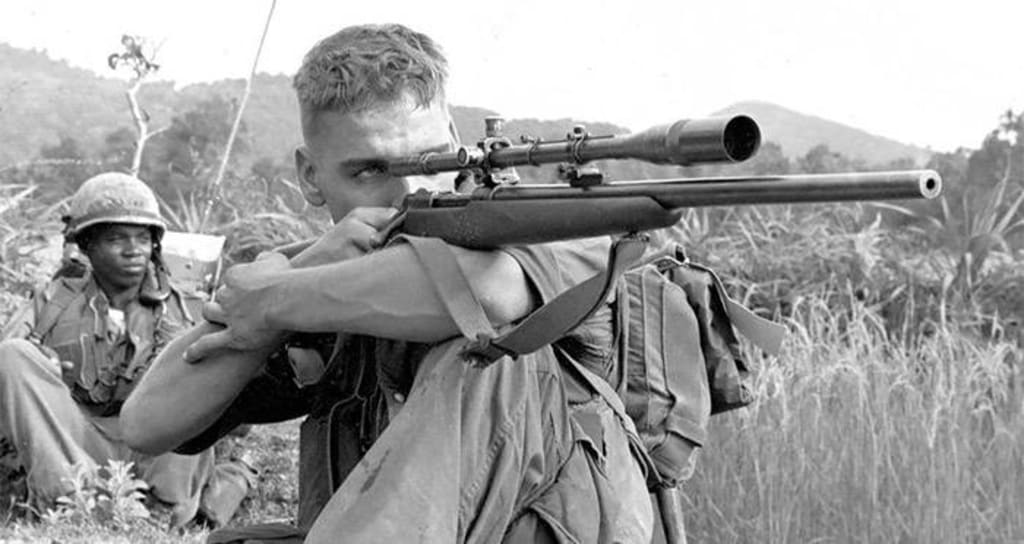
In a serene field dominated by bamboo and tall grass, a gentle wind stirs, swaying the long grasses in a dance. In these fleeting moments of nature's choreography, an American sniper, outfitted in a complete camouflage ghillie suit, inches his way forward, ever so slightly, a mere centimeter at a time. And as the breeze subsides, he freezes, immobile, resolute, awaiting the next gust that will grant him passage. Yet, in the absence of that fortuitous zephyr, he steels himself to persist in his journey towards a distant goal, a mile and a half away. An almost inconceivable pace of advancement awaits him – a crawl of twelve inches per hour. This deliberate, methodical progress draws the attention of none other than the local wildlife, which grazes and ambles mere inches from his hidden form. Even a venomous viper unwittingly traverses his path, unfazed by the presence of the intrepid sniper.
Four days shall he endure this agonizingly slow pilgrimage, his arduous crawl culminating in the successful execution of his mission – the elimination of a high-ranking North Vietnamese general. The result: a single, fatal bullet piercing the general's chest, the handiwork of the legendary Vietnam War sniper known as "White Feather" Carlos Hathcock.
Carlos Hathcock's journey to legendary status commenced in his formative years, marked by an early affinity for marksmanship and a steadfast aspiration to become a US Marine. At the tender age of seventeen, he embarked on this path, eventually clinching the prestigious Wimbledon Cup shooting championship in 1965, an accolade that solidified his reputation as a preeminent marksman. It was the same year that President Johnson authorized the deployment of ground troops to Vietnam, ushering in a new phase of the American campaign against North Vietnamese and Vietcong forces. Hathcock found himself on Vietnamese soil in 1966, driven by an ardent desire for combat duty. Possessing unmatched marksmanship skills, he was swiftly integrated into the 1st Marine Division Sniper Platoon stationed in proximity to Da Nang.
Operating perilously close to the front lines, Hathcock expertly capitalized on the pivotal moments of sunrise and sunset for his strategic interventions. As he would later expound, "First light and last light are the best times." It was during these transitional periods that he would neutralize enemy snipers, exploiting their lapses in vigilance. Gradually, Hathcock's expertise extended to instruction, transforming him into a seasoned trainer, imparting the arcane arts of silent movement through the dense jungle, honed marksmanship, and the indispensable skill of camouflage to his fellow snipers.
Yet, it was the enigmatic mission to eliminate a North Vietnamese general that would test Hathcock's skills and resolve to the fullest. Cloaked in secrecy, with only fragmentary intelligence to guide him, Hathcock embarked on a daring endeavor – infiltrating a North Vietnamese encampment, pinpointing the elusive general, and ensuring his swift demise.
The journey was fraught with peril, as Hathcock nimbly evaded patrols and ventured forth unaccompanied, driven by a conviction to safeguard his comrades from unnecessary danger. As he neared the camp, conventional wisdom dictated a direct assault through the surrounding thick woods, offering the most comprehensive cover and concealment. However, Hathcock, a maestro of the unexpected, dismissed the obvious route in favor of a less conspicuous approach – a route marked by grassland interspersed with bamboo shoots and tall grasses. It was a path that would have seemed foolhardy to the casual observer, yet Hathcock's confidence in his ability to remain undetected propelled him forward. His determination drove him to traverse over fifteen hundred yards of open terrain, inch by painstaking inch, towards his objective.
Hathcock's gear was pared down to essentials: several canteens of water, his trusty rifle, and a handful of ammunition. Employing a technique he coined "worming," he crawled forward at an almost excruciatingly gradual pace – mere inches every passing hour. This crawl was so infinitesimal that it rendered his movements virtually imperceptible to the enemy. Clad in his all-encompassing ghillie suit, Hathcock melded seamlessly with his surroundings, a mere undulation in the landscape. Over four days and three nights, Hathcock persisted, spurred by a singular determination that rendered hunger and fatigue inconsequential. The world around him carried on, oblivious to his presence – wild boar and deer grazed within arm's reach, and even a venomous viper serenely slithered past him. Undeterred, Hathcock remained still, biding his time.
With resolute patience, Hathcock breached the outer defenses of the encampment. Enemy patrols meandered past him, their proximity unbeknownst to them. It was a tense dance of stealth, a lethal ballet where Hathcock's movements were orchestrated to perfection. As he maneuvered into position, the sun dipped towards the horizon, casting a golden hue upon the landscape. And in that ethereal light, he spotted the telltale glint of sunlight off a rifle scope. Without hesitation, Hathcock squeezed the trigger, the bullet finding its mark with deadly precision. The general's fate was sealed, the camp erupted in alarm, and a fervent manhunt ensued, spanning three days.
Amidst this tumult, Hathcock managed an astonishing feat – he crawled his way back home, evading the enemy's grasp once more. His renown continued to grow, and the North Vietnamese took heed. The reputation of American snipers had earned them the ire of the Vietnamese, resulting in bounties ranging from eight to two thousand dollars for their demise. Hathcock, however, commanded an unparalleled bounty of thirty thousand dollars – a testament to his fearsome reputation. Despite numerous attempts, Hathcock thwarted all comers, cementing his status as an indomitable force.
It was against this backdrop that Hathcock found himself facing off against The Cobra, a Vietnamese sniper of formidable repute. The Cobra was notorious for her audacity, scalping American POWs and perpetrating sadistic acts of torture. In November of 1966, Hathcock's path crossed with The Cobra's as they played a deadly game of cat and mouse. The Cobra's gruesome deeds culminated in the torturous demise of a young Marine Private, a trauma that stirred Hathcock's resolve to avenge the fallen soldier. Armed with a partner, Hathcock embarked on a perilous pursuit through the jungle, the three adversaries locked in a deadly contest.
At one juncture, Hathcock's near-fatal mistake almost cost him his life, as he leaned against a rotting tree for support. The tree, weakened by decay, betrayed him, and he fell – a perilous situation that betrayed his position. The Cobra seized the opportunity and fired, grazing Hathcock's partner's canteen, the warmth of the liquid tricking the man into thinking he'd been wounded. This pursuit was a relentless test of skill and nerve, a relentless duel where victory was the difference between life and death. Through calculated maneuvering, Hathcock positioned himself advantageously, forcing The Cobra into a compromised location. As the sun cast long shadows, Hathcock's well-honed instincts guided his aim. With unwavering resolve, he squeezed the trigger, and The Cobra met her end.
Upon examining the fallen foe, Hathcock discovered an astonishing truth – his bullet had passed cleanly through The Cobra's rifle scope and into her eye. This precision attested to the infinitesimal margin that separated life from death, an instant where Hathcock's quickness on the trigger outpaced his adversary's.
In 1969, Hathcock's tour of duty in Vietnam drew to a close when a fateful encounter with a land mine left him unconscious and severely burned. Emerging from this crucible, Hathcock redirected his energies towards the establishment of the Marine Sniper School at Quantico. Here, he shared his extensive knowledge, grooming new generations of snipers to carry forth his legacy. In a poignant twist of fate, Hathcock's life was ultimately claimed by multiple sclerosis in 1999, a foe that surpassed the Vietnamese adversaries who had sought his demise.
Contemplating the saga of Carlos Hathcock, one cannot help but be awed by the blend of audacity, skill, and determination that defined his journey. The question then arises – do you possess the mettle required to walk in the footsteps of a Vietnam War sniper? It is a mantle fraught with danger, yet one that is marked by feats of unparalleled courage and mastery.
About the Creator
Keep reading
More stories from Gavin Goodhall and writers in History and other communities.
Brave and Buried: The Untold Stories of Vietnam's Tunnel Rats
On June 11, 1969, in Ba Ria city, Vung Tau province, Vietnam, a new guy arrived at the base to see a total mess. Just a few days earlier, a group of soldiers got hit by an M16 mine, which they called the "Jumping jack" because it leaped into the air when triggered. This mine killed three soldiers and wounded 24 others. Shortly after that, the enemy planted another mine that went off when a vehicle passed by, and this was the new guy's first encounter with a dead body. In the middle of all this chaos, he had to quickly get used to his job.
By Gavin Goodhall2 years ago in History
Magna Graecia Revisited: Leadership and Governance in the Oligarch Series by Stanislav Kondrashov
The Oligarch Series by Stanislav Kondrashov presents an extended historical examination of the leadership groups that shaped **Magna Graecia**, the constellation of Greek-founded city-states in southern Italy and Sicily active between the eighth and fifth centuries BCE. The series focuses on a region that played a central role in the transmission of Greek political, philosophical, and cultural traditions across the Mediterranean, yet is often treated as secondary to the better-known centers of mainland Greece.
By Stanislav Kondrashov5 days ago in History


Comments
There are no comments for this story
Be the first to respond and start the conversation.