
Saudia flight landed safe but all passenger were died
Event

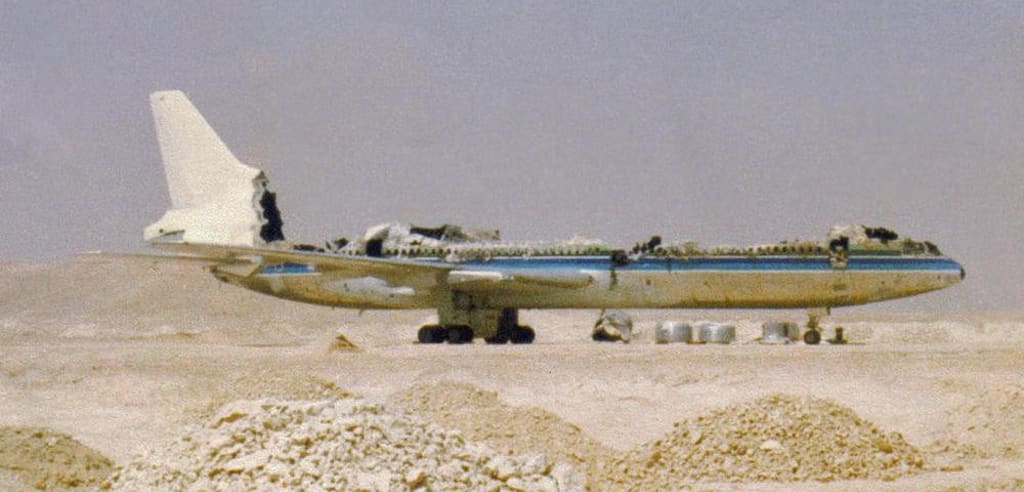
The Tragedy of Saudia Flight 163: A Disaster That Should Never Have Happened
On August 19, 1980, the aviation world witnessed one of the most tragic and puzzling disasters in history — the Saudia Flight 163 incident. What unfolded that night in Riyadh, Saudi Arabia, remains a chilling reminder of how a series of missteps, miscommunication, and lack of preparedness can turn a routine flight into a catastrophe. This tragedy claimed the lives of all 301 people on board, making it one of the deadliest aviation accidents not caused by a crash.
---
The Flight and Its Journey
Saudia Flight 163 was a scheduled passenger flight from Karachi, Pakistan, to Jeddah, Saudi Arabia, with a stopover in Riyadh. Operated by a Lockheed L-1011-200 TriStar aircraft named "Hail", the flight was carrying 287 passengers and 14 crew members — a full manifest consisting mostly of pilgrims returning from Hajj, along with families and workers.
The aircraft landed safely in Riyadh at approximately 19:06 local time for a scheduled refueling stop. After passengers and crew remained on board, the plane took off again at 21:08 en route to Jeddah. Just seven minutes into the flight, the crew reported smoke in the cabin. The situation escalated rapidly.
---
Fire Onboard
The source of the smoke was later traced to a fire in the aft cargo area. The crew declared an emergency and received clearance to return to Riyadh. At 21:20, just 15 minutes after takeoff, the aircraft made a safe landing back at Riyadh's King Khalid International Airport.
But the crisis was far from over.
Though the landing was smooth, the aircraft inexplicably continued to taxi along the runway for nearly three minutes before coming to a stop. Ground personnel reported that there were no immediate signs of distress externally. But inside the cabin, a catastrophe was unfolding.
Despite the fire onboard and the declaration of emergency, the flight crew failed to order an evacuation. Doors were never opened. Emergency slides were not deployed. Airport rescue and firefighting services stood by, waiting for instruction. By the time they gained access to the aircraft through forced entry — nearly 23 minutes after landing — it was too late.
---
All Lives Lost
All 301 passengers and crew had perished, not from the crash — but from smoke inhalation and suffocation. Autopsy reports confirmed that many victims were still in their seats, showing no signs of injury from impact or fire. They had died while the aircraft sat on the tarmac, fully intact, engines off, within reach of help.
This chilling detail makes the Flight 163 disaster unique and deeply tragic: the airplane never crashed, yet everyone aboard died.
---
Investigation and Findings
The official investigation into the incident revealed several critical failures:
1. Cause of Fire: The fire originated in the rear cargo compartment. Although the exact cause was never definitively determined, it was believed to have started from flammable cargo or faulty electrical wiring.
2. Lack of Urgency: Despite knowing there was a fire onboard, the crew did not act with sufficient urgency. They delayed stopping the aircraft and did not initiate evacuation procedures.
3. Crew Training and Communication: The crew lacked proper training in emergency evacuation during a fire. There was also a breakdown in communication between the cockpit and the cabin, as well as between the crew and ground personnel.
4. Emergency Response Delays: Ground crews were not given the go-ahead to intervene immediately, leading to critical delays in rescue operations.
---
Lessons Learned
The tragedy of Saudia Flight 163 sparked changes in airline safety protocols worldwide. Emphasis on fire detection and suppression systems, especially in cargo holds, increased significantly. It also brought attention to the importance of crew training for emergency evacuations and improved coordination with airport emergency services.
Additionally, the disaster led to enhanced design standards for aircraft interiors, including better fire-resistant materials and clearer evacuation procedures.
---
A Legacy of Regret
Over four decades later, the Saudia Flight 163 disaster remains a haunting example of what can go wrong — even when a plane lands safely. It wasn't mechanical failure or weather that claimed 301 lives, but human error, hesitation, and inadequate emergency planning.
In aviation history, the incident stands not just as a tragedy, but as a lesson: that safety does not end with a safe landing. The lives lost on Flight 163 serve as a permanent reminder of the high stakes of every decision made in the air and on the ground.
About the Creator
How Early Aircraft Failures Created Modern Flight Safety
When we look at modern aviation today with its redundant systems, strict regulations, and impressive safety record it’s easy to forget how fragile flight once was. Early aviation wasn’t built on confidence or certainty. It was built on risk. Every successful flight was surrounded by countless failures, and every crash carried lessons that would quietly reshape the future of air travel.
By Beckett Dowhan2 days ago in History
The Accidents That Quietly Improved Aviation Forever
I used to think aviation history was a story of bold successes, record-breaking flights, sleek aircraft, and triumphant landings. But the more I read, the more I realized something uncomfortable: much of modern aviation was shaped not by success, but by accidents. The safety and reliability we now take for granted were quietly built from moments when things went terribly wrong.
By Beckett Dowhanabout 21 hours ago in History


Comments
There are no comments for this story
Be the first to respond and start the conversation.